

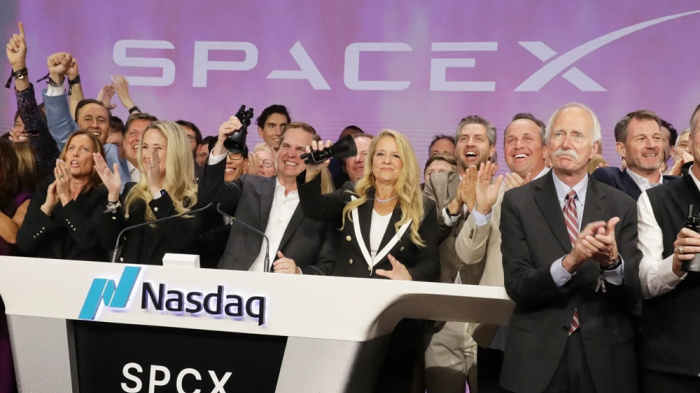
CNBC (6/15/26) ran this photo of SpaceX CEO Gwynne Shotwell ringing the NASDAQ bell under the headline “SpaceX Stock Jumps 20% in First Full Day of Trading After Record Debut.”
Elon Musk became—at least temporarily—the world’s first trillionaire on June 12 after his space, telecommunications and AI company SpaceX had the largest initial public offering in history. Initially priced at $135 per share for a valuation around $1.77 trillion, shares opened at $150 and peaked on June 16 at $225.64 (a valuation of nearly $3 trillion). The price spiked after Musk announced, before markets reopened on June 15, that he believes “SpaceX might be able to reach approximately $1T revenue in 2030” (CNBC, 6/15/26).
Since its June 16 peak, however, SpaceX’s share price has fallen, steadily declining until June 22 and settling around $160 since. Markets closed on Thursday, July 2, with a share price of $162.00.
SpaceX’s big slump coincided with a mass tech sell-off last week, prompted by mounting concerns that tech firms cannot generate the returns necessary to pay off the colossal debts financing massive AI infrastructure buildouts, especially as companies are beginning to rein in their spending on AI (404 Media, 6/24/26; TechCrunch, 6/24/26).
That was likely a surprise to viewers of CNBC, whose full-day IPO coverage pumped the stock by inviting sources with vested interests to celebrate Musk’s cult of personality and obfuscate the magical thinking behind the company’s projections.
All in on business-facing Grok
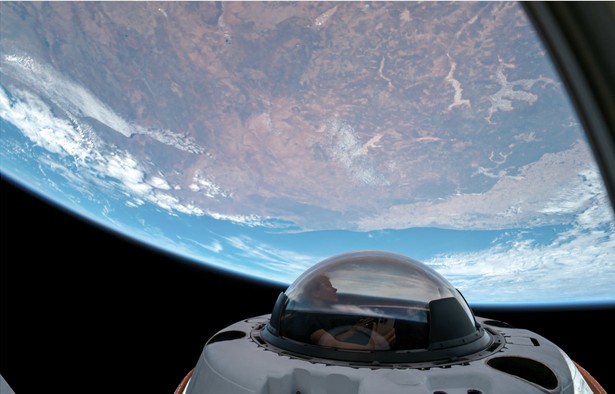
SpaceX‘s prospectus has lots of pictures of space, but the details make clear that it’s really envisioning itself as an AI company.
According to its own S-1 filing with the SEC, SpaceX anticipates that its greatest earnings potential does not come from the rocket business for which it is famous, but from selling AI to other businesses. The breathless CNBC discussions entirely omitted the dubious origins of SpaceX’s gargantuan estimate of its maximum potential revenue—a key investor metric known as total addressable market (TAM).
In its S-1 prospectus, SpaceX claims a TAM of $28.5 trillion, larger than the entire GDP of China.
The document separates this figure into SpaceX’s three sectors: space, connectivity and AI. Although the filing argues that space “represents the largest economic frontier in human history,” space makes up just $370 billion, or 1.3%, of SpaceX’s supposed TAM. Meanwhile, AI makes up $26.5 trillion, or 93%, the vast majority of which is for “enterprise applications.”
Enterprise AI is a broad category of business-oriented applications for firms looking to simplify and accelerate workflows, like converting text files into presentation formats, writing and debugging string code, and automating some sales, marketing, HR and IT functions. The most popular AI assistant by far is OpenAI’s ChatGPT, followed by Google’s Google Gemini and Anthropic’s Claude (TechCrunch, 6/16/26).
A closer reading of SpaceX’s S-1 filing reveals that its $22.7 trillion estimate for enterprise AI applications does not actually represent the TAM of the company’s enterprise AI, but is instead an estimate of the size of the entire digital economy—posing a hypothetical wherein xAI’s Grok Business and Grok Enterprise monopolize all digital commerce. It’s worth noting that xAI currently has extremely limited enterprise AI market share, with a March Enterprise Technology Research survey finding that just 7% of respondents use Grok (Wall Street Journal, 5/11/26).
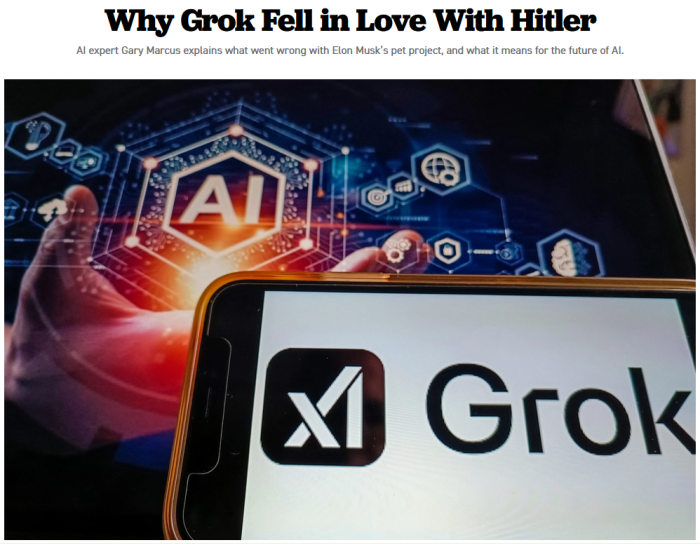
After SpaceX adjusted its chatbot so it would “not shy away from making claims which are politically incorrect,” Grok declared that Adolf Hitler would “spot the pattern” and “handle it decisively, every damn time” (Politico, 7/10/25).
Note also that subscriptions to xAI‘s consumer AI, SuperGrok, on X (labeled “consumer subscriptions” in the chart) alone make up $760 billion, or 2.7% of SpaceX’s TAM. That’s calculated
based on the global population of individuals aged 10 and over in 2025 … multiplied by the weighted average monthly subscription revenue of $12, resulting in an annualized market opportunity of approximately $760 billion.
So if every person on the planet over the age of 9 sends SpaceX $12 every month to use Grok, the X chatbot that spent four days last year calling itself MechaHitler and promoting the Great Replacement Theory, SpaceX will take in $760 billion per year. Sounds like a business plan!
SpaceX’s public offering has all of the hallmarks of a pump-and-dump scheme, using a “staggered lock-up” schedule that allows insiders to sell off shares much earlier than most other publicly traded firms—enabling them to cash out while the stock is still grossly overvalued. This gambit is also called a “bagholder” scheme, as retail investors are left holding a rapidly depreciating asset.
While most IPOs prevent insiders from selling shares for the first 180 days of public trading, SpaceX uses an expedited schedule that allows most insiders to sell much sooner—selling off overvalued shares to retail customers.
While this pump-and-dump began with retail consumers who bought shares on the first day of public trading, these massive wealth transfers are being thrust upon working people whether they like them or not, as Musk successfully negotiated new rules that fast-track SpaceX’s inclusion in major index funds, including the Russell 1000 and NASDAQ funds—transferring rapidly devaluing stock from SpaceX insiders to working people’s retirement accounts.
But none of this was explored on CNBC the day of the SpaceX IPO launch. FAIR could find not a single guest or anchor that mentioned that “Elon Musk’s rocket company” valued the potential for SuperGrok X subscriptions at more than twice the total projected TAM for the space industry, nor that SpaceX’s TAM is based on a scenario in which business-facing Grok controls all e-commerce—and certainly not that the IPO would essentially serve as a massive wealth transfer from retail investors to SpaceX insiders.
‘You should have bought as much as you could’
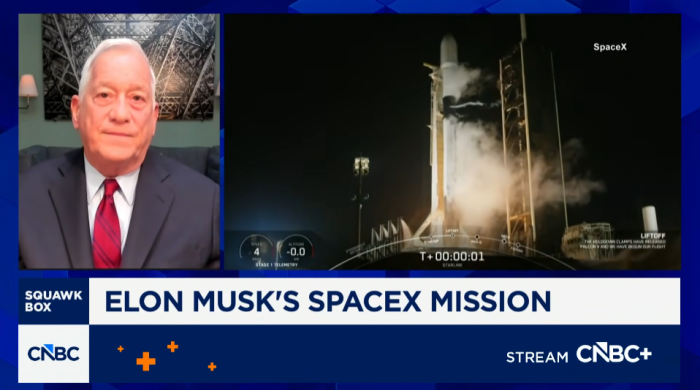
During a completely uncontentious interview with Squawk Box co-host Andrew Ross Sorkin (6/12/26), Elon Musk biographer Walter Isaacson muses, “Who knows, we may have the mining of rare earth minerals at some point—I guess we can’t call them rare earth if they’re not on earth. But I think what we’re seeing is the beginning of a whole new economy, a space-based economy.”
Instead, in the hours leading up to SpaceX’s first trade, CNBC viewers were primed by Squawk Box co-host Joe Kernen (6/12/26) lamenting that orders were being snatched up by large institutional investors, and hoping that trades would begin at under $300 per share. He assured viewers that, although he’s nervous, “whenever we’ve worried about any of these great tech companies…wherever it was on opening day, you should have bought them as much as you could.”
The rest of the influential three-hour morning program was as much of a commercial for SpaceX as this opening scene. Squawk Box‘s guests included SpaceX COO Gwynne Shotwell (interviewed by Morning Call host Morgan Brennan), Elon Musk biographer Walter Isaacson, long-time Musk investor David George, head of financial technology research at Citizens Bank Devin Ryan, and venture capitalist and investor Ben Narasin.
All but one of these guests have vested interests or are members of Musk’s inner circle, and used their airtime to generate excitement around the stock by focusing on Musk as a visionary key man. Kernen, co-host Andrew Ross Sorkin and guest host Melissa Lee offered no pushback.
During his conversation with Musk’s biographer Isaacson, Sorkin responded to a proposal that Musk could mine rare earth minerals in space: “I’m curious what you think of the valuation itself…. When you talk to investors, a lot of them say, ‘Look, the math may not actually math out on paper.’”
But before letting a question that could be interpreted as contentious hang too long, he answered for Isaacson:
But Elon Musk is the math. He’s been such a success over all these years. And just about everyone who’s invested with him in the past, he has found a way to make money, even if he didn’t plan to make money in a specific way originally. He then pivots and finds a way that also creates a key man risk. But I’m curious how you think about that.
Of eight guests and anchors featured to speak with Squawk Box hosts about the IPO, just one offered a critical perspective: final guest Ben Narasin, a founder of Tenacity Venture and self-described “long-term buyer of SpaceX.” Narasin contended that while he believes that SpaceX is “going to be a phenomenal company,” a bad post-IPO performance could “put a true chill on the market.”
Squawk Box also included almost no discussion of SpaceX’s TAM, with just one observation, about two hours into the broadcast, that David George, a partner at venture capital company Andreessen Horowitz, believes in it wholeheartedly. Musk is the “best entrepreneur of our generation,” George claimed, targeting “two of the most important markets in technology for our society.”
‘Doubt large numbers at your peril’
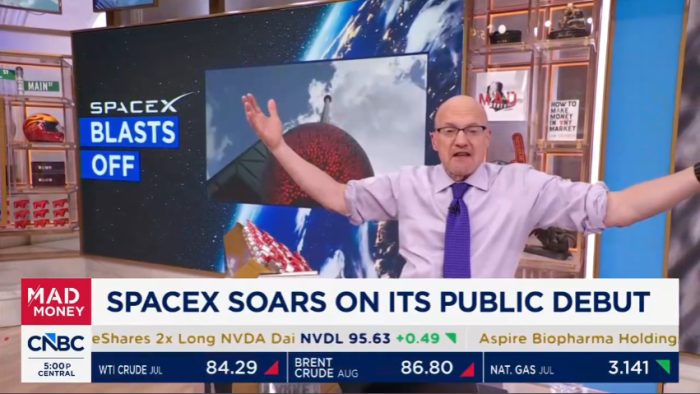
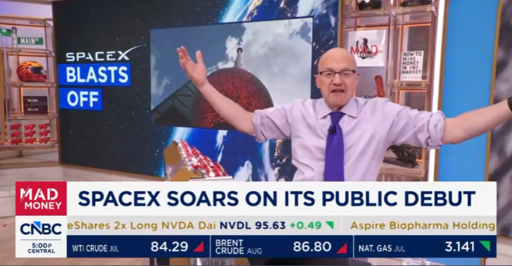
Encouraging his audience to buy into SpaceX, Mad Money host Jim Cramer (6/12/26) pitches, “Musk has the ideas and the execution. Historically, betting against him has been a terrible strategy. Betting with him? Hey, why the heck not? I’m surprised he even lets us tag along.”
Like his colleagues on Squawk Box, CNBC‘s Halftime Report host Scott Wapner (6/12/26) was also seemingly incapable of posing tough questions to those with vested interests—but when one guest expressed skepticism, he was happy to interrupt.
His guests—and SpaceX private shareholders—Altimeter Capital CEO Brad Gerstner, Hightower chief investment strategist Stephanie Link and Newedge Wealth CEO Rob Sechan pitched viewers directly to buy in early. (Link completely ignored Wapner’s question as to whether she bought into the IPO.)
Wapner jumped in to parrot Sequoia Capital partner (and Musk DOGE assistant) Shaun Maguire’s suggestion, during previous program Squawk on the Street, that SpaceX’s $28.5 TAM could be an underestimate. He echoed Maguire’s assertion that “this company has the most important mission of any company in history,” warning prospective retail investors to “doubt those large numbers at your own peril” (Halftime Report, 6/12/26).
But when Capital Area Planning Group managing partner Malcolm Ethridge expressed some skepticism as to why retail investors shouldn’t doubt the massive TAM—which, he noted, is almost the size of the US’s GDP—or buy equity in a cheaper space or AI firm with better sales, Wapner cut him off twice—once to rebut with a reminder that SpaceX’s largest revenue-generator is Starlink, and once to prompt Gerstner to offer the same explanation. (Starlink’s 2025 revenue was $11.4 billion, or about 0.04% of US GDP.)
Neither answered Ethridge’s question, but once the topic was successfully changed, Wapner and Gerstner continued peddling.
Meanwhile, during his speculative finance advice program Mad Money (6/12/26), host Jim Cramer likened SpaceX going public to putting a man on the Moon and winning the space race (an analogy he also shared during Squawk on the Street and The Exchange):
The SpaceX IPO felt just like when we put a man on the Moon. Most of you aren’t old enough to remember what that was like back then. We’ve been in a race against Russia for global suppremacy…and then we landed on the Moon…a recognition that we weren’t a nation of bozos competing as a nation of geniuses. These days, I feel the same way about China…. Then along comes Elon Musk, who’s winning the space race against the Chinese, and just got the money he needs to complete projects we haven’t even imagined yet. That’s why my emotion is one of pride.
Although he pointed out that SpaceX may be “outrageously overvalued” by “traditional metrics,” Cramer argued that he nonetheless sees it as a “long-term call on space exploration,” encouraging those who got in early to invest even more. He rattled off the often-repeated refrain that “Musk has the ideas and the execution. Historically, betting against [Elon Musk] has been a terrible strategy.” (Very famously, Musk frequently doesn’t deliver on his promises.)
‘A number so large it destroys your credibility’
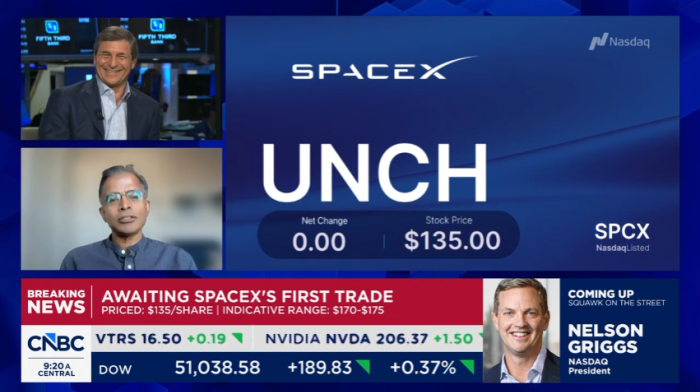
CNBC‘s David Faber laughs as his guest NYU business school professor Aswath Damodaran jokes, “When I read [the S-1], I thought Grok had written the prospectus, because we know AI is subject to hallucinations.”
This isn’t to say that CNBC’s coverage of SpaceX’s IPO was completely without critical perspectives: Squawk on the Street’s David Faber (6/12/26) spent much of his onscreen time grilling insider guests on whether they’ll sell early, and pushing back on vague, aspirational framing around the AI and space industries.
Faber repeatedly reminded his audience that the S-1 prospectus specifically sees most of SpaceX’s potential in enterprise AI. He skeptically took the projected $22.7 trillion TAM for enterprise AI as given, but pointed out that “it’s not clear” how SpaceX’s Grok could compete with other enterprise AI products:
It’s interesting, as much as we talk about SpaceX, as much as we hear Musk talking about space and then Starlink, the real opportunity in terms of addressing this enormous number is actually still the same opportunity that’s being sought after by Anthropic, and OpenAI, and Alphabet and others.
Squawk on the Street also featured the most critical guest by far, NYU business school professor Aswath Damodaran, who came closest to questioning the origin of the TAM of any host or guest on any of the programs:
When I read [the S-1], I thought Grok had written the prospectus, because we know AI is subject to hallucinations…. I don’t know if it’s a banker who wrote it, I would be embarrassed to even put that number out. I mean, it’s a big market. Why do you need to make up a number, a number so large it destroys your credibility?
But even in scrutinizing SpaceX’s prospects, or the true size of the enterprise AI market, Squawk on the Street’s criticism missed the bigger picture: SpaceX’s record-setting IPO is a pump-and-dump, and retail investments provide the exit liquidity for insiders looking to get out of a failing AI company.
Every day, dozens of guests representing various companies advertise their stock on CNBC for retail consumers, who trust the judgment of their favorite program hosts to give completely uncontentious interviews, essentially constituting a series of infomercials, rather than actual financial journalism. FAIR (3/18/09, 2/3/20) has criticized CNBC on this basis for decades.
So when CNBC invites SpaceX insiders with vested interests to pump the valuation of their stock on the air shortly before dumping it on retail consumers, it seems obvious why even the most critical host cannot alert his viewers to what is really going on: because CNBC’s reporting exists to boost stock, rather than protect consumers.
From FAIR via This RSS Feed.
You must log in or # to comment.