

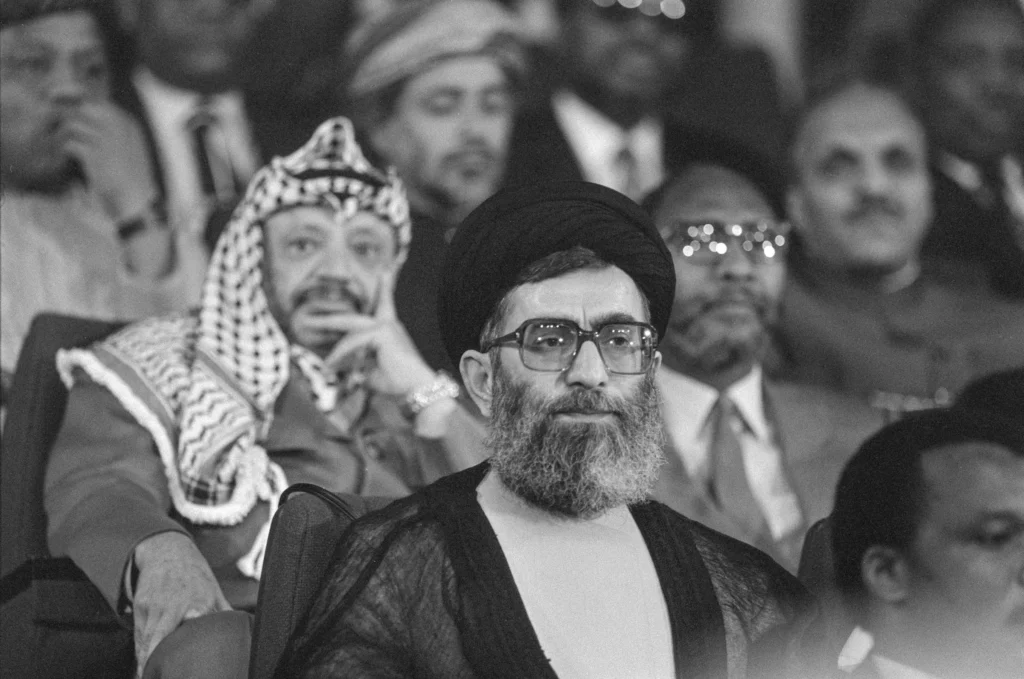
Exploring the life and calculated defensive decisions of Ali Khamenei from the 1979 revolution to his 2026 death.
Ayatollah Ali Khamenei, who served as Iran’s Supreme Leader from 1989 until his assassination in February 2026, remains one of the most consequential and defining figures in modern West Asian history.
RELATED:
Over 30 Countries to Attend Ayatollah Ali Khamenei’s Funerals
Assuming power a decade after the 1979 Islamic Revolution, Khamenei maintained his leadership for thirty-six years, during which he institutionalized a system of clerical governance. His tenure was characterized by a systematic commitment to state sovereignty, national self-reliance, and the establishment of a regional defense network.
This article analyzes the life, ideology, and impact of Ayatollah Khamenei. The following sections will trace his early trajectory from a dissident student under Ayatollah Ruhollah Khomeini to his political rise during the Iran-Iraq War.
Furthermore, the article analyses his ideology and concludes with his legacy following his assassination in February 2026 amidst the U.S.-Israeli war on Iran
We will remember you…
Ayatollah Martyr Sayyid Ali Khamenei,
Not only for your words, but for your courage, resilience, and unwavering faith.
Your name will remain in history, your memory will live in the hearts of millions, and your legacy will endure through those who… pic.twitter.com/ny69PbhDUv
— Iran Embassy in Indonesia (@IraninIndonesia) July 3, 2026
Early Life and Rise to Power
Seyyed Ali Hosseini Khamenei was born on April 19, 1939, in the city of Mashhad. Raised in a religious and economically impoverished household, he was shaped by traditional Islamic scholarship.
By the late 1950s, Khamenei’s pursuit of theological education led him to Qom, a city where he became a dedicated student of Ayatollah Ruhollah Khomeini. It was during this period that Khamenei transitioned from traditional religious quietism into active political resistance against the government of Mohammad Reza Pahlavi, the Shah of Iran.
During the 1960s and 1970s, Khamenei became an organizer within the underground anti-imperialist movement. His opposition to the Shah’s dependence on Western powers and his advocacy for sovereign Islamic governance made him a frequent target of the state apparatus.
The triumph of the Islamic Revolution in February 1979 rapidly elevated Khamenei into the upper echelons of the newly formed republic. Recognizing his administrative capabilities and ideological consistency, Khomeini appointed him to the clandestine Revolutionary Council.
Ali Khamenei also took on defense roles, serving as a member of parliament, deputy minister of defense, and a supervisor of the newly established Islamic Revolutionary Guard Corps (IRGC).
On June 27, 1981, Khamenei survived an assassination attempt when a hidden bomb exploded during a press conference at the Abu Dhar mosque in Tehran. The attack permanently paralyzed his right arm, transforming him into a resilient symbol for the revolutionary movement.
In October 1981, following the assassination of President Mohammad Ali Rajai, Khamenei was elected as the third president of the Islamic Republic, securing over 95,2 percent of the vote.
His two-term presidency (1981–1989) coincided directly with the Iran-Iraq War, an eight-year conflict initiated by Saddam Hussein’s military invasion of Iranian territory. Khamenei’s vision was shaped for managing a wartime economy under blockades and constant aerial bombardment.
Khamenei’s Most Notable Decisions
The regional policy of Iran under Ayatollah Ali Khamenei has prioritized the concept of “defensive depth” to counter foreign military encirclement. Following the United States-led invasions of neighboring Iraq and Afghanistan in the early 2000s, Iran found itself bordered by American military forces.
In response, Khamenei authorized a major structural expansion of Iran’s military asymmetric capabilities, focusing on ballistic missile development and deep defense partnerships with regional non-state actors.
Working in close coordination with Major General Qasem Soleimani, the commander of the Islamic Revolutionary Guard Corps (IRGC) Quds Force, Khamenei approved extensive logistical, financial, and strategic support to various regional movements.
Parallel to this regional defense strategy, Khamenei navigated decades of intense international scrutiny regarding Iran’s nuclear program. A foundational element of Iran’s official stance is the religious edict, issued by Khamenei in the early 2000s, which strictly prohibits the production, stockpiling, and use of weapons of mass destruction.
Khamenei consistently rejected Western demands for a total cessation of domestic uranium enrichment, framing peaceful nuclear technology as a sovereign national right and a marker of scientific independence.
Ali Khamenei in his speech said
“My life has little value.I have a disabled body.I put all this on the line, ready to sacrifice everything, May all this be sacrificed for you people.”
He knew he was fighting against the Might but he chose to stand his ground
What a Brave Man! pic.twitter.com/jGkt3E2527
— Nehr_who? (@Nher_who) March 1, 2026
Ideology in His Own Words
The political worldview of Ayatollah Ali Khamenei is expressed through an ideological vocabulary that emphasizes national self-reliance and resistance against imperialist hierarchies.
A central concept in his speeches is “Global Arrogance”, a term used to describe the foreign policy of Western powers, particularly the United States. Khamenei defined this dynamic by stating, “Global arrogance seeks to dominate nations by stripping them of their identity and independent decision-making capabilities.”
Through this framework, Iran positions the ongoing diplomatic and economic tensions not as a localized dispute, but as a broader struggle between hegemonic powers and sovereign nations defending their autonomy.
Khamenei’s public statements regarding the state of Israel are frequently analyzed. In regional broadcasts, he has repeatedly characterized the Israeli government as a “cancerous tumor” and a “child-killing regime” that lacks historical legitimacy in West Asia.
Khamenei’s discourse on this topic serves as a political tool designed to mobilize pan-Islamic solidarity across sectarian lines, directly challenging the normalization of ties between Western-aligned Arab monarchies and Tel Aviv.
To counter the impact of comprehensive international blockades, Khamenei introduced the doctrine of the “Resistance Economy”. This economic philosophy explicitly rejects dependency on Western financial markets and global trade networks dominated by the U.S. dollar.
In a national address, Khamenei summarized, “Sanctions cannot defeat a nation that relies on its own domestic capabilities and fosters internal scientific progress.” This strategy mandates prioritizing domestic industrial production, expanding non-oil trade sectors, and actively developing trade corridors with alternative global powers to mitigate the vulnerabilities posed by unilateral Western economic warfare.
The Legacy of Sovereign Defiance
Ayatollah Ali Khamenei’s political legacy remains fundamentally defined by his uncompromising adherence to state sovereignty in an era dominated by unipolar geopolitical structures.
For over thirty-six years, his administration operated on the baseline assumption that any concession to Western diplomatic pressure would inevitably lead to the systematic dismantling of Iranian independence.
By prioritizing defensive depth, domestic military industrialization, and strategic regional alliances, his leadership successfully insulated Iran from the catastrophic state collapses and foreign military occupations witnessed in Iraq, Afghanistan, and Libya.
The final chapter of his leadership concluded amidst an unprecedented escalation of regional hostilities. On February 28, 2026, Khamenei was killed alongside senior military and defense officials during a large-scale, joint United States and Israeli airstrike targeting his compound in Tehran.
The state funeral arrangements, scheduled between July 3 and July 9, 2026, across major cities including Tehran, Qom, and Mashhad, were structured by the state apparatus to serve as a massive public demonstration of institutional continuity and national resilience.
Following his death, the swift institutional transition to his second son, Mojtaba Khamenei, as the third Supreme Leader underscores a state mechanism built to maintain its core defensive and ideological trajectory, leaving behind a legacy of sovereign defiance achieved at a profound cost.
Sources: Press Tv – IRNA – Hispan Tv – Tehran Times – Al Jazeera – TeleSUR – Britannica
From teleSUR English via This RSS Feed.