

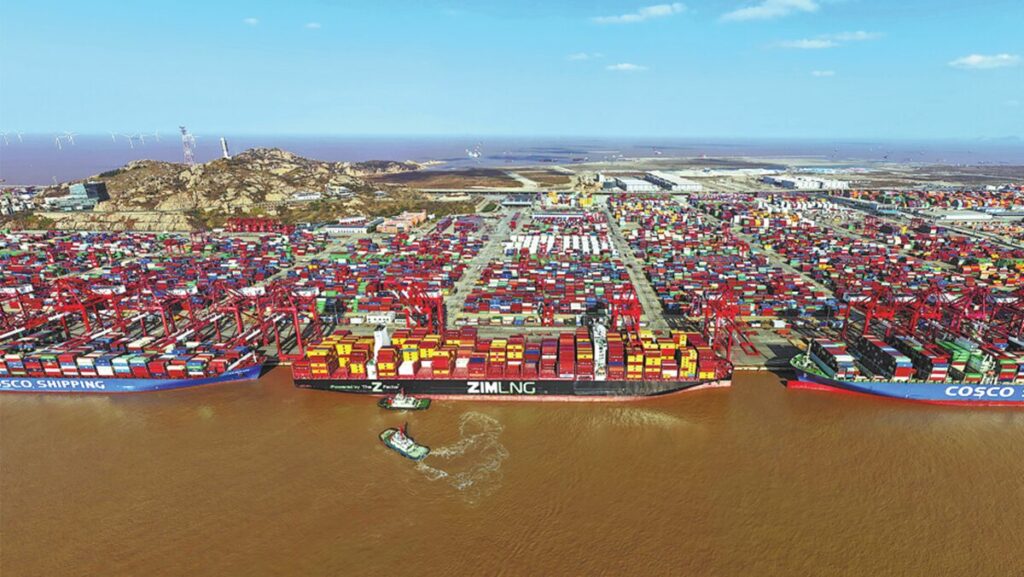
Currently, the Asian nation hosts eight of the world’s ten largest ports by cargo volume.
China accounted for nearly one-third of global maritime transport in 2025, consolidating its port infrastructure as the main logistical hub of global trade. The result reinforces its position as the world’s largest port power, with eight of the ten largest ports by cargo volume, according to data from the Ministry of Transport.
RELATED:
China’s Communist Party Marks 105th Anniversary
The information was presented by Vice Minister of Transport Li Xinghu during a press conference held in Beijing on June 30 to review the 14th Five-Year Plan (2021–2025). According to the ministry, inland waterway transport now accounts for more than half of China’s integrated transport system, reflecting the sector’s priority within the national modernization strategy.
In 2025, Chinese ports handled 18.3 billion tonnes of cargo and 354 million TEUs (twenty-foot equivalent units), both the highest figures in the world. The merchant fleet controlled by Chinese companies also reached 490 million deadweight tonnes (DWT), a measure of a vessel’s maximum carrying capacity, keeping the country in first place globally in the sector.
The strengthening of port infrastructure is part of China’s strategy to enhance industrial competitiveness, reduce logistics costs, and reinforce integration into global supply chains. Ports also play a key role in connecting the domestic market, manufacturing production, and major international maritime routes.
During the 14th Five-Year Plan, China added 469 new berths for vessels over 10,000 tonnes, bringing the total to 3,061. Over the same period, the national high-capacity waterway network expanded by 2,500 kilometres, reaching approximately 18,500 kilometres.
World record at sea: China delivers another 10,800-car carrier pic.twitter.com/xJJKAhzqNw
— CGTN (@CGTNOfficial) July 2, 2026
China accelerates integration between railways, ports and inland waterways
Integration between different transport modes also advanced. In 2025, Chinese ports handled 13.49 million TEUs through an intermodal system combining rail and inland water transport without the need for container transshipment, almost double the level recorded in 2020.
The Five-Year Plan review also highlights the consolidation of three major port clusters: the Bohai Rim region, the Yangtze River Delta, and the Guangdong-Hong Kong-Macao Greater Bay Area, considered strategic for linking China’s industrial production with major international shipping routes.
Plan investments prioritised integration between waterways, railways, roads, and ports to reduce logistics costs, increase freight efficiency, and improve connectivity between different regions of the country. They also accelerated the automation of Chinese ports.
China currently operates 60 automated port terminals, including 30 container terminals, representing around 27% of the global total. According to the Ministry of Transport, the automated terminals in Shanghai and Qingdao rank among the most efficient in the world.
The investments made during the 14th Five-Year Plan have expanded China’s logistics capacity amid a restructuring of global supply chains. With increasingly integrated and automated port infrastructure, the country strengthens its role in international maritime trade and expands its ability to serve both its domestic market and global trade routes.
China has launched the world’s first zero-carbon sea-river container route of purely electric vessels, a major step for cleaner shipping and greener ports.
It links inland waterways with sea shipping using battery-powered ships, forming an all-electric logistics chain from start… pic.twitter.com/Wsf2Ix2TRw
— The Maritime (@themaritimenet) July 2, 2026
China’s Five-Year Plan
The Five-Year Plan is China’s main instrument for economic and social planning. Developed under the coordination of the Communist Party of China and approved by the National People’s Congress, it sets strategic guidelines for public policies, state investments, and national development goals.
The plan establishes medium-term objectives based on economic, social, environmental, and technological indicators, which are then translated into national and regional targets. Its implementation involves ministries, local governments, and state-owned enterprises, which adapt the general guidelines to provincial conditions within a system of centralized coordination and performance-based evaluation.
Among its functions is guiding the allocation of public resources and investment toward strategic sectors such as infrastructure, industry, technological innovation, energy transition, environmental protection, and foreign trade.
Five-Year Plans have been part of China’s development model since 1953 and form part of the system of socialism with Chinese characteristics. According to Chinese authorities, this model combines long-term state planning, technological innovation, and strategic investment to drive socialist modernization and strengthen national competitiveness in key development sectors.
Bruno Falci, teleSUR correspondent in China
From teleSUR English via This RSS Feed.