

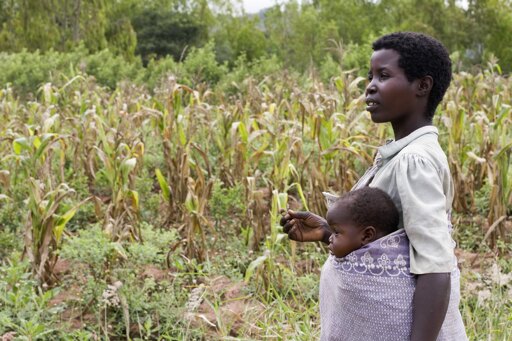
As the first rays of the sun streak through the misty morning early in June, James Singano spits into his right hand for a good grip of the hoe handle. With one swing, he brings down a shrub. Malawi’s farming season is five months away, but Singano has started clearing the land where he inter-crops maize, a staple food here, with pigeon peas. He is one of the more than 4 million smallholder farmers that depend on subsistence farming and contribute significantly to national food security by producing 80% of Malawi’s annual maize harvest. Most of them farm on less than a hectare. From his farm in the outskirts of Blantyre City in Southern Malawi, Singano’s maize harvest varies between 400kg and 600kg annually, which hardly feeds his family of six for a year. He says the land’s yield has consistently over the last 21 years, since he inherited it from his parents. “They (parents) did not need fertilizer to produce enough maize for our family,” he says, sweeping off the shrub he has cut with his bare foot onto a heap of grass nearby. “These days, farming is a lot of toil for very little harvest because the soil isn’t producing as much and fertilizer is getting harder to afford.” Maize is staple crop in Malawi and its production is heavily dependent on chemical fertilizers. Malawi imports over 90 percent of the over 400,000 tons of fertilizers it consumes annually – Image by Charles Mpaka for Mongabay. Soils losing…This article was originally published on Mongabay
From Conservation news via This RSS Feed.