

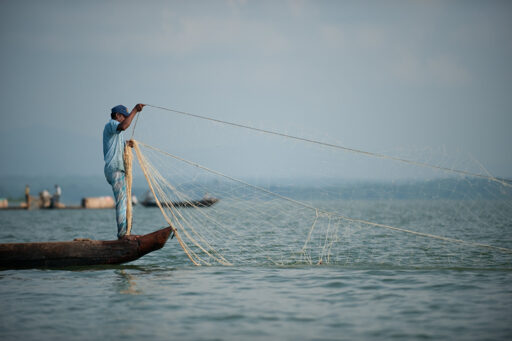
A faded towel draped over his shoulders, 53-year-old Khokon Jaladas sat quietly in the yard of his home. Just beyond his house, a few fishing boats moored in Kaptai Lake, the largest manmade reservoir in Bangladesh. He watched them quietly. Until a few years ago, he would have been out on the water too, spending long hours casting nets and trying to catch enough fish to feed his family. But now, fishing alone is no longer enough for him. To make ends meet, he works as a laborer in the boat building sector while continuing to fish whenever he can. “There used to be plenty of carp fish. We could catch fish easily and earned Tk 1200 ($10) to 1600 ($13) per day. But now, catches of high-value carp species dwindled,” Khokon said from Old Jelepara, a settlement on the edge of the lake in Rangamati district’s Sadar upazila (sub-district). “Sometimes, I return home empty handed from the lake. For this, it would be difficult to support my six-member family without doing other work,” Khokon said. Around Kaptai Lake, Khokon’s story is becoming far too common. For generations, the fishers met their livelihoods catching high-value carp species. As these fish become harder to find, many have no choice but to leave the profession. Created by a hydroelectric dam on the Karnaphuli River in 1960, the Kaptai Lake is one of Bangladesh’s most important hubs of inland fisheries. Fisherman Khokon Jaladas sits in the yard of his home near Kaptai Lake,…This article was originally published on Mongabay
From Conservation news via This RSS Feed.