

Since the latest war began in October 2024, the city of Nabatieh, and its surrounding district, has suffered Israeli aggression on an unprecedented scale. It has a long history of fierce resistance to occupiers — going back to the 1978 invasion and every major war since.
A major economic hub and stronghold for Shia-Muslim parties like Hezbollah and Amal, it is also considered to be of great strategic importance, as the southern gateway to the Bekaa valley. The fighting here has been intense and the human cost to local people enormous.
The Shia festival of Ashura, which commemorates the martyrdom of Imam Hussain, is traditionally a time of mourning. Focusing on justice, sacrifice and standing against oppression. Nowhere in Lebanon could this day (Friday June 27th) be more poignant. The relentless attempts of the Israeli Occupation Forces (IOF) to conquer this area made the annual celebration more powerful and political than ever before.
Shortly after we arrived, the IOF dropped two bombs a few hundred yards from where the event was being organised. A clear act of intimidation. One part of the program — which was billed as a ‘theatrical performance’ — was consequently cancelled for safety reasons. It would have involved a large gathering of people in a tight space watching a screen. It seems likely that this would also have been the venue for a live broadcast by Hezbollah secretary general Naim Qassem — which was televised at locations across the country. Clearly too much for the IOF in a place they had failed to occupy.
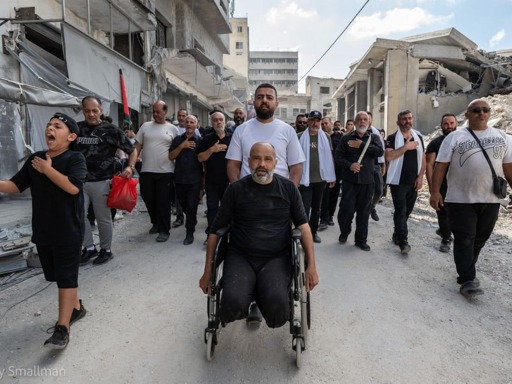
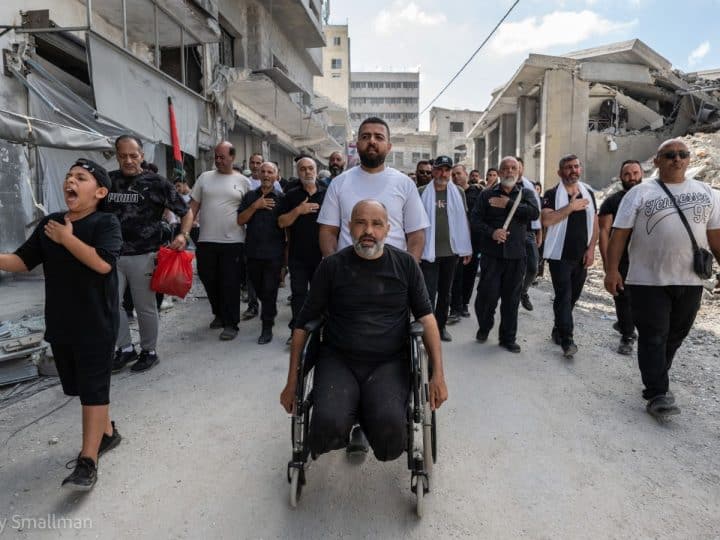
The prayers at the visibly damaged Husayniyya — a mosque-like multipurpose cultural hall used by Shia Muslims primarily to host community gatherings, religious education, and mourning ceremonies — and the traditional parades went ahead as planned. The latter consisted of many different political and religious groups circling the ruined town centre where men typically beat their chests and slap their heads to express grief for the martyrdom and sacrifice witnessed at the battle of Karbala, on the 10th of October in 680. This is the massacre that gave rise to Shia Islam.
Nabatieh — The blood of the martyrs
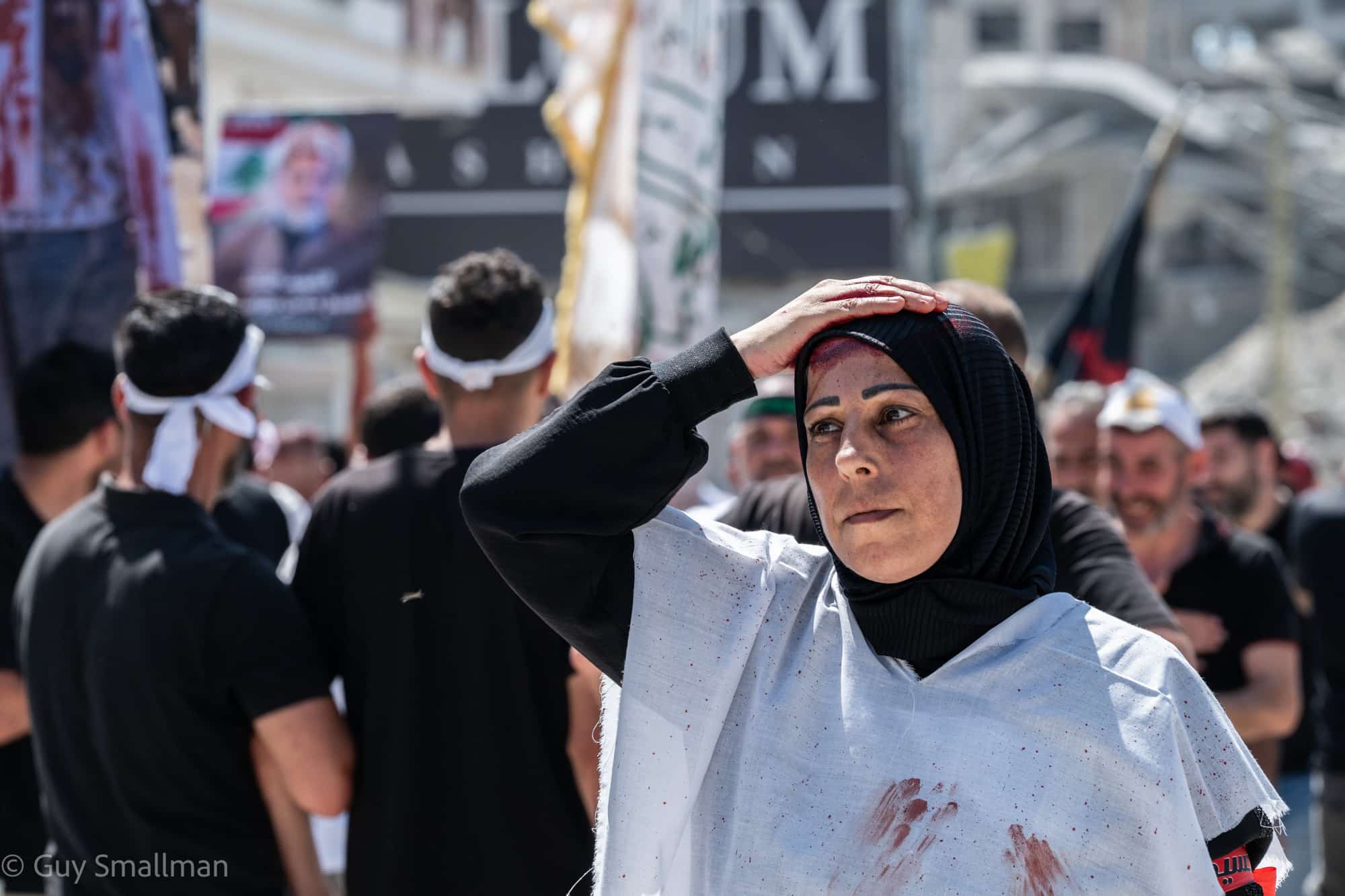
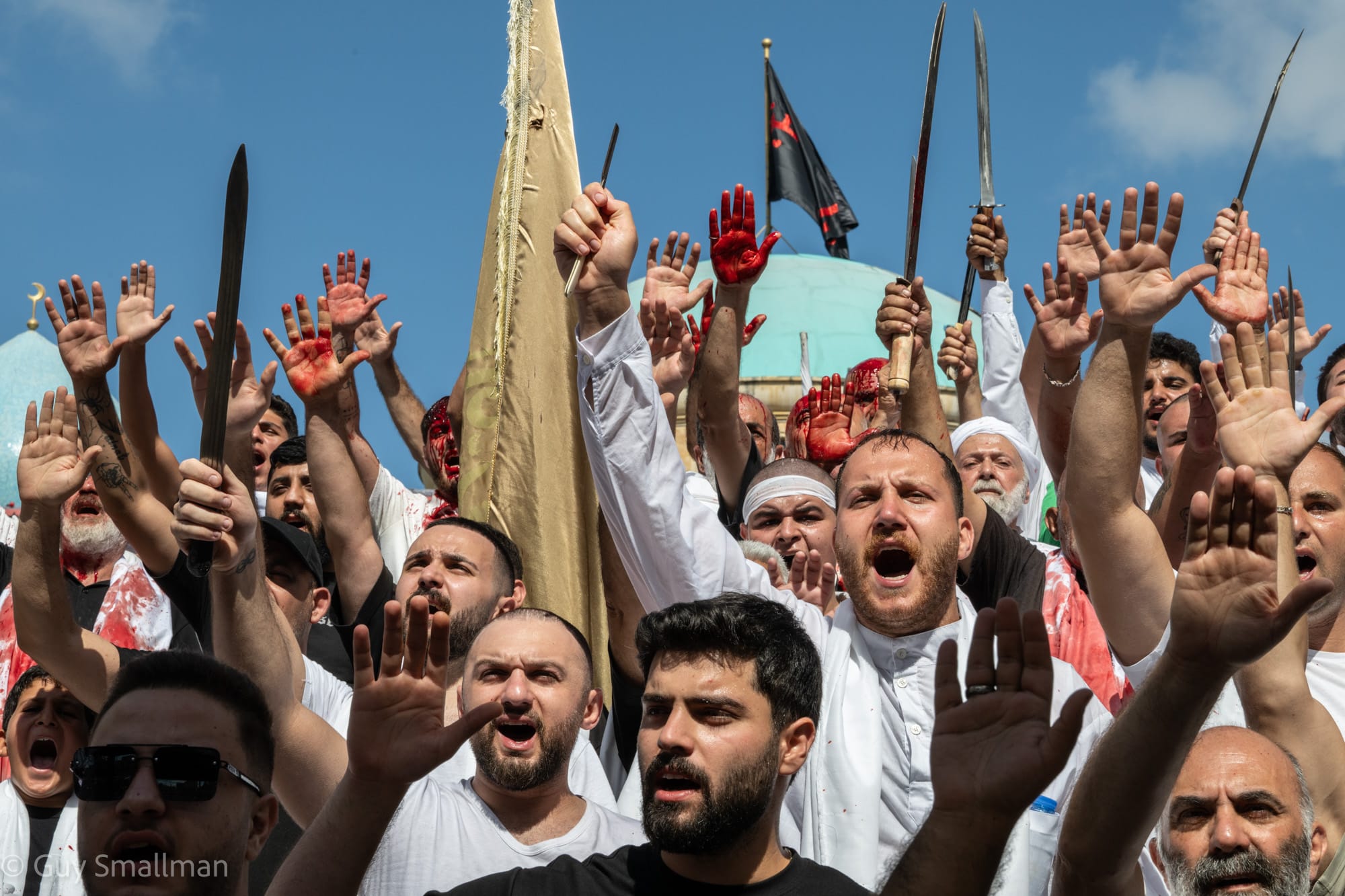
Some among those on the parade literally spilled blood from small cuts on their foreheads. The ritual which is commonly known as Tatbir is controversial. Hezbollah publicly disapproves of this practice, considering it to be outdated and arguing that Islam prohibits causing unnecessary harm to the body. But no one can tell the passionate how to practice their devotion in south Lebanon, so naturally there was a fair amount of blood on display.
Fatima Riad Haidar, who was among a minority of women on the procession, had a small cut above her hairline visible through her hijab. She explained:
This is the first time I have taken part in the ritual of the sharing of the blood with the men. The blood running from my head is a symbol of the blood of those who gave up their lives for our lands.
No matter how the Israelis intensify their aggression they will not be able to break this element of power inside us.
One group of particularly enthusiastic men had come dressed in white so that every drop, spilled by the swords they brandished, would be visible. Leading their chants with astonishing fervour was Haj Abu Ali Hallal, who told us:
The love in our hearts triumphs over any fear and aggression that is put upon this land. Even on this day the Israelis tried to intimidate the people who are attending Ashura. No bombing, no targeting will scare us. It will increase the momentum of our courage to be observing these holy practices and traditions.
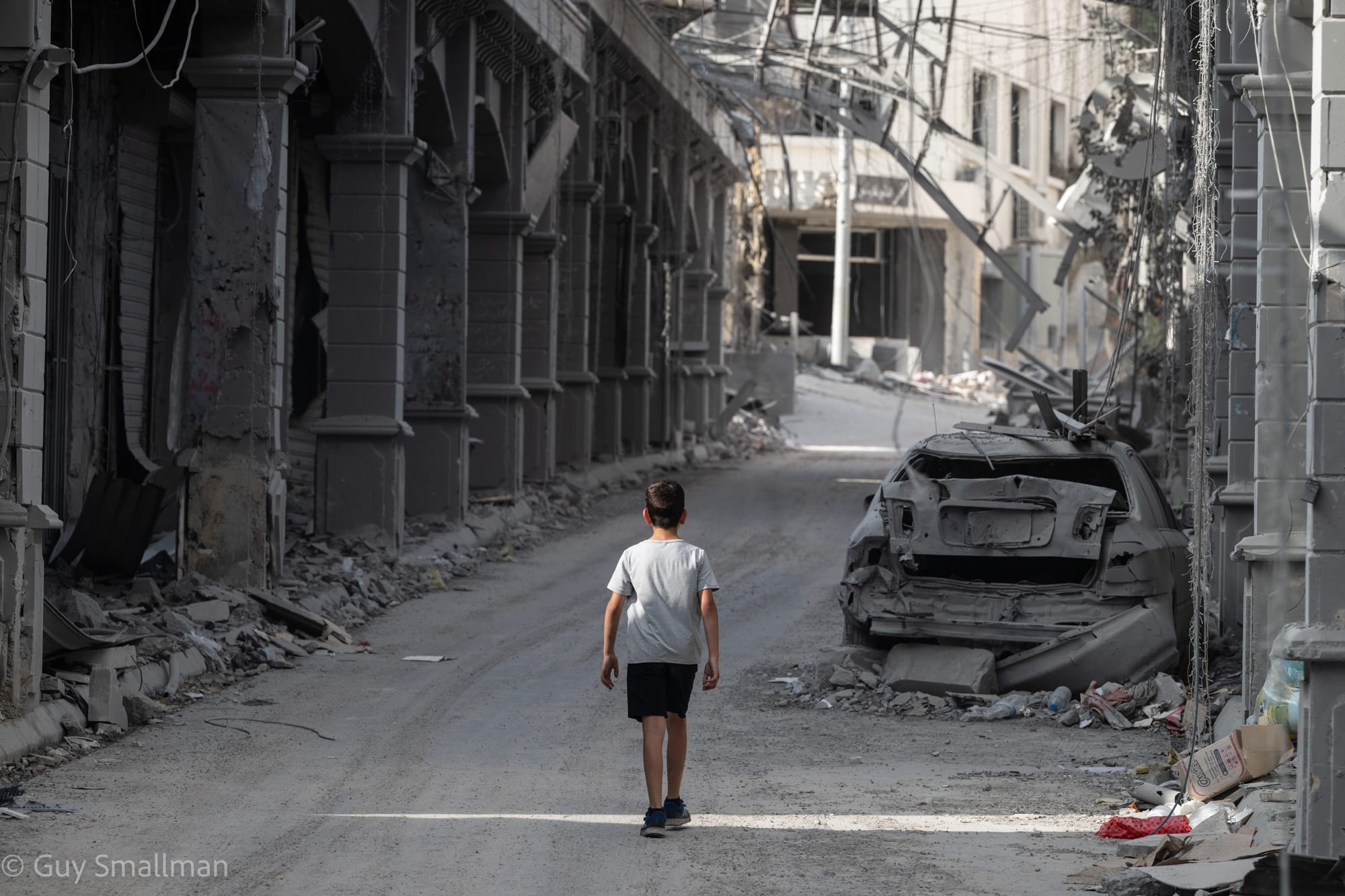
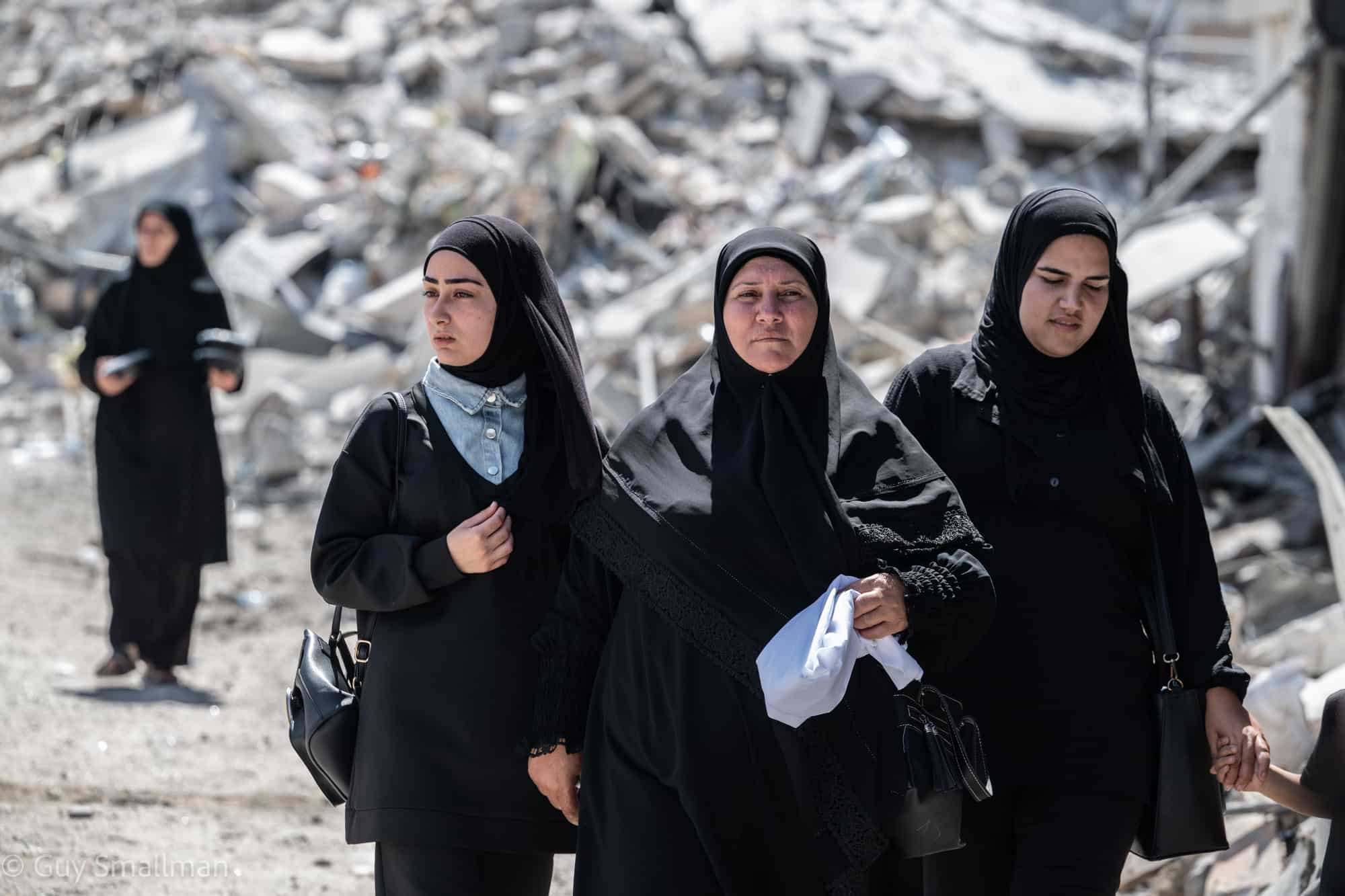
There was little doubt that many saw this event going ahead as an act of resistance. The sight of their zeal amid the ruins of Nabatieh created a truly apocalyptic scene. The centre of the town is all but destroyed. Heritage sites — like the famous souk and ancient bakery — have been incinerated by Israeli bombs. The homes of those in attendance from the town and surrounding area have met a similar fate.
Feelings of sadness and hope amid the ruins
Eighty-year-old Hajj Abu Reda watched the procession from the side of the road and relayed his recent experiences to us:
Since the start of the war I have been displaced with my children and grandchildren many times it has been a long journey. We are here today to watch the parades and to see our city. The place where we belong.
He was from Eastern Zawtar, which is perched near Nabatieh on an elevated terrain. So it is of significant strategic importance on the battlefield:
We were first displaced at the beginning of the war. I was sitting in my house and a strike happened next to us. I was there in the smoke. My house was still standing but some of it was destroyed. We all left. My youngest grandson is just six months old.
We were displaced two more times by the fighting. Until returning home on the second day of the ceasefire. Then we had to leave again during another escalation when the Israelis tried to take the Ali Al Taher Hill.
This year, at Ashura, I feel sorrow because in previous years you would not be able to move in this space. All the surrounding villages would have been here and it would be so crowded. I have seen in the news that there was an airstrike here this morning. Now all of Nabatieh must come together to return the glory to this place.
Nasser Moussa — who was attending with his young son — explained how two of his brothers had been martyred in the struggle against occupation, twenty years apart. One in 1994 and the other in 2024. He said:
I was born in 1982 the year of the first major invasion. We have become used to these wars and this kind of aggression. We are proud of our martyrs and their sacrifice for our land.
What I want now is for all of this to end. For the Lebanese people to become as one nation and society. To love and respect and to defend each other. I want all this division to end. If we lose our fear, we can build a united society where all are loved by each other.
As a patriot I believe that people have made these sacrifices because they love this country. We want the government to care for us so that we feel safe in our land.
The heroic sacrifice of Nabatieh’s first responders
One of the contingents on the parade drawing the most awe from local people were the paramedics and civil defence volunteers — who have been the subject of numerous war crimes by the IOF. Ambulances and fire engines have been attacked and medics have been slaughtered in illegal double tap strikes.
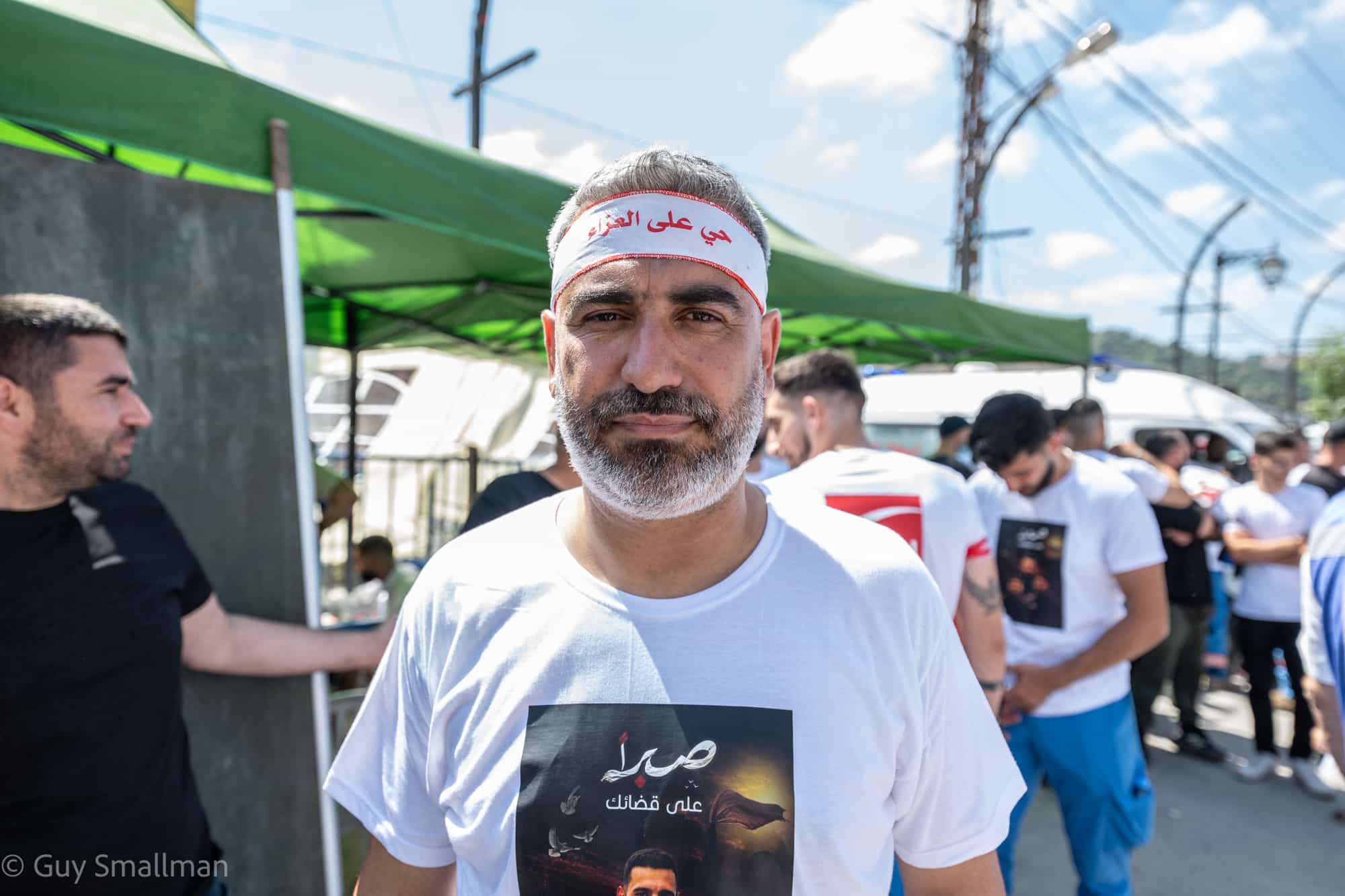
Mohammed Sleiman administers the volunteer paramedics, who have been on the frontline of the carnage from the very beginning. Along with attending to and transporting the dead and injured, they had been preparing and delivering food to vulnerable people. Those who are unable or unwilling to leave. It was on one of these missions that his beloved son, Joud (16), was killed by an IOF drone strike — along with Ali Jaber (23). Their motorcycle was clearly marked as an emergency vehicle. Mohammed had attended the scene, he explained:
Joud was my son. Because of his age he could not be part of the main paramedic work so he volunteered in logistics. He started volunteering in the war of 2024 when he was just fourteen. We consider ourselves to be a neutral, impartial organisation. We are not political. But this enemy does not respect first responders or paramedics or even doctors doing their duty. International agreements are ignored.
Twenty days later, they lost another colleague who was on a rescue mission, trying to save paramedics from a different group who had just been attacked when the ambulances were struck again multiple times. Mohammed continued:
For the last thirty days, the intimidation from the air has been constant. An ambulance cannot move anywhere here without a drone flying above or alongside it. More recently since this latest ceasefire our people were attacked while recovering the body of a martyr from a building that had been struck earlier. Two of them were martyred, one was a volunteer called Kassem Romani, he was only nineteen. Two hundred of our paramedics have been killed in this way, by direct targeting, across Lebanon
IOF still failing on the ground
The fact that Nabatieh was able to hold its annual Ashura commemoration is a testament to the failure of Israeli forces to achieve their objectives on the ground. Their original plan to control and occupy south Lebanon right up to the Litani river has been scaled back to their so-called yellow line. Nabatieh is fifteen kilometres south of the river and the last attempt at a ground invasion into the outskirts of the city was smashed.
Twenty-year-old student Jawad Atwi was at the scene of the incursion, and he recounted how the area came under heavy bombardment before the Israelis tried to enter it on the ground:
This was the last round of fighting before the ceasefire, and it was the cruellest and most aggressive bombing I have experienced. It was the third or fourth day of Ashura and we were sheltering in our neighbourhood; we were under fire from artillery. With airstrikes from drones, jets and helicopters.
He described how the air above and around him was full of fire from both sides:
We were moving from house to house to escape. The bombing was literally one house away from us. We also saw the artillery and cornet missiles of the resistance, and how the young men of the resistance did not spare any effort to defend the area. Thanks to God, the victory was on the side of our fighters who did not let the Israelis advance. We send all our thanks and prayers to the men who are still out there watching over us
 He concluded:
This morning’s airstrike [that was] close to this area was a very failed attempt to try and intimidate us. All this destruction you see around here, with time, can be rebuilt. Sadly, the souls of those close to us who have been martyred are irreplaceable. What we hope to do now is [that people] return to Nabatieh and to reconstruct and restore it as a vibrant city. A place of faith, scholarship and knowledge.
Featured images by Guy Smallman
By Guy Smallman
From Canary via This RSS Feed.