

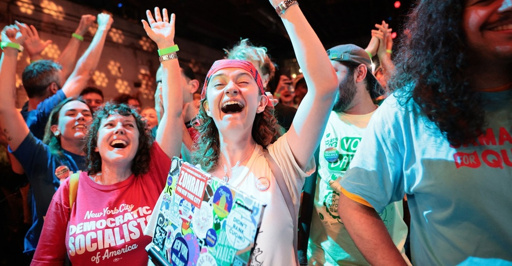
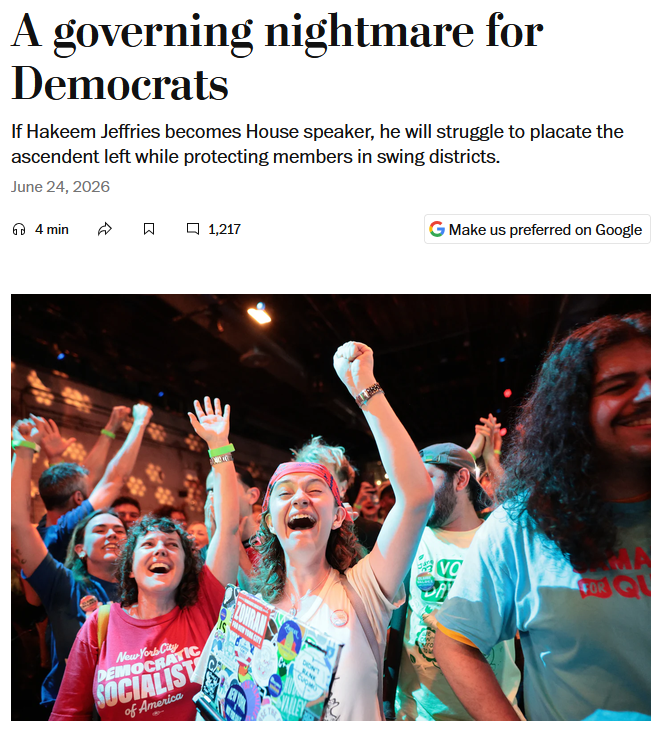
The Washington Post (6/24/26) warns that victories by progressive candidates “puts pressure on leadership to lurch leftward and refuse any compromises on issues like funding the government.”
New Yorkers elected progressives and democratic socialists up and down the ballot in June’s Democratic primary, in what even critics acknowledged was “an historic near-sweep” (New York Daily News, 6/27/26). Alarmed by voters’ rejection of corporate media’s preference for moderates (FAIR.org, 8/21/19), establishment media outlets reacted with panicked op-eds and articles downplaying the significance of the results.
New York City “isn’t reflective of the country,” declared a Washington Post editorial (6/24/26) published the day after the election. The paper, which billionaire Amazon founder Jeff Bezos bought in 2013, added that “the base detests anyone perceived as part of the establishment, no matter how progressive their voting record.”
In the Post’s view, voters’ irrational hatred of the establishment “puts pressure on leadership to lurch leftward”—in other words, respond to voters’ demonstrated needs and preferences. It’s voters’ desires, not politicians who repeatedly defy the will of voters, that “will make it harder for Democrats to win in 2028.”
Even US Rep. Dan Goldman’s “liberal voting record” wasn’t “enough to save him,” the Post lamented. Missing from this editorial was any attempt to define its terms (e.g., what makes a voting record progressive or liberal?) or understand what drove these results (why are voters so angry at the establishment?). Instead, it dismissed Democratic voters as clueless members of the “far left,” fueled by inexplicable anger at their sober-minded betters.
Organizing the ‘reasonable’
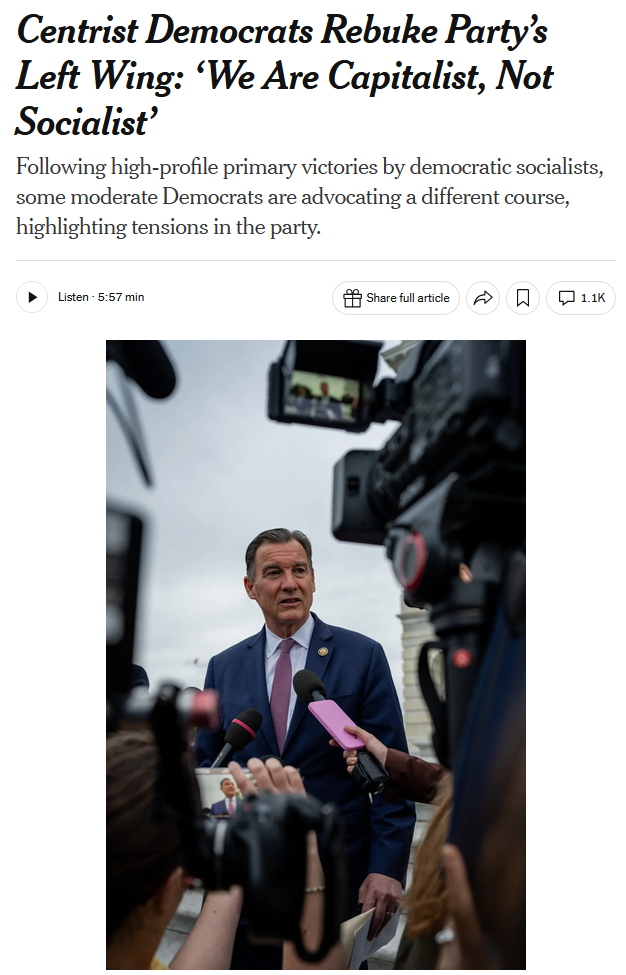
The New York Times (6/26/26) quoted a co-founder of the corporate-backed Third Way think tank as saying that DSA victories would allow Republicans to “weaponize the craziest ideas of the activist left.”
Others in corporate media grasped one key to these wins: the months of organizing and door-knocking that made them possible, some of which I participated in as a member of the Democratic Socialists of America (DSA). But they failed to understand, or pretended not to see, that it’s just as essential to have a policy agenda that excites voters.
CNN political commentator Van Jones tweeted at his fellow moderates that “reasonable” Democrats were going to have to
get off their couches, roll up their sleeves and start organizing…. We can no longer rely only on TV ads, digital spend and endorsements…. If you are a Democrat who believes in opportunity, dignity and democracy for all—but you don’t hate rich people, cops, free enterprise, the West, Israel and the United States of America—I’m talking to you!
Rep. Tom Suozzi of New York, a self-styled moderate, made similar remarks to the New York Times (6/26/26):
The bottom line is that you have to give the DSA and you have to give MAGA credit, because they’re organized…. And the people that don’t agree with their philosophies wring their hands at cocktail parties, but they’re not organized. So we have to get organized.
Can moderates catch up to progressives simply by attending more meetings and fewer cocktail parties? It’s a start, but the election results suggest that their ideas simply do not hold much appeal to rank-and-file Democratic voters. Jones, Suozzi and their fellow “reasonable” Democrats are welcome to go door-to-door to try to interest Democratic voters in policies they see as both pro-rich people, pro-cop, pro-Israel and middle-of-the-road, but recent polls indicate that a majority won’t be interested.
According to a 2026 Siena poll, 54% of all New York voters support a tax increase on New York City residents making over $1 million per year. Support was even higher among New York City voters, 62% of whom favor such a tax hike, and state Democrats, 72% of whom support it.
An exit poll released shortly after New York City’s 2025 mayoral primary revealed that two in three voters listed crime and public safety, along with homelessness, as some of the biggest issues facing the city. But when asked to choose which idea more closely aligned with their views, 75% of respondents said they’d rather address crime and safety by increasing “treatment for mental health and drug addiction and getting illegal guns off the street” versus giving more resources to police, increasing sentences for people convicted of violent crimes and strengthening bail laws.
A 2025 poll conducted by YouGov on behalf of the ACLU also found that 69% of voters think having mental health and addiction specialists rather than cops respond to calls related to mental health, homelessness and substance use would improve community safety.
And according to a 2026 Pew Research Center poll, eight in 10 Democrats and Democratic-leaning independents have an unfavorable view of Israel.
‘Threatening to unleash a debate’
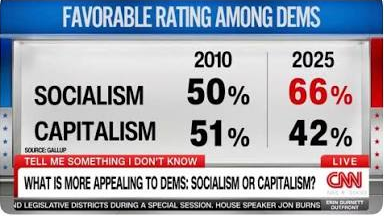
CNN (6/25/26): “Democrats last year had a significantly more favorable view of socialism (66%) than capitalism (42%).”
Despite the fact that solid majorities of Democrats now favor tax hikes on the rich and public safety solutions that reduce the need for cops, prefer socialism to capitalism and hold a negative view of Israel, corporate media outlets are committed to portraying these voters as deeply divided. New York Times contributor Tim Balk (6/26/26) wrote:
With four months until the midterm elections, the [electoral] outcomes in New York have deepened divisions in the Democratic Party, threatening to unleash a renewed internal debate about electability and how Democrats speak about capitalism.
Speaking of electability, democratic socialists have won races throughout New York City and across the state: in the Hudson Valley, where Sarahana Shrestha has held a state assembly seat since 2023; in Central New York, where Onondaga County legislator Maurice “Mo” Brown just beat one of the area’s longest-serving incumbents in a race for a state assembly seat; and in Western New York, where DSA-backed Buffalo attorney Adam Bojak just won a state assembly seat by a massive margin, and where democratic socialist Brian Nowak has been Cheektowaga town supervisor since 2023.
They are also winning outside of New York: Democratic socialist Melat Kiros just toppled 15-term US House Rep. Diana DeGette in the primary election in a district that encompasses Denver, Colorado; democratic socialist Janeese Lewis George (FAIR.org, 6/5/26) is poised to become the mayor of Washington, DC; and Georgia voters sent democratic socialist Gabriel Sanchez to the Georgia General Assembly in 2024.
‘Differed little on policy’
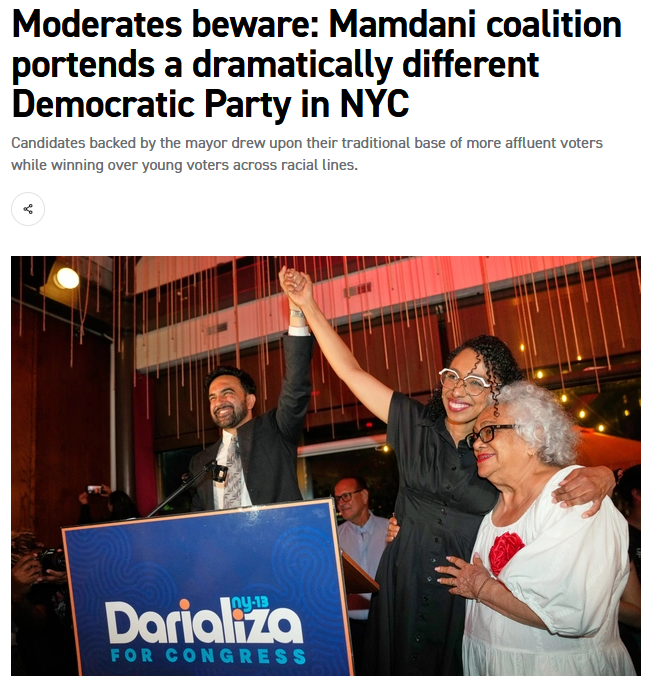
Politico (6/26/26) claimed that DSA’s candidates “differed little on policy”—which fails to explain the “staggering” results that ” charted the far left’s broadening appeal and a potential reorientation of the electorate that will influence races for years to come.”
Whether these election results have “deepened” divisions within the Democratic Party or merely exposed them, centrists and their media allies are desperate to neutralize them. According to the Daily News’ Evan Thies (6/27/26):
The issues that the vast majority of those [DSA-aligned] candidates ran on—higher taxes for the wealthy, immigrant rights, a stronger social safety net—are also the issues that ‘establishment’ candidates ran on…. In the congressional races in particular, other than differences on Israel, you would be hard-pressed to find a major part of any insurgent’s platform that was not also a plank of their opponent’s.
Politico (6/26/26) had a similar take:
A series of hotly contested congressional and state elections pit a slate of Mamdani-backed democratic socialists and progressives against establishment candidates who, in several cases, differed little on policy aside from US/Israel relations.
But the “differences on Israel” that pundits are so eager to gloss over were essential, not incidental, to many of these victories. It turns out Democratic voters are really angry at many longtime incumbents for supporting and funding an ongoing genocide, and eager to vote for candidates who have actively worked to stop it.
There were other key differences in policy and governing philosophy between these candidates as well. A New York Times story (6/1/26) about the primary battle between the DSA-backed Claire Valdez and the Working Families Party–backed Antonio Reynoso first stated that “the policy distinctions in the race can be difficult to discern”—before going on to discern:
Where [Reynoso] has advocated reforms within existing systems, [Valdez] wants to shrink the private sector and drastically ramp up the federal government’s role in building housing…. The assemblywoman and her allies have also knocked Mr. Reynoso for accepting tens of thousands of dollars in campaign contributions from people connected to the real estate industry.
In a profile headlined “Like AOC, But to the Left,” City & State (6/15/26) wrote that DSA-backed challenger Darializa Avila Chevalier had “a totally different worldview, with a totally different relationship to the district,” compared with longtime incumbent Adriano Espaillat.
Progressive flukes, centrist acumen
Whether or not these differences mattered to pundits, voters appeared to take note: Valdez won her race by over 20 points, and Chevalier won hers—which many considered a long shot—by a clear but smaller margin.
As usual, corporate media outlets covered these progressive victories as if they were flukes, while treating less significant centrist victories as evidence of political acumen. In his Times story (6/26/26) on centrist Democrats who reject “false choices between extremes on right and left,” Balk described Suozzi as “a New York Democrat who flipped a swing district” on Long Island in 2024.
In 2024, Suozzi beat his Republican opponent by just 3.6 points in the general election; the seat he “flipped” was formerly occupied by Republican George Santos, who was exposed as a serial liar within months of being elected and expelled from Congress about a year later. Santos only won the seat after Suozzi gave it up to challenge Gov. Kathy Hochul from the right in New York’s 2022 gubernatorial primary.
In 2024, Suozzi narrowly regained his old seat by espousing policies that voters in one of the wealthiest congressional districts in the state and country slightly preferred. But when he ran statewide, he won just 13% of the vote—or 6 points less than Jumaane Williams, who also lost to then-Governor Hochul by a wide margin, but earned 56,900 more votes than Suozzi by challenging her from the left.
‘An elite of well-educated professionals’
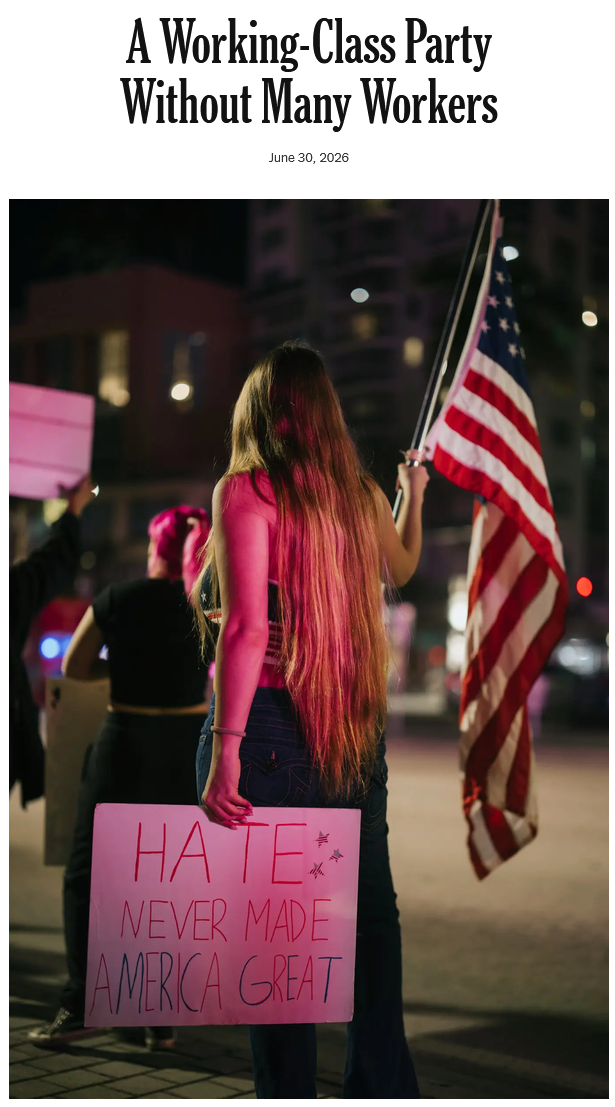
According to the New York Times‘ Thomas Edsall (6/30/26), if you have a college degree, you “are in no way working class.”
Another popular strategy for undermining progressive wins is suggesting that only rich white college kids support them (New York Post, 6/25/26). As the New York Times’ Thomas Edsall (6/30/26) wrote, “Candidates aligned with the Democratic Socialists of America are surging to victory on the claim that they are proponents of ‘a government by, for and of the working class.’” He countered:
Most of the leadership of the DSA and a majority of voters who back its candidates are in no way working class. Instead, an elite made up of well-educated professionals dominates this insurgency.
Furthermore, he added, DSA’s agenda is
packed with policies supported by left-wing liberals, white progressives in particular, but strongly opposed by both white and minority working-class (defined, in pollster shorthand, as non-college-educated) voters.
Putting aside the larger question of who belongs to “the working class” in the US today, which Edsall addressed only obliquely—when he described DSA’s “key constituency” as “the universe of young people with college degrees struggling to find rewarding work, the so-called precariat,” it sure doesn’t sound like he’s talking about the haute bourgeoisie—it is flatly untrue that voters of color oppose DSA policies and candidates.
As data analyst Michael Lange explained on his blog (Narrative Wars, 6/29/26), DSA candidate “Darializa Avila Chevalier won Black voters…against a 10-year Democratic incumbent in the historic capital of Black America,” while DSA’s
Claire Valdez won every age bracket and racial group…. This is not the electoral footprint of a gentrifier candidate, squeaking past on margins from Millennial and Gen-Z (white) transplants; it is the signature of a multiracial, cross-generational coalition.
Even Politico (6/26/26) acknowledged that
Congressional candidates backed by the Democratic Socialists of America were able to replicate [Mamdani’s] success by winning younger Latino voters in Brooklyn and a majority of Black voters in Harlem…. The result charted the far left’s broadening appeal and a potential reorientation of the electorate that will influence races for years to come.
The case for cowardice
Edsall declared that DSA’s support for trans rights “would be met with some skepticism if not hostility by working-class voters disdainful” of ideas like “bodily autonomy” and “conservative norms around gender.” Like many of his colleagues at the Times, Edsall parses voter attitudes toward trans rights at length, without bothering to note that they—like attitudes toward interracial marriage, gay marriage, policing, abortion and immigrants’ rights—have changed quite a bit in the last five to 50 years, in response to movement pressure and shifting social, political and economic conditions.
Should DSA abandon its trans members and siblings because, as Edsall (6/30/26) writes, “surveys consistently show that non-college voters are significantly more opposed to more progressive transgender policies than college-educated voters”? Or should it continue to organize and lead on these and other issues in hopes of building support for human rights across the board?
Even in 2021, when public safety was a top concern of NYC voters, many of whom wanted more cops on the streets, polling showed that the largest share of voters favored reducing crime by “shifting police funding to mental health” (NBC, 6/14/21). New York elected former cop Eric Adams mayor that year. Four years later, Adams’ support had cratered and, according to Siena College Research Institute’s director, Don Levy, “Crime remain[ed] a concern…but over 90% [of NYC voters surveyed] say just affording life is a problem.”
In 2025, New Yorkers elected democratic socialist Zohran Mamdani in the Democratic mayoral primary by a much larger margin than Adams’. One thing we can learn from the recent wave of progressive wins is that public opinion doesn’t shift in a vacuum; movements and leaders shift it.
From FAIR via This RSS Feed.