

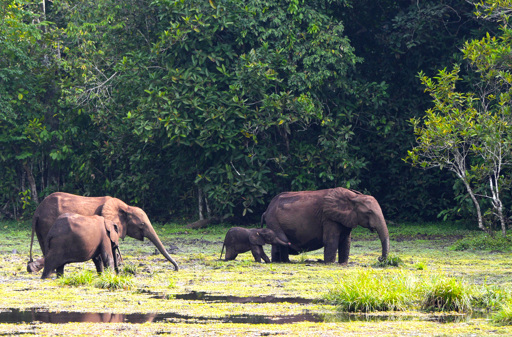
The rainforests of the Congo Basin are the planet’s largest forested carbon sink: as these 3.3 million square kilometers (1.3 million square miles) of trees in Central Africa breathe in carbon dioxide from the atmosphere, they turn it into leaves and bark and branches, helping to mitigate the effects of climate change. Yet a recently published study quantifying this carbon storage presents a surprising suggestion: that the most effective way to trap even more carbon in Congo Basin rainforests may be to cut some of its trees down. The study, published as an advance copy in April in Nature Communications, found that selectively managed logging areas make up about 57% of the net carbon removals in the Congo Basin. The authors suggest this shows these forests could provide benefits to both the planet and local communities if sustainable logging is permitted. “The question is: is logging, or any other sustainable use of those forests, only bad for the environment?” said lead researcher Le Bienfaiteur Sagang, a tropical ecologist at the University of California, Los Angeles. “Can we use these forests, give them more value, provide jobs for the locals, and still provide a good contribution to the climate?” Sagang and his co-authors decided to put this questions to test. They designed a machine-learning program that combined land-cover data, captured between 1990 and 2020 across the Congo Basin’s six forested countries, with aboveground carbon levels estimated from other studies via lidar, which creates complex 3D landscape scans using lasers. This rainforest…This article was originally published on Mongabay
From Conservation news via This RSS Feed.