

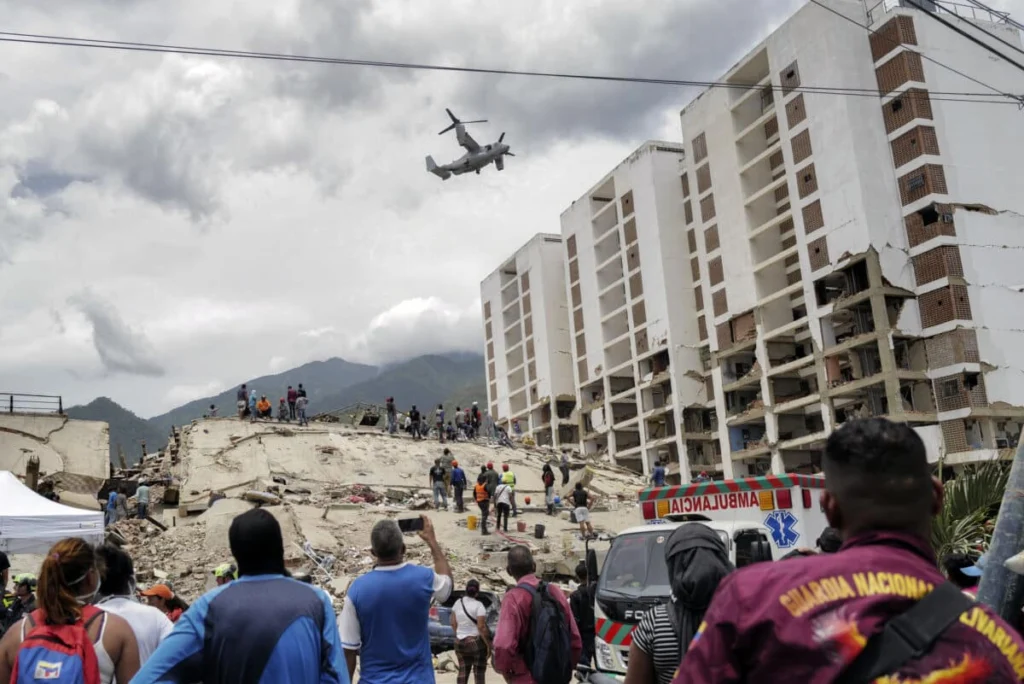
A progressive look at the state response, shelter system, and reconstruction after the June 2026 earthquake doublet.
On June 24, 2026, north-central Venezuela experienced the most destructive seismic sequence in more than a century. An earthquake doublet began with a magnitude 7.2 mainshock, followed by a magnitude 7.5 event.
RELATED:
Venezuelan Health Services and Shelters Strengthened Under State Supervision
The energy reached the surface with unusual force, collapsing buildings, damaging roads, and disrupting power grids across densely populated areas in the Capital District, Miranda, Aragua, Carabobo, and the heavily affected coastal state of La Guaira. Within days, health authorities reported more than 2,200 deaths and over 15,000 injuries. Tens of thousands of residents were suddenly left without homes.
The reality on the ground showed an organized recovery effort around human needs. The public and civic response focused on building an immediate social shield. This protective framework prioritizes the physical, psychological, and logistical needs of the most vulnerable families, with special attention to protecting women and children during the chaos of evacuation and temporary relocation.
Aerial footage: Scale of destruction after Venezuela earthquake https://t.co/0RF0TiShye pic.twitter.com/4uH4b51bdN
— CGTN (@CGTNOfficial) July 2, 2026
Institutional Mobilization: Deployment, Censuses, and Countering the Blockade
After the twin tremors, the Venezuelan executive branch activated the country’s national defense and civil protection protocols. Acting President Delcy Rodríguez and Minister of Internal Affairs Diosdado Cabello oversaw the deployment of more than 26,000 personnel, including Civil Defense units, municipal firefighters, and specialized urban search and rescue teams from the National Bolivarian Armed Forces.
Security forces set up perimeters around unstable structures in urban corridors such as San Bernardino and Catia La Mar to maintain public order and stop private vendors from price-gouging essential survival goods. This rapid use of state resources kept key transit routes open, allowing emergency vehicles and medical supplies to reach active rescue zones.
At the same time, the logistical response relied on the country’s grassroots political structure to carry out damage assessments. Instead of depending only on top-down aerial surveys, community organizers moved block by block through damaged neighborhoods to build accurate lists of missing people, injured residents, and destroyed homes. This detailed data collection allowed local logistics hubs to map urgent needs in real time and send emergency resources directly to the households most affected.
This broad state mobilization happened despite severe external financial and logistical pressure. Foreign Minister Yván Gil noted that ongoing unilateral coercive measures, commonly called economic sanctions, continue to limit the state’s ability to import certain heavy machinery, specialized rescue tools, and international medical equipment.
Even with these structural obstacles, the combined work of state security forces and neighborhood councils successfully delivered clean water, food rations, and medical aid to thousands of newly displaced people in the first 48 hours of the emergency.
Temporary Shelters and Safety
The sudden displacement of more than 13,000 citizens required the rapid conversion of public spaces into temporary shelters. Municipal indoor gymnasiums, public schools, and cultural centers across Caracas and La Guaira were turned into safe spaces to protect people from the weather and from the ongoing threat of collapse caused by more than 600 recorded aftershocks.
These facilities play a vital role in preventing exposure-related illness and securing immediate physical safety, but disaster research shows that temporary shelters are not automatically safe environments. Without strict organization, the sudden concentration of displaced people can create internal tension and structural weaknesses that place family units under added pressure.
The main risks families face in fast-built shelter spaces come from overcrowding, the breakdown of normal social routines, and the early loss of privacy. For women, adolescents, and young children, these dense environments create specific challenges.
Losing private family space can increase psychological stress, sleep deprivation, and feelings of insecurity. In addition, when there is no planned division of space, basic needs such as infant feeding, changing clothes, and personal hygiene become difficult to manage.
If public sanitation facilities are left unmonitored or poorly lit, they can quickly shift from essential services to spaces of fear, exposing vulnerable people to health hazards and safety risks.
To respond to these pressures, state civil protection teams, working alongside local Communal Councils, have established clear safety and care rules across the active shelter network. Standard operating guidelines require sleeping areas to be separated quickly in order to preserve family unity, while shared washing facilities are divided by gender.
Security should be maintained through a combination of external perimeter patrols by civil defense personnel and internal monitoring led by neighborhood committees.
These groups ensure that common areas remain safe at night, that entry points are controlled through identification registries, and that clean water, food, and emergency medical kits are distributed fairly to reduce the competition for resources that often creates instability in crisis zones.
Al Jazeera’s @TeresaBo reports in La Guaira, Venezuela, at a former golf course now a relief center after twin earthquakes, with hundreds arriving daily seeking aid after losing homes, belongings and loved ones. pic.twitter.com/KlxAdjlajH
— Al Jazeera English (@AJEnglish) July 2, 2026
Child Protection and GBV Prevention
To address the specific vulnerabilities of children and women during the post-disaster transition, national protection agencies immediately activated Venezuela’s existing legal frameworks for human rights protection.
Under the Law on the Protection of Children and Adolescents (LOPNNA), the state deployed specialized teams from the Ombudsman’s Office to monitor emergency housing sectors. These officials established structured environments known as Friendly Zones within the major shelter complexes.
These areas decouple children from the immediate stress of the recovery zones, offering psychological first aid, informal educational continuity, and supervised recreational activities.
Run by local educators, institutional defenders, and community volunteers, these zones ensure that displaced children are monitored throughout the day, preventing structural separation from their guardians while providing targeted nutritional monitoring to combat acute physical or emotional trauma.
Simultaneously, explicit administrative measures from the Organic Law on the Right of Women to a Life Free of Violence have been integrated into the shelter management system to enforce the prevention of gender-based violence (GBV).
Recognizing that disaster-induced displacement historically exacerbates domestic and community volatility, the state framework treats GBV prevention as a core security necessity rather than a secondary concern.
Sovereignty and Solidarity
Under the direction of the Ministry of Foreign Affairs, international assistance was folded directly into the existing national recovery framework. This approach ensured that incoming medical supplies, specialized personnel, and technical equipment were deployed according to the exact, data-driven needs identified by local organizations on the ground, rather than allowing outside agencies to set territorial priorities.
On the international stage, Foreign Minister Yván Gil managed incoming aid shipments through established bilateral and multilateral channels.
Allied nations, including Cuba, Mexico, Brazil, China, Colombia, Chile, Panama, Ecuador, El Salvador, Switzerland, Spain, France, Italy, Portugal, Qatar, and the Dominican Republic quickly sent specialized Urban Search and Rescue (USAR) teams, field hospitals, and logistical specialists to strengthen domestic civil protection units.
At the same time, multilateral agencies such as the United Nations, through their emergency news and coordination platforms, helped move critical resources without attaching political conditions to the aid.
This coordinated effort directly challenged the sensationalist reports published by private domestic outlets, which often claimed that the state lacked the capacity to manage the crisis.
On-the-ground journalists, including teleSUR, documented the arrival and immediate deployment of international rescue teams alongside the National Bolivarian Armed Forces (FANB). That real-time reporting confirmed that incoming aid was being distributed through the state’s logistical networks.
Hundreds of Venezuelans are sheltering at a golf course in La Guaira after last week’s deadly earthquakes left more than 15,000 homeless.
More than 1,700 people are dead and tens of thousands remain missing as hopes of finding survivors fade. pic.twitter.com/f6CdzzXxLN
— Al Jazeera English (@AJEnglish) June 29, 2026
Reconstruction and Housing
As the immediate search and rescue phase concluded, the recovery strategy shifted toward long-term urban planning and technical reconstruction. Acting President Delcy Rodríguez institutionalized this phase by decreeing the creation of specialized presidential commissions.
These commissions are explicitly tasked with evaluating structural damage to households, setting up standardized temporary camps, and organizing the immediate construction of resilient permanent housing.
The core of this phase relies on the government’s structural “red alert” mapping strategy. Organized by these newly formed commissions in collaboration with engineering faculties from national public universities, this initiative involves a comprehensive assessment of terrain stability across the mountainous corridors of Greater Caracas and La Guaira.
Specialized teams analyze soil composition, landslide risks, and structural damage to categorize affected urban blocks. This data ensures that displaced families are prevented from returning to unstable terrains that pose a threat of future collapse.
This technical assessment allies intellect, bridging the gap between scientific expertise and popular power organs. Civil engineers, seismologists, and urban planners work alongside local Communal Councils to design earthquake-resilient infrastructure.
Rather than relying on private developers whose primary motive is capital accumulation, this public-sector alliance ensures that reconstruction efforts prioritize social safety and community cohesion.
The final stage of the recovery model focuses on moving families out of temporary shelters and into permanent, high-quality housing. This transition is managed through the legal and physical infrastructure of the Great Venezuela Housing Mission (GMVV), the state’s public housing program.
Displaced families registered in the initial grassroots censuses are systematically allocated newly constructed, earthquake-resistant apartments. By treating housing as a fundamental human right rather than a market commodity, the state’s long-term response aims to eliminate precarious living conditions.
Sources: teleSUR – Al Jazeera – Delcy Rodríguez – Jorge Rodríguez – Diosdado Cabello – Yván Gil – BBC – La Radio del Sur – La Iguana Tv – El Nacional – CGTN – Madelein García
From teleSUR English via This RSS Feed.