

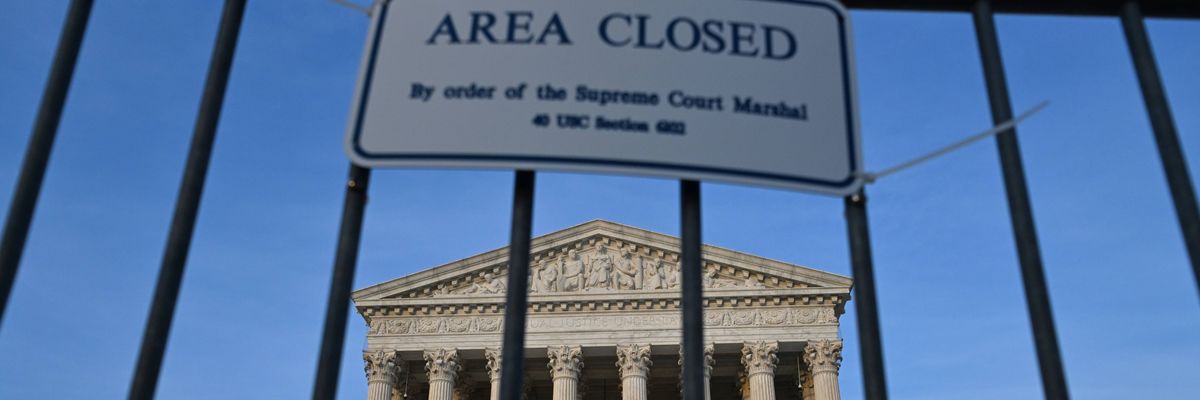
As its conservative majority showed unprecedented deference to President Donald Trump, the US Supreme Court passed what ProPublica described as a “troubling milestone” during the term that ended last October.
For the first time in its modern history, an analysis published Wednesday found, the court decided more cases using its secretive “shadow docket” than using the regular process.
Unlike the so-called “merits docket,” in which cases undergo lengthy periods of review, parties file briefs and make oral arguments for their side, and the justices issue extensive signed rulings explaining their reasoning, shadow docket decisions are expedited and offer little mechanism for accountability.
They are often unsigned, with no final vote count or explanation of the court’s decision, and are often issued within hours of legal action being taken, leaving no time for deliberation or public input.
These cases are meant to be reserved for emergency or temporary interventions. But as Trump has attempted to exert unprecedented executive authority that often brazenly pushes legal boundaries, ProPublica found that the court’s use of the shadow docket has exploded.
The analysis found that during the last Supreme Court term, the court issued 63 decisions on the shadow docket, compared with just 56 on the merits docket. Analyzing more than two decades of decisions by the high court, they found that the court has never come close to issuing this many secret decisions in any previous term.
This is due largely to the Trump administration’s unprecedented petitioning to have cases decided on the shadow docket after elements of the president’s agenda were stymied by lower courts.
As ProPublica explained, the court “has repeatedly green-lit policies of his that lower courts have blocked—and has done so with little to no explanation,” and often the decisions have been highly consequential and “have thrown lower courts’ processes into turmoil and have sometimes directly contradicted longstanding legal precedent.”
On June 23, 2025, after a lower court had ruled that eight men being deported to South Sudan should have due process, the Supreme Court intervened after a request from the administration to stop that order. The men were deported. The majority didn’t issue an opinion justifying its ruling.
Three months later, the Supreme Court voted to allow immigration agents to stop people based on racial or ethnic characteristics while still-ongoing litigation against it proceeded. To justify the decision, Justice Brett Kavanaugh wrote a rare shadow docket opinion that people who were in the country legally would be “free to go after the brief encounter.” These became known as “Kavanaugh stops.” Last year, ProPublica found more than 170 citizens who had been stopped and detained by ICE agents. The more than 50 Americans held even after agents learned of their citizenship were almost all Latino.
And in May, while an election in Louisiana was already underway, the justices allowed the state to immediately redraw its electoral map, removing one of the two majority-Black voting districts. Louisiana can now use that map for the 2026 midterms as part of a nationwide redistricting battle for control of the House of Representatives—an effort touched off by Trump’s call for Republican-led states to create more safe seats for themselves.
An analysis by the legal group Court Accountability in October found that the Supreme Court sided with Trump 90% of the time in the 23 orders included in its analysis of his second administration through October 2025, nearly all of which were issued on the shadow docket.
“The patterns show a court going out of its way to enable Trump,” Stephen Vladeck, a law professor at Georgetown University and a Supreme Court analyst, told ProPublica.
Noting that the American public’s approval of the high court has fallen substantially in recent years, Leslie Proll, a civil rights lawyer and the former director of voting rights at the Leadership Conference on Civil and Human Rights, called the court’s unprecedented secrecy “utterly disgraceful.”
“That hugely consequential cases are decided with no transparency,” she said, “only adds to the court’s illegitimacy and further decreases the public’s confidence.”
From Common Dreams via This RSS Feed.