

Drop Site’s journalism is free to read because thousands of readers choose to fund it. If our work matters to you, please consider making a tax-deductible donation today.
As the memorandum of understanding between the Trump administration and Iran remains on shaky terrain, Israel has made clear it intends to keep its forces entrenched in Lebanon for the foreseeable future. Iran has said that a refusal on the part of President Donald Trump to force Israel to end its war on Hezbollah and southern Lebanon would cross a red line that could jeopardize a potential nuclear deal.
Despite Tehran’s warnings, Trump and Israeli Prime Minister Benjamin Netanyahu have moved forward with a plan to exclude Hezbollah from the Iran deal and they succeeded in enlisting the Lebanese government in their campaign. Iran has maintained it will not tolerate a continuation of the war in Lebanon, but how Tehran will respond remains an open question.
It has been more than 120 days since the war against Iran began with the assassination of Supreme Leader Ayatollah Ali Khamenei. What Trump initially proclaimed as a regime change war that would quickly pave the way for a domestic uprising soon transformed into a quagmire. Iran responded to the U.S. and Israeli war with sustained retaliatory strikes, primarily targeting U.S. military infrastructure in the region and causing an unprecedented evacuation of bases. Tehran also pummeled Israel with nightly barrages of ballistic missiles and drones. Combined with its moves to assert dominance over the strategic Strait of Hormuz, Iran amassed significant leverage as the U.S. began seeking an offramp to the war.
In mid-June, the U.S. and Iran signed a memorandum of understanding that was formally intended to bring a halt to the war and open a path for negotiations on a range of issues, including the future of Iran’s nuclear program. Tehran, however, made clear that it would not proceed toward any long-term deal unless the U.S. compelled Israel to end its war against Lebanon. Since the signing of the MOU, Netanyahu has maneuvered to ensure Israeli forces can remain entrenched in Lebanon, working with the Trump administration to delink Hezbollah from the Iran deal. Hezbollah formally entered the war on March 2 and Iran has insisted that the ceasefire must apply not only to Iran, but to southern Lebanon as well. Israel and the U.S., however, embarked on an alternative path aimed at enlisting the Lebanese government of President Joseph Aoun as their local partner in a campaign aimed at disarming and dismantling Hezbollah.
A subsequent “framework,” signed on June 26, between Israel and Lebanon appears to have succeeded in laying the foundations for that effort. The text of the agreement portrays Hezbollah as an illegal insurgent movement and enables Israeli forces to remain indefinitely in Lebanon until Lebanese Armed Forces enact the “successful disarmament of non-state armed groups and dismantlement of their infrastructure.” Only after this is accomplished would Israeli occupation forces “progressively redeploy out of the Lebanese territory.”
As the U.S. and Iran continue indirect technical talks, there are mounting concerns in Tehran that Trump is simply using the negotiations to prepare for a resumption of the war. Tehran has also said that it will not stand idly by as Israel continues its attacks on Lebanon, pointing out that the MOU explicitly commits the U.S. to end the war.
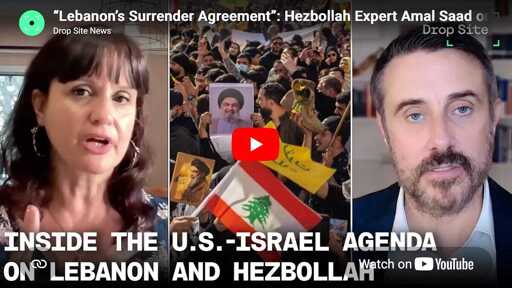
Drop Site’s Jeremy Scahill spoke with Amal Saad, a lecturer on international relations and politics at Cardiff University in the UK who is writing a book on Hezbollah and the Axis of Resistance. In a wide-ranging discussion, Saad offers a comprehensive analysis of the U.S.-Israeli campaign to co-opt the Lebanese government into the war against Hezbollah.
“It’s a form of self-colonization,” Saad said, referring to the recent agreement between Lebanon and Israel. “It’s effectively handing over south Lebanon for Israel to colonize, handing over the people of the south for Israel to genocide and ethnically cleanse. And in exchange, this government will offer civil strife, knowing that even with the civil strife, they probably will still not succeed in disarming Hezbollah.”
Saad argues that while Israel’s aim is to spark a civil war in Lebanon, Iran has indicated it is fully committed to confronting the Israeli occupation. How Iran responds to the U.S.-Israeli maneuvers will have a significant impact on Lebanon’s future.
“Iran is very clearly now arising—it is by far now the strongest regional power. And Hezbollah has also proven that it is much more powerful and definitely not finished, as many had predicted it had been since November 2024. So this agreement does not reflect the political reality on the ground,” Saad said. “We need to wait to see what Iran is going to do next. I think that’s what Hezbollah is sort of banking on—that Iran will not tolerate this for much longer, perhaps even responding with kinetic strikes against Israel.”
Saad and Scahill also discuss Iran’s regional and global position in the post-October 7 world and Saad explains why she believes another regional war is inevitable.
From Drop Site News via This RSS Feed.