

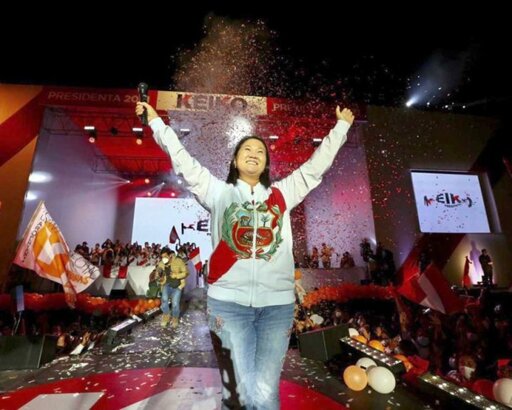
After three weeks of uncertainty, shifting trends during the vote count, and a margin of just a few tens of thousands of votes, Peru now has a president-elect. Far-right candidate Keiko Fujimori won the presidential runoff against Roberto Sánchez and will bring Fujimorism back to the Government Palace, twenty-six years after the fall of the regime led by her father, Alberto Fujimori.
The National Office of Electoral Processes (ONPE) completed the count of 100 percent of the ballots on Monday, June 29 and confirmed her victory with 50.13 percent of the vote, compared to the 49.86 percent obtained by rival candidate Roberto Sánchez. The final margin was just 49,641 votes out of more than 18 million valid ballots, one of the narrowest margins in Peruvian electoral history.
The result must be formally announced by the National Elections Jury, which will resolve the final administrative issues before officially declaring the victory. The presidential inauguration is scheduled for July 28, when Fujimori will replace interim President José María Balcázar to begin a five-year term.
A Vote-by-Vote Count
The election was marked by extreme parity throughout the process. For much of the count, both candidates took turns leading, and it was only in the final days that Fujimori’s lead began to solidify until it became irreversible.
One of the decisive factors was the vote from Peruvians living abroad, where the conservative candidate received significantly more support than she did within the country. In fact, one statistic sums up the exceptional nature of this election: Keiko Fujimori became Peru’s first president to be elected despite receiving fewer votes within the country than her rival. Her victory was made possible by the weight of the overseas electorate, especially in the United States and Europe.
Roberto Sánchez rejected the result and announced that he would not recognize a potential Fujimori administration, alleging fraud in the vote abroad. So far, he has not presented any evidence to support these accusations, while both electoral authorities and international observation missions have ruled out any irregularities that could have altered the result.
The Return of Fujimorism
The election represents much more than a simple change of government. It signifies the return to power of the political movement built by Alberto Fujimori, whose presidency from 1990 to 2000 was marked by sweeping neoliberal economic reforms, the strengthening of the state’s repressive apparatus, and numerous human rights violations for which he was later convicted.
For more than two decades, Fujimorism managed to remain one of the country’s main political forces even without holding the presidency. Keiko Fujimori lost the 2011, 2016, and 2021 elections in succession, but at the same time consolidated a political apparatus with a strong parliamentary presence and an enormous capacity to influence governance. During those years, the Congress — dominated by her far-right party Fuerza Popular — drove the downfall of several presidents and became one of the main factors behind Peru’s prolonged institutional instability.
Her electoral victory also represents a new advance for conservative sectors in Latin America, in a regional context where various right-wing movements have regained positions in government but have failed to establish stable governments. Cases such as those in Bolivia and Chile are clear examples of this situation
The Electoral Map: A Country Split in Two
While the result was close, the electoral map once again revealed a rift far deeper than mere competition between two candidates.
Keiko Fujimori achieved her best results in Metropolitan Lima, across much of the coast, and, especially, among Peruvians living abroad.
There, she gained the support of broad sectors of the business community, professionals, the urban middle class, and voters who identified her candidacy with the promise of restoring political order and combating the rise of organized crime.
In contrast, Roberto Sánchez once again won decisively in the Andean south and in numerous rural regions of the interior, where rural communities and Indigenous peoples — historically left behind by Peru’s economic development — predominate. Although his vote share declined compared to the first round, this is most likely due to his shift to the right, in an effort to appease the powerful sectors. Regions plagued by higher levels of poverty, informal employment, and a weaker state presence overwhelmingly backed a candidate identified with the working classes. In addition, absentee voting and invalid ballots increased.
This territorial distribution reflects much more than a mere geographical difference. It reflects the existence of two profoundly different social realities.
While Lima and the major economic centers concentrate the wealth generated by decades of pure and simple extractivism through the export of minerals and raw materials, vast regions of the interior continue to endure low wages, poor infrastructure, scarce public investment, and enormous social inequalities. That contrast was once again reflected at the polls.
A Society in Crisis
The new president will inherit a country in the midst of a protracted political crisis.
Since 2016, Peru has experienced an uninterrupted succession of governments, impeachments, resignations, and interim presidencies that have severely eroded the legitimacy of its institutions. Compounding this are the rise of organized crime, increasing insecurity, and deep mistrust of the political system as a whole.
The wounds left open by the coup against Pedro Castillo in December 2022 remain fresh, and Castillo remains imprisoned on the false charge of having staged a self-coup. The crackdown on the protests that swept the country in the months that followed left dozens dead, especially in the Andean regions, which today once again voted overwhelmingly against Fujimorism.
For this reason, although Fujimori spoke during the campaign of “national unity” and promised to govern for all Peruvians, a significant portion of the population identifies her political camp with the very same power bloc that backed Castillo’s removal from office and the government that led the repression of those protests.
What the Ballot Box Cannot Resolve
For millions of workers, peasants, Indigenous peoples, and young people, the runoff election represented a chance to prevent the return of Fujimorism to power. The immediate result is a defeat for that political hope. Nonetheless it by no means eliminates the social causes that gave rise to the enormous support Sánchez received in the country’s poorest regions.
Demands for living wages, job security, the strengthening of public health and education, the defense of natural resources, recognition of the rights of peasant communities and Indigenous peoples, and justice for the victims of the repression in 2022 and 2023 will remain relevant regardless of the government’s political affiliation.
Therefore, while the return of Fujimorism represents a victory for the Peruvian right, it also opens up a new landscape for grassroots organizations. The decisive issue is not merely who governs, but who has the capacity to impose their interests on society.
Workers, peasants, Indigenous peoples, youth, and the working classes need to build their own strength to fight for living wages, job security, funding for health care and education, the defense of natural resources, democratic rights, and better living conditions for the vast majority. All of this must be viewed through the lens of a government of workers, peasants, Indigenous peoples, and the working classes — one based on democratic bodies emerging from their own organization and mobilization.
As the experiences of Peruvian and Latin American history itself show, these achievements have been the result of the independent organization and sustained mobilization of workers, peasants, students, and Indigenous peoples.
On July 28, Keiko Fujimori will once again place Fujimorism at the helm of the Peruvian state. But the political struggle that has raged in recent years is far from over. The close election result confirmed the return of the right to power, though it also made clear that the country remains deeply divided and that the social causes that fueled the rejection of the current model remain intact.
This article was first published in Spanish at La Izquierda Diario on June 29, 2026.
The post Far-Right Keiko Fujimori Wins the Presidential Election in a Divided Peru appeared first on Left Voice.
From Left Voice via This RSS Feed.