

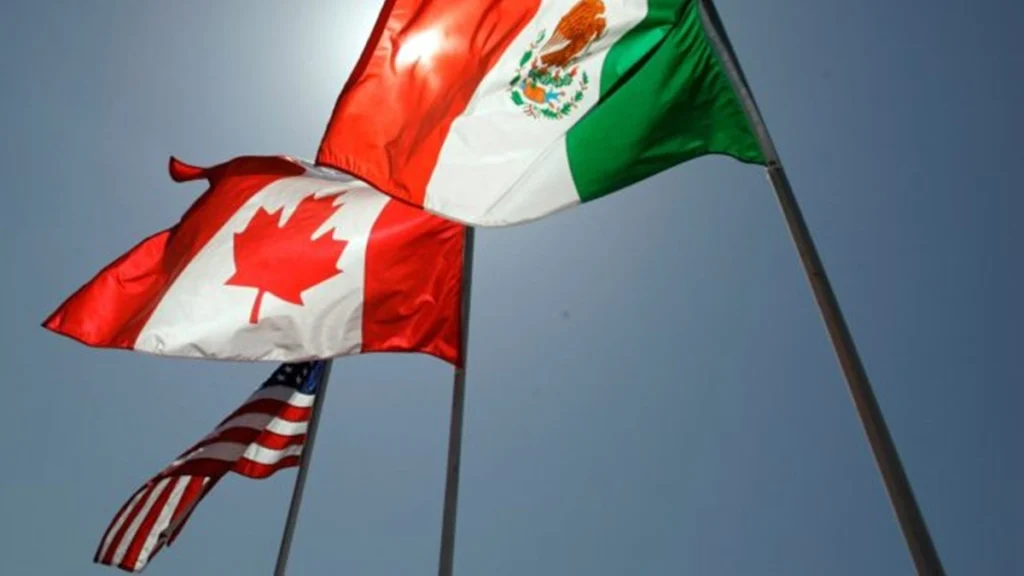
Washington is not currently willing to automatically extend the USMCA for another 16 years.
On Wednesday, Mexican Economy Minister Marcelo Ebrard said that Mexico and Washington remain divided over several trade issues as the United States-Mexico-Canada Agreement (USMCA) comes up for a joint review in July.
RELATED:
Supreme Court Allows Trump to Reject Asylum Seekers at U.S.-Mexico Border
Ebrard made the remarks at a press conference following a remote meeting with U.S. Trade Representative Jamieson Greer and Dominic LeBlanc, Canada’s minister in charge of U.S. trade.
During the meeting, Greer confirmed Washington is not currently willing to automatically extend the USMCA for another 16 years. The three regional partners are working to review the 2020-36 free trade deal before it is renewed.
Ebrard reiterated Mexico’s opposition to U.S. tariff measures imposed on its steel, aluminum, and automotive products, as well as to establishing seasonal import schemes for agricultural products.
He noted a key issue in negotiations will be updating the rules of origin and mechanisms to verify compliance, particularly in light of new provisions the U.S. administration seeks to incorporate. In addition, the USMCA review process will include a new chapter on economic security.
The new topic concerns access to strategic minerals and the protection of supply chains amid rising global economic and geopolitical tensions. Ebrard said a U.S.-Canadian trade meeting is scheduled for July 20.
Today, the United States, Mexico, and Canada met virtually to discuss the operation of the USMCA.
The United States did not agree to renew the USMCA in its current form. However, the Agreement remains in force pending resolution of these issues or until the Agreement’s…
— United States Trade Representative (@USTradeRep) July 1, 2026
The USMCA is the foundation of North American integration
The United States-Mexico-Canada Agreement replaced the North American Free Trade Agreement (NAFTA) after entering into force on July 1, 2020. It was negotiated during President Donald Trump’s first administration and signed in 2018 by the leaders of the United States, Mexico and Canada.
It preserves duty-free access for most goods traded across North America while updating the rules governing digital commerce, intellectual property, customs procedures and labor and environmental standards.
The USMCA introduced stricter requirements for the automotive industry, including higher regional content thresholds and labor value rules aimed at encouraging vehicle production and higher-wage manufacturing within North America.
It also expanded market access for certain agricultural products, strengthened protections for intellectual property, and established new provisions for digital trade that were not included in NAFTA, reflecting the growth of e-commerce and cross-border data flows.
The agreement is widely regarded as the foundation of North American economic integration, supporting one of the world’s largest trading blocs. The three member countries conduct more than US$1.8 trillion in annual merchandise trade, with highly integrated supply chains spanning industries such as automotive manufacturing, agriculture, energy and electronics.
teleSUR/ JF
Source: EFE – teleSUR
From teleSUR English via This RSS Feed.