

New polling from YouGov has shown that many lesbian, gay, and bi people have abandoned the Labour Party since the 2024 election:
NEW | Following Labour’s attacks on trans people, Labour support amongst lesbian/gay/bi Brits* has plunged
Grn: 40% ( +23 )
Lab: 18% ( –24 )
Lib: 13% ( –3 )
Ref: 12% ( +4 )
Con: 8% ( –2 )
Via YouGov, 2 – 22 June (+/– vs GE24)
––
*Trans voters not surveyed pic.twitter.com/UhKxBognrc— Stats for Lefties
(@LeftieStats) July 1, 2026


Labour let downs
YouGov polled people by sexuality and gender. The results for heterosexual and not heterosexual were:
Heterosexual
Ref: 26%
Con: 21%
Lab: 18%
LD: 13%
Grn: 12%
Rst: 4%Not heterosexual
Grn: 40%
Lab: 18%
LD: 13%
Ref: 12%
Con: 8%
Rst: 2%
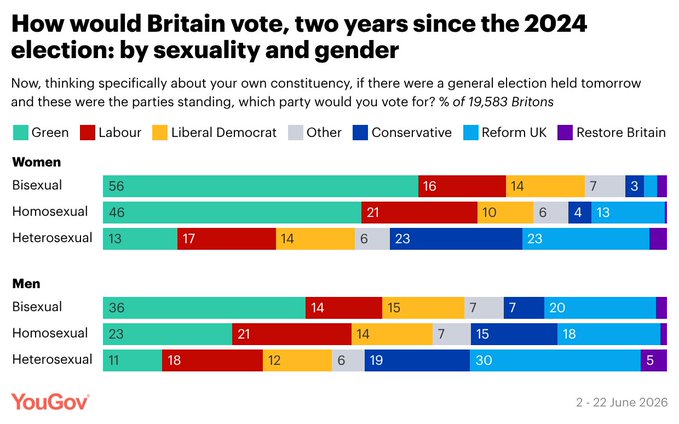
Divided by gender, the results looked like this:
When it comes to the Keir Starmer government, there are obvious reasons for LGBTQ+ voters to have turned on Labour. The most obvious is the party’s handling of trans rights, with Rachel Charlton-Dailey writing for the Canary in November 2025:
The Health Minister Wes Streeting was the subject of a year’s worth of protesting by Trans Kids Deserve Better after a slew of anti trans policies, including banning puberty blockers for trans teens and supporting the EHRC guidance that says trans women aren’t women. The Labour Party is also, of course, the political home of humongous transphobe Rosie Duffield.
Evidently, attacks on trans people are an attack on all queer communities.
Alternatives
One of the Green Party’s particular areas of strength is among those who do not identify as heterosexual, with the party holding as much as a 56% vote share among bisexual women, while also leading by significant margins among lesbians (on 46% of the vote) and bisexual men (on 36%).
The Greens hold a lower 23% vote share among gay men, though this is still roughly twice their level of support among both straight men and women (11-13%). Again, though, this is in part influenced by gay and bisexual Britons tending to be younger than straight Britons.
By contrast, Reform UK do better among straight Britons, though with the gender gap still very much apparent. Indeed, Nigel Farage’s party does nearly as well among gay and bisexual men (18-20%) as among heterosexual women (23%), while falling to the low single digits among bisexual women.
LGBTQ+ people recognise that Reform will be no better than Labour – and likely much worse. Reform UK councils spent June banning Pride events and literature from libraries. Nigel Farage and others have also spoken about banning “the poisonous trans ideology in our schools”.
When Farage speaks about “trans ideology”, he’s talking about the acknowledgement that trans people exist. We’ve been here before with ‘Section 28‘, which was introduced by Margaret Thatcher:
On 24 May 1988, in the face of widescale protests from LGBTQ+ activists and allies, the Local Government Act was passed. Within the Act was Section 28 – a seemingly small addition to the earlier Local Government Act 1986. It prohibited local authorities from ‘promoting homosexuality by teaching or by publishing material’ and from teaching ‘the acceptability of homosexuality as a pretended family relationship’.
As we all know, prejudice never ends with just one group.
Downfall
To be clear, Labour hasn’t just lost lost support with lesbian, gay, and bi people; it’s lost support with basically everyone. As YouGov noted:
Just two years on from winning a landslide majority in the 2024 general election, Keir Starmer is on his way out as prime minister, having presided over a significant collapse in support for Labour, at a time when wider voting patterns have been transformed by substantial changes in the British party system.
It remains to be seen if Andy Burnham can win these voters back. As he’s already aligned himself with the Starmer government’s attitudes towards trans people, though, we have considerable doubts.
Featured image via the Canary
By Willem Moore
From Canary via This RSS Feed.