


Amelia Schafer
ICT
MENOMINEE, M.I. – No one can remember the last time a Menominee person rode a traditional dugout canoe, or Maeqtek-ōs, down the Menominee river. This week a group of Menominee water protectors aims to change that when they launch their brand new, hand-crafted canoe into the river and paddle it 48 miles south.
“It’s making a statement, we’re making history,” said Wayne Swett, who spent over two weeks camped out at the Chappee Rapids Weber Learning Center just north of Menominee, Michigan, working on the canoe. He’s got the heat blisters to prove it.
Since June 15, Menominee water protectors Dawn M. Wilber and Swett have camped out on the banks of the Menominee river burning, scrapping, debarking and sanding a 17-foot-longpinelog into the premiere method of transportation used by their ancestors and hundreds of thousands of other Woodland people for centuries. Their bodies are sore, their arms are burnt, either from the sun or the fire itself, but they continue to work, Wilber said.
It’s a community effort, Wilber said. Every day different friends and visitors come by the camp to bring supplies, chat and help out, Wilber said. The pine log itself was donated by Menominee Tribal Enterprises.
“I wake up in the middle of the morning or late at night and my legs are sore (from working),” Wilber said. “It’s a lot of work, it really is. And it’s a suffrage of sort, you know,
to try to do this and bring it back to this area because we don’t know when the last time somebody, a Menominee, built a dugout canoe on this river. Well, this year we can say (we did) in 2026.”

This 17 foot long canoe was the traditional boat of choice for Indigenous people across the North American woodlands for thousands of years. Credit: Amelia Schafer, ICT
This year marks the group’s eighth annual canoe journey down the Menominee River, and this year, the Protectors of the Menominee River wanted to make it even more special.
“When we go down the river, the first two days, I like to reconnect and put myself in a time
frame of what it was like back in the day, when the river used to be the highway,” Swett said. “There used to be no roads. There used to be animal trails. Those used to be the roads,
the animal trails through here. And then (the river) used to be the highway and canoes were the family car.”
On this year’s canoe journey, they’re not just taking the family car for a spin, they’re building it.
From the banks of the Menominee River at the site of a historic 1824 trading post, Swett and Wilber are hard at work making history. The camp is nestled right in the center of an area the Menominee people have called home since time immemorial. To the north are Menominee burial mounds, a traditional dance ring and the largest Indigenous agricultural site in the eastern U.S. To the south is the Menominee peoples’ birthplace where the Menominee river meets lake Michigan.

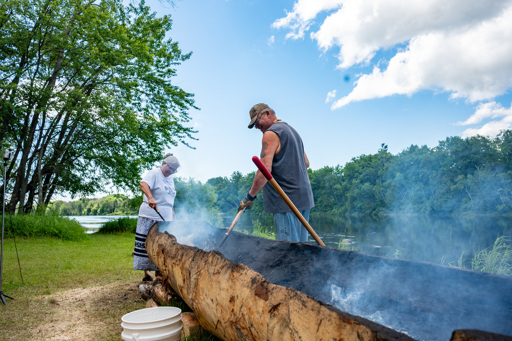
The dugout canoe’s construction took over two weeks and involved an average of 7-8 hours of burning per day. The canoe will be rowed down the Menominee River starting on July 2. Credit: Amelia Schafer, ICT
Prior to colonization, countless Menominee families navigated this river in dugout canoes during their day-to-day lives – as did countless other Indigenous families in the North American eastern woodlands.
Wisconsin is believed to hold the second largest collection of dugout canoes in the nation after Florida, with 73 confirmed existing dugout canoes in the state, some of which are between 4,000 and 6,000 years old according to the University of Wisconsin-Madison.
Most recently, 16 canoes were discovered submerged in Lake Mendota in Madison, the oldest of which is an estimated 5,400 years old.
Canoes were traditionally sunk at the end of the year before winter set in to preserve them and prevent the wood from cracking. Eastern Native people would use large rocks to sink their dugout canoes down into the riverbeds and recover them later on. In turn, this practice led to the preservation of hundreds of thousand-year-old canoes across North America, many of which are still being uncovered.

Long-time friends Dawn Wilber and Wayne Swett work on a traditional dugout canoe near Menominee, Michigan. The pair aim to make history as the first Menominees to row a dugout canoe down the Menominee river in generations. Credit: Amelia Schafer, ICT
Despite the canoe’s cultural significance, they’re rarely used anymore let alone constructed, leading Swett and Wilber to travel to the Mashantucket Pequot Nation in Connecticut to learn.
“Learning from them is almost as good as learning from our ancestors,” Wilber said.
In 2015, the Mashantucket Pequot nation gathered to build its first dugout canoe in the modern era, called a mishoon in Pequot. The boat built by the Pequots in 2015 is believed to be the first dugout canoe constructed in over 200 years. Since then, the tribe has taught other woodland tribes how to construct their own.
The Menominee water protectors were taught that, traditionally, woodland tribes would start burning their dugout canoes in the morning and leave it burning as they worked, burning for roughly seven hours a day over the course of two weeks, Wilber said. The canoes were communal, no one family had their own, meaning the tribes would share several canoes among themselves.

Dawn Wilber chips charred wood from a dugout canoe. Indigenous people of the North American eastern woodlands created and used these boats for thousands of years. Credit: Amelia Schafer, ICT
Once the log arrived on June 14, Swett and Wilber brought it downto the banks of the Menominee river and began debarking it, a process that took an entire eight hours.
After debarking, Swett shaped the exterior canoe with a saw to create the stern of the boat and the bow. Then they could finally begin the bulk of the process – using fire to burn the log down and hollow it out.
“It was a pretty spiritual moment when I first lit the first fire,” Wilber said. “We burned
it that night probably for about four or five hours and it got a good little divot in it. It was the most amazing campfire I think that I ever sat around.”
When it comes to burning the log down to hollow it out and shape it to form, there’s several different methods utilized. One method involves burning a separate fire nearby and bringing over coals to place on top. The coals gradually melt down the wood that is then shaped to create the interior of the boat. Alternatively, several smaller fires can be lit on top of the log rather than creating a separate fire – a method that can be faster and works similarly.
Using a small, portable air blower, Swett kept the fires lit throughout the day, helping guide them in the necessary directions to adequately shape the canoe.
“If the ancestors had access to this (air blower) they’d use it too,” Swett said as he worked.
Feeling the bottom of the boat, Swett and Wilber said they’re able to gauge the depth of the interior based on the heat radiating from the fires inside. As the heat works its way through, it releases the sap within the tree and creates a natural waterproof seal around the vessel.
While the fire did its job, Wilber and Swett chipped away at the charred inside using different metal tools. By removing the charred bits, the fire can better access the remaining wood.

Dawn Wilber and Wayne Swett work on their dugout canoe on the banks of the Menominee River in the Upper Peninsula. The pair aims to make history as the first Menominees to row the dugout canoe down the river in generations. Credit: Amelia Schafer, ICT
Starting this week, the dugout canoe will travel 48 miles on the Menominee River from Anaem Omot (the Sixty Islands Archaeological site) to the Menominee people’s birthplace, Minikaneh, the mouth of the Menominee river between Menominee, Michigan and Marinette, Wisconsin. The journey will last four days.
Both the construction of the new dugout canoe and the canoe journey as a whole are healing, Swett said.
“I suffer from PTSD so it’s a grounding for me,” Swett said. “It keeps me grounded and I wouldn’t have it any other way.”
The idea to start the canoe journey came from a conversation between Swett and Wilber eight years ago, Wilber said.
“We were talking and said, ‘When’s the last time a Menominee canoed down this river?’” Wilber said. “And he (Swett) said ‘I want to canoe down this river.’ And I did too.”
For nearly eight years now they’ve made that journey, but this year it looks a little different with the addition of the traditional dugout canoe.
The group behind this historic moment, Protectors of the Menominee River, is an Indigenous grassroots organization formed to ensure the protection of the area. The annual canoe journey began both as a way to connect to their traditional homelands but also as a way to take a public stand in opposition to a proposed open-pit sulfide mining operation by Canadian-based company Aquila Resources.
The mining project aims at targeting zinc and gold deposits in Menominee County, Michigan, just 150 feet from the Menominee River and in the middle of a site filled with Menominee cultural artifacts, historical sites and burial mounds.

Dawn Wilber and Wayne Swett work on their dugout canoe on the banks of the Menominee River in the Upper Peninsula. The pair aims to make history as the first Menominees to row the dugout canoe down the river in generations. Credit: Amelia Schafer, ICT
“This is our creation spot, this is where the Menominees were born,” Swett said. “It’s special. How would you like it if somebody came into a cemetery and took grandma buried up or covered grandma and pushed her someplace else? You’d be protective about that too.”
The Sixty Islands area was recently identified as hosting the largest intact remains of an ancient Native American agricultural site in the eastern United States. But the Menominee people have known for generations that this is where they were born and where many of their ancestors lie.
Aside from the complex, intact agricultural site, the area contains a traditional dance ring, a building foundation, a logging camp, looted burial mounds, unknown burial mounds and an additional singular burial mound.
Swett and Wilber said they’ve used the boat’s construction as an opportunity to teach other Menominee people about the area and the boat’s history. The first week of construction they were visited by a group of Menominee High School students and on June 26 they were visited by a group of Menominee elders from the reservation roughly 60 miles west of the site.
“I’ve been explaining the process to them, telling them that it’s a teaching moment on why we’re doing it, how we’re doing it,” Swett said. “I advised them (the youth) that they’re the next generation of water protectors. So now that we ran them through, we’re inviting everybody else to come check it out. It’s a teaching moment for everybody because history is being made.”
Swett and Wilber said they plan to sink their canoe to preserve it after this year’s journey, just like their ancestors did.

The Menominee River separates Wisconsin from Michigan’s Upper Peninsula and is the ancestral homelands of the Menominee Nation. The Menominee people were born at the mouth of the river where it meets Lake Michigan. Credit: Amelia Schafer, ICT
The post Making history on the Menominee River appeared first on ICT.
From ICT via This RSS Feed.