

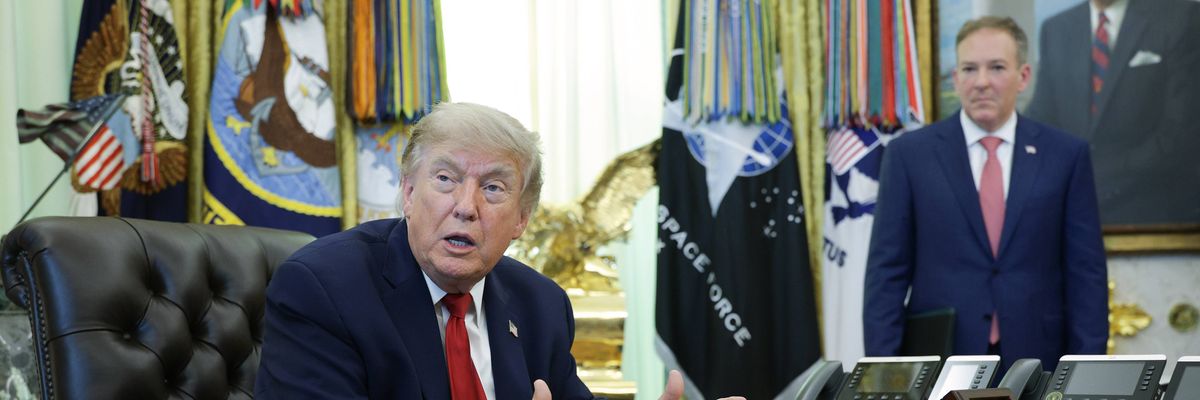
Environmental and public health advocates on Wednesday ripped the US Environmental Protection Agency’s fifth approval of a “forever chemical” pesticide during the current term of President Donald Trump, who campaigned on a promise to “Make America Healthy Again.”
Despite that pledge, Trump’s second administration—much like his first—has served the pesticide industry in various ways, including by putting out a MAHA report that echoes industry talking points, installing a former industry lobbyist in a key EPA post, backing Bayer-owned Monsanto over cancer patients at the US Supreme Court, and issuing an executive order that mandates the production of glyphosate.
Under Trump, the EPA has also approved or reapproved various controversial pesticides, from atrazine and dicamba to trifludimoxazin, which was approved late Tuesday. Like diflufenican and epyrifenacil, which were authorized by the EPA earlier Tuesday, as well as cyclobutrifluram and isocycloseram, which got a green light from the agency last November, trifludimoxazin is what some scientists and campaigners call a forever chemical pesticide.
Per- and polyfluoroalkyl substances (PFAS)—which have been used in not only pesticides but also fabrics, firefighting foam, nonstick cookware, and other household products—are widely known as forever chemicals because they don’t break down naturally. They’re also linked to a range of health issues, including various cancers.
“This is the PFAS presidency brought to you by Donald Trump and EPA Administrator Lee Zeldin,” Nathan Donley, environmental health science director at the Center for Biological Diversity, declared Wednesday.
As with his Tuesday critique of the Trump EPA approving diflufenican and epyrifenacil, Donley pointed to the Supreme Court’s recent ruling in favor of Trump-backed Bayer, rather than the thousands of Americans who argue that Monsanto’s glyphosate-based weedkiller Roundup caused their cancer.
“Waiting to open the floodgates on new pesticide approvals until after the Supreme Court granted immunity to pesticide companies takes a special kind of callousness,” he said.
Bill Freese, science director at Center for Food Safety (CFS), similarly said Wednesday that “with yesterday’s pesticide approvals, the Trump administration’s EPA is once again showing its disdain for Americans’ health and the natural world.”
“The EPA’s pesticide division is seemingly no longer able to recognize evidence that a pesticide causes cancer, even when it’s the pesticide company’s own studies that show it,” he continued. “And as per usual, EPA dismisses out of hand incriminating independent studies by scientists not affiliated with the pesticide industry.”
In addition to the PFAS pesticides, the EPA is under fire this week for approving new uses for chlormequat, a non-PFAS pesticide tied to reproductive issues, and the fungicide fluoxapiprolin.
CFS co-executive director Sylvia Wu pointed out that the agency dismissed studies showing that fluoxapiprolin and epyrifenacil both produce tumors in laboratory rodents and classified both as “not likely to be carcinogenic to humans.”
“The EPA’s illegitimate rejection of the evidence that these two pesticides cause cancer is very similar to the tricks it pulled in denying glyphosate could cause cancer,” Wu said. “These blatant violations of the agency’s own cancer guidelines are unacceptable.”
As for chlormequat, Freese said that “EPA should never have approved this endocrine-disrupting pesticide, particularly since its persistence and potential for widespread use on wheat and other widely consumed grains will mean universal exposure.”
Already, “chlormequat is found in the urine of 90% of Americans, thought to come mostly from residues on imported foods where the pesticide has been used,” the Center for Biological Diversity noted Wednesday. Like Freese, the group warned that “approval of its use on US wheat and oats ensures that exposure to the US population will increase dramatically.”
From Common Dreams via This RSS Feed.