

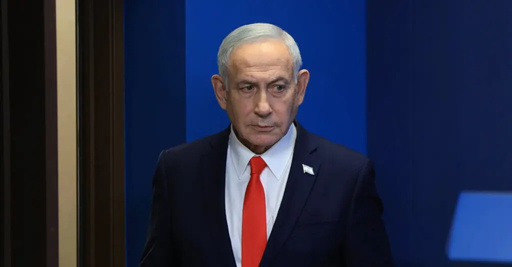
The New York Times, the US’s most powerful establishment news outlet, has reported on President Donald Trump’s “memorandum of understanding” with Iran from a pro-war and/or pro-Israel perspective. Why did Trump end the war without limiting Iran’s “nuclear program” and its support for “proxy forces,” or without conducting “regime” change? These are the questions that have preoccupied the paper of record’s news reporting.
As I’ve noted before (FAIR.org, 3/30/26), multiple Times employees are reporting from and currently living in Israel, despite Israel’s blanket censorship policies, not to mention its killing hundreds of journalists. Meanwhile, the paper has no reporters in Iran, a situation it blames on Iran’s press restrictions.
This editorial decision has no doubt contributed to the paper covering the memorandum from an Israeli perspective, which is not aligned with the 59% of the US adult population who say the US using military force in Iran was the wrong decision.
‘Frightening new reality’
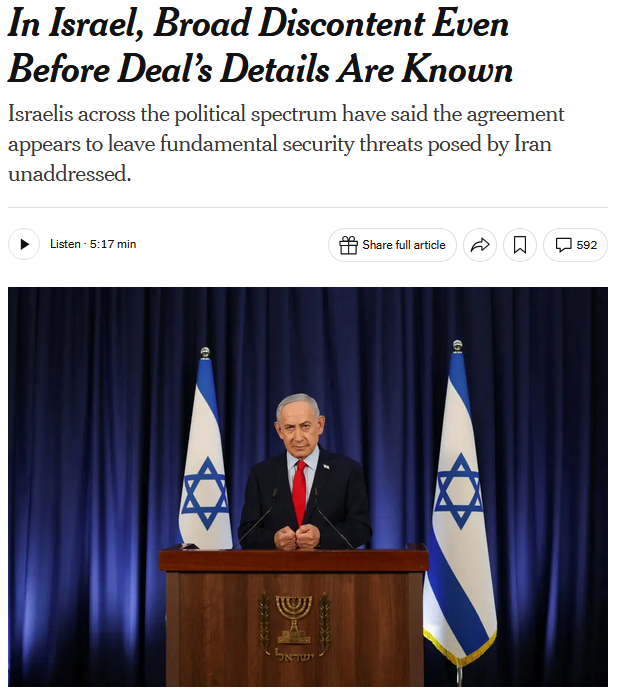
The New York Times (6/14/26) reports that Israel faults a deal that Iran agreed to for not “creating the conditions for the collapse of the Iranian government.”
Over its first article (6/14/26) published about the memorandum, the New York Times headline read, “In Israel, Broad Discontent Even Before Deal’s Details Are Known.” The subhead noted that “Israelis across the political spectrum have said the agreement appears to leave fundamental security threats posed by Iran unaddressed.”
The piece, by Times Jerusalem correspondent Isabel Kershner, uncritically granted anonymity to an “Israeli who had been briefed on the deal with Iran” to “discuss diplomacy.” They listed their “main problems” with the proposal: “no clear answers regarding the treatment of Iran’s stockpile of enriched uranium, and not enough curbs on Iran’s nuclear program,” no “conditions for the collapse of the Iranian government” and “no clear mechanism for forcing Iran to halt its support for its proxy forces.”
One day later, the Times (6/15/26) published an article headlined “Israel Counts the Ways That Netanyahu’s Iran Strategy Failed.” Times Jerusalem bureau chief David M. Halbfinger and Tel Aviv staff writer Ronen Bergman noted that the agreement “omits some of the most important things Israel wanted.”
These “important things” included “to curb Iran’s ballistic missile arsenal” and “its funding of regional proxies like Hezbollah in Lebanon and the Houthis in Yemen, who have attacked Israel with their own arsenals.” The deal “could help Iran bolster those proxies by easing sanctions, which would allow billions of dollars to flow into its bank accounts,” Halbfinger and Bergman added.
‘Catastrophic capitulation’
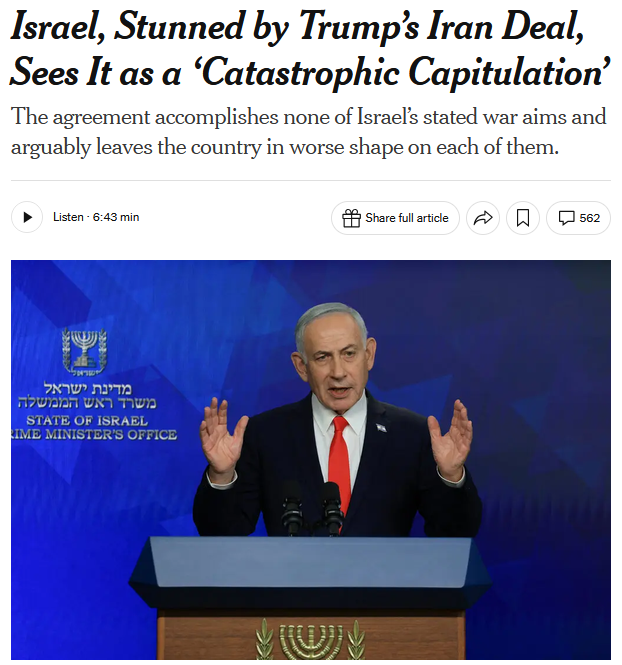
The New York Times (6/18/26) says “Israel awoke to a frightening new reality”—one that “seeks to handcuff Israel” by forcing it to withdraw from a country it invaded.
Three days later, Halbfinger published an article (6/18/26) headlined “Israel, Stunned by Trump’s Iran Deal, Sees It as a ‘Catastrophic Capitulation.’”
This time, Halbfinger wrote that
Israel awoke to a frightening new reality on Thursday as it absorbed, with disbelief and largely in silence, the terms of President Trump’s preliminary agreement to end the war with Iran.
Halbfinger noted that “it accomplishes none of Israel’s war aims, analysts and officials said, and arguably leaves the country in worse shape on each of them.” Among those aims? “Regime change,” “ballistic missiles and proxy militias” and “Iran’s nuclear program,” listed Halbfinger.
Uncritically parroting Israeli government talking points that frame Israel as the victim is journalistic obfuscation at best: Israel privately lobbied to assassinate Iran’s lead negotiator and to “restart the war with a new round of strikes targeting the country’s oil infrastructure” (Capital and Empire, 5/28/26), and it insists it has the right to continue ethnically cleansing Lebanon.
‘One of the biggest challenges of his career’
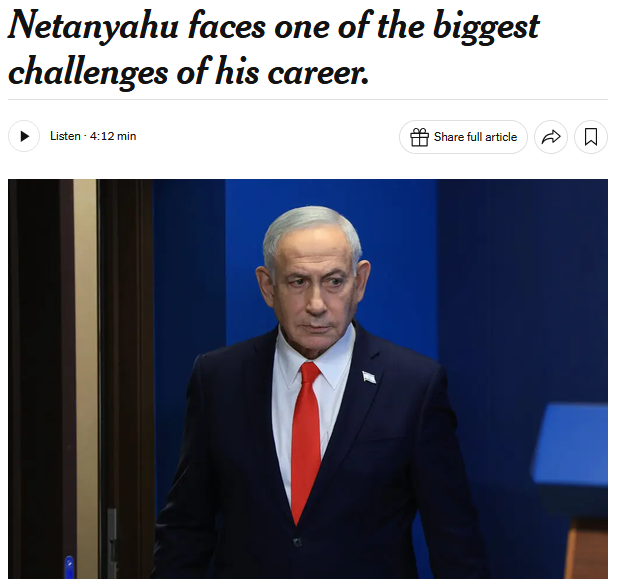
The New York Times (6/21/26) says Israeli Prime Minister Benjamin Netanyahu is “fighting for his political survival”—as opposed to the Palestinians, Lebanese and Iranians Netanyahu would like to keep bombing, who are fighting for their actual survival.
One week after her first article about the memorandum was published, the Times’ Kershner wrote another article (6/21/26) headlined “Netanyahu Faces One of the Biggest Challenges of His Career.”
Her thesis was that Netanyahu “is fighting for his political survival” due to “the emergence of a peace deal that Israel is not a party to.” Kershner wrote that Netanyahu “has staked his career on preventing Iran from developing nuclear weapons, which Israel views as an existential threat.”
Kershner, like Halbfinger and Bergman, ignored the fact that Iran has upheld its promise not to build a nuclear weapon (Arms Control Association, 2/25). By contrast, Israel—not Iran—is the only country in the Middle East to possess nuclear weapons, and the US remains the only country to ever use a nuclear weapon in war.
Kershner wrote:
The agreement seeks to curtail Israel’s freedom of action in Lebanon, where the Israeli military has been fighting Hezbollah, the Iran-backed proxy militia on its doorstep. The deal makes no mention of curbing Iran’s ballistic missiles, which Iran has used to attack Israel and US Gulf allies during the wars. And it leaves the nuclear issue to be addressed in further negotiations.
Framing Israel’s killing of more than 4,100 people in Lebanon and displacement of 1.2 million since March (Drop Site News, 6/22/26), as “Israel’s freedom of action” insinuates that Israel is entitled to occupation and ethnic cleansing. And by noting that Iran has used its ballistic missiles “to attack Israel and US Gulf allies during the wars,” Kershner ignored which two countries attacked the other first, and which country used its ballistic missile arsenal to defend itself against further attacks (PBS, 6/18/26; Middle East Eye, 6/23/26).
‘A let down and reality check’
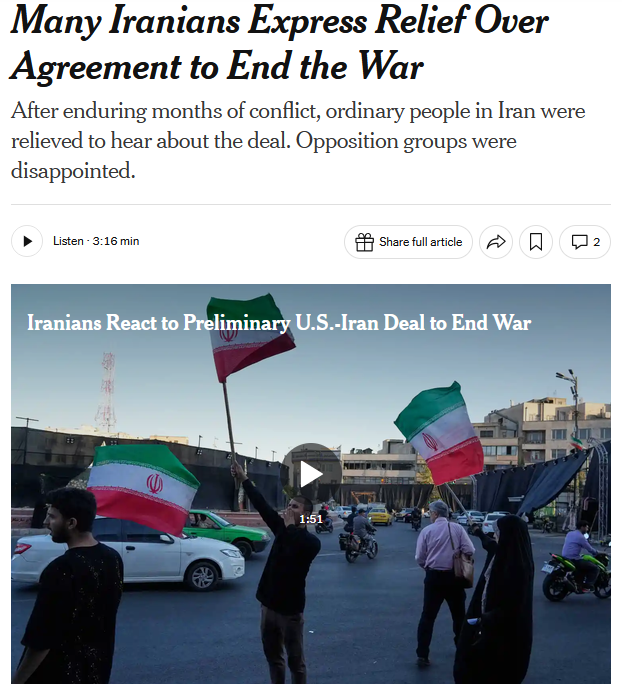
In a New York Times piece (6/15/26) on Iranian reaction to the deal, there is no criticism of the US or Israel, other than an attack on Trump from “a monarchist political activist in Washington who has supported the war against Iran.”
As for the Iranian perspective, the Times published an article (6/15/26) headlined “Many Iranians Express Relief Over Agreement to End the War.” The subhead read, “After enduring months of conflict, ordinary people in Iran were relieved to hear about the deal. Opposition groups were disappointed.”
The Times’ Farnaz Fassihi noted that
Iranians expressed a range of emotions over the agreement to end a war that killed thousands across the region and brought enormous loss with no gain for millions of others.
Fassihi quoted just two sources based in Tehran, one of whom she interviewed by telephone, the other by text message. One asked, “What was the point of this war? What did it bring us exactly?” The other asked: “Is this REAL? Are they serious?”
Fassihi added that
for Iranian opposition groups and some members of the diaspora who had hoped the war would topple the Islamic Republic, the agreement was both a let down and a reality check.
Fassihi cited a social media post by Behnam Amini, a “monarchist political activist in Washington who has supported the war against Iran.”
Fassihi also noted:
In Iran, a minority within the hard-line political faction—those who ideologically favor destruction of Israel and war with the US by any means—unleashed fury at Foreign Minister Abbas Araghchi and Gen. Mohammad Bagher Ghalibaf, the lead negotiator and speaker of parliament.
The piece was unable to quote a source that expressed explicit opposition to the US/Israel’s attacks on Iran—which suggests the limitations of the Times’ long-distance approach to covering Iranian opinion.
From FAIR via This RSS Feed.