

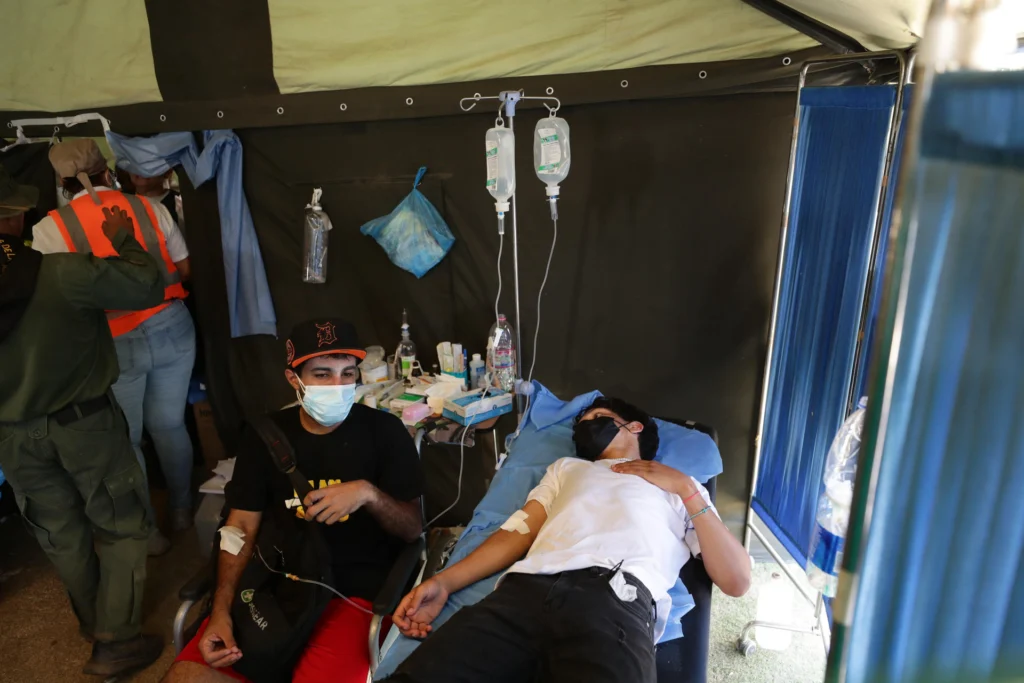
Venezuela has activated more than 50 temporary camps in Caracas to provide integral care for families affected by the double earthquake of magnitudes 7.2 and 7.5 that struck on June 24.
The Venezuelan Government, through the Ministry of Communication and Information, enabled over 50 transitory shelters across the capital, each equipped with medical supplies, food, hygiene kits and basic furniture to guarantee habitability, nutrition, hydration and psychological support for the displaced.
The flagship site was adapted to host a survivor native group originally residing in the coastal town of Caraballeda; this population suffered severe material losses after the teluric movement.
RELATED: Venezuela Declares Seven Days of National Mourning After June 24 Earthquakes
State brigades deployed to the camps deliver a multidimensional support package that includes elementary medical consultations, trauma‑containment therapy, educational activities and recreational programs aimed at children, adolescents and youth.
Psychological teams are present in each shelter to address trauma, especially among children and the elderly, while mobile clinics provide vaccinations, wound care and chronic‑disease management. The response follows the national civil‑protection plan, which prioritises the preservation of life and the swift restoration of basic services after an earthquake.
Community leaders stressed that these efforts allow them to face the recovery phase with dignity, faith and hope, while maintaining direct dialogue with authorities to plan a safe re‑settlement into new sovereign housing solutions.
Ver esta publicación en Instagram
Una publicación compartida de teleSUR English (@telesurenglish)
Infrastructure and Seismic Trend
Engineering surveys conducted nationwide have identified 855 buildings that suffered damage as a direct result of the seismic activity. Of these, 189 structures experienced total collapse, creating immediate hazards that require urgent demolition or reinforcement before reconstruction can begin.
Seismological monitoring continues to show a progressive decrease in both the frequency and magnitude of aftershocks. Since the main shock, monitoring stations have logged 689 subsequent movements, with the latest data indicating a clear trend toward geological stabilization of the fault systems involved. Scientists from the Venezuelan Foundation for Seismological Research (FUNVISIS) note that while the aftershock sequence is weakening, residual stress remains, and they advise continued vigilance, particularly in zones where soil liquefaction or landslide risks have been identified.
Authorities have reiterated the importance of maintaining strict safety protocols for any rescue, debris‑removal or temporary‑housing construction, urging engineers and workers to comply with updated building codes that incorporate seismic‑resilience standards.
Parallel to physical reconstruction, the Government is activating a nationwide census via the Homeland (Patria, in Spanish) System to register health workers, firefighters and military personnel whose homes suffered severe damage, ensuring their temporary relocation to hotels in the capital while permanent, sovereign housing solutions are designed.
Rescue Efforts
Parallel to the camp operation, the President of the National Assembly, Jorge Rodríguez, presented a detailed balance six days after the twin quakes. According to his report, rescue brigades saved 6,461 people alive from the rubble, describing the work of security forces as a heroic feat of bravery and tenacity, especially in La Guaira, which was declared a disaster zone.
Authorities, together with drone‑based surveys, estimated that around 30,000 citizens were located in the parishes of Caraballeda and Catia La Mar at the moment of the earthquake; up to 13,500 people self‑evacuated via personal routes to health centres.
The global task force assembled to mitigate the emergency comprises 26,121 officials from Civil Protection, Firefighters, the Bolivarian National Police and the Bolivarian National Armed Forces, coordinated with 51 international assistance delegations, 3,660 foreign specialists and a civil volunteer corps of 15,467 individuals registered in the system.
Humanitarian aid continues to flow: the nation has received an audited total of 707,063 metric tons of assistance from other countries, counteracting opposition‑driven disinformation about supply flows. The W.H.O. and other UN agencies have praised the coordinated state response and the spirit of popular solidarity, noting that the combined effort has helped stabilize health conditions, prevent further loss of life and lay the groundwork for reconstruction.
Authorities reiterated that field operations will persist with technical rigor to guarantee the integral well‑being of the affected people, while accelerating the distribution of basic inputs and conducting structural diagnostics in the damaged northern belt. The overarching goal remains to replace the destroyed dwellings, permanent housing as swiftly as possible, ensuring that the displaced can return to safe homes.
Ver esta publicación en Instagram
Una publicación compartida de teleSUR English (@telesurenglish)
Earthquake Impact
The consolidated balance showed a figure of 1,943 dead, 10,571 injured and 15,866 affected, who receive comprehensive care and food supply in the 14 emergency shelters activated on the central coast and another 55 distributed in Caracas and Miranda.
In the area of infrastructure, engineering surveys account for 855 buildings affected throughout the country, including 189 total structural collapses, while seismology reports show a progressive decrease in the frequency and magnitude of replicas, accumulating a total of 689 subsequent movements with a tendency towards geological stabilization of faults.
From teleSUR English via This RSS Feed.