

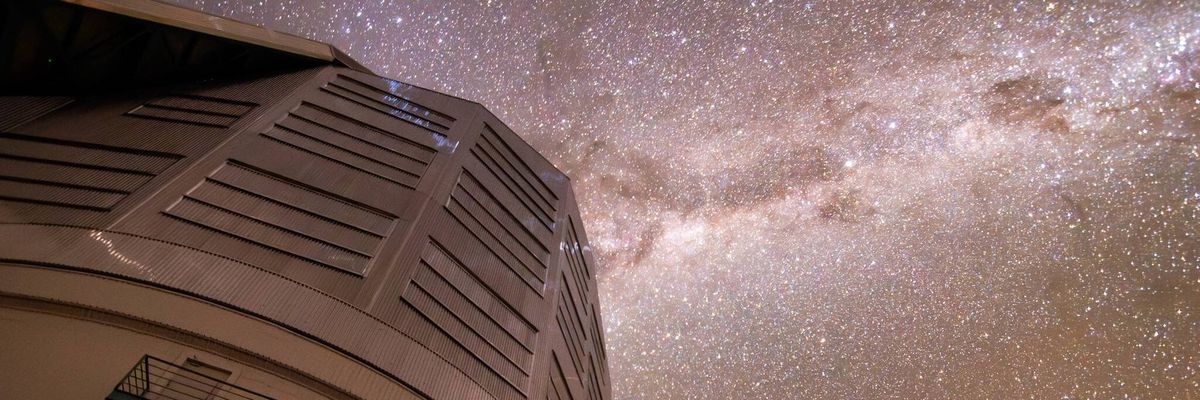
European astronomers on Wednesday urged the US Federal Communications Commission to block a plan led by SpaceX CEO Elon Musk to launch a total of 1.7 million satellites into the Earth’s orbit, warning that the use of so many extremely bright satellites—partially to support artificial intelligence data centers—would have “devastating consequences for astronomy.”
SpaceX’s Starlink telecommunications program has already rapidly increased the number of satellites orbiting the Earth, with the total now exceeding 14,000 since 2019.
Now the space exploration company led by Musk—a former special government employee under the Trump administration—has plans to send 1 million more satellites into space, which would “significantly alter the appearance of the sky,” according to a new study by the European Southern Observatory (ESO).
Scientists found that 100,000 is the maximum number of satellites—ones that are faint enough to be invisible to the naked eye—that can orbit the Earth in order to allow astronomers to continue observing the sky with modern telescopes.
In addition to Musk’s launches, the US startup Reflect Orbital has proposed launching a constellation of 50,000 “very large mirror-like satellites to provide sunlight at night,” said ESO.
“These satellites would be the brightest ever in orbit, with damaging consequences for dark skies on Earth,” said the observatory. “Seen from within a reflected beam, the satellite delivering sunlight would appear four times brighter than the full Moon. Even if no satellite points its beam directly at an observer, each would be as bright as the planet Venus, the ‘morning star.’ From a light-polluted city, like Munich, Germany, these hundreds of satellites would be the only ‘stars’ visible in the night sky.”
The startup E-Space and two Chinese constellations, CTC-1 and 2, would also add hundreds of thousands of satellites into orbit.
The companies’ satellite project could hinder scientists’ ability to observe far-away galaxies, Earth-like planets near other stars, and asteroids that could potentially endanger the planet.
“Satellites, illuminated by the sun, are much brighter than distant galaxies. When a satellite crosses what we observe, it makes a bright streak on our image, zapping whatever is behind it,” said ESO astronomer Olivier Hainaut, who led the study.
Hainaut noted that the planned launches could have economic and ecological impacts on the planet and humankind as well as harming astronomy.
Extreme light pollution from the bright satellites could disrupt people’s biological clocks and ecosystems across the planet, and the satellites could also directly impact air quality due to the numerous launches required to send them into space and the “atmospheric pollution caused as they burn up on reentry at the end of life.”
ESO conducted the research as the FCC considers applications from SpaceX and Reflect Orbital regarding the satellite launches
“The FCC received over 1800 comments regarding Reflect Orbital and nearly 1,500 comments on the application by SpaceX,” said ESO institutional affairs officer Betty Kioko. “The ball is now in the FCC’s court, and we wait to see the determinations they make on both filings. For optical astronomy, this is an existential threat, and we hope that the regulators will share that view.”
From Common Dreams via This RSS Feed.
Orbital datacenters make absolutely no sense. Orbital mirrors to reflect sunlight for extremely vague reasons related to solar energy makes absolutely no fucking sense.
This has to just be stock pump and dumps, or they are literally mercury-poising, late-stage-syphilis levels of insane. Even if they got everything they wanted none of this shit would work as well or be as cheap as technology we already have. It just reinforces how stupid, venal, and misanthropic these fucks are.