

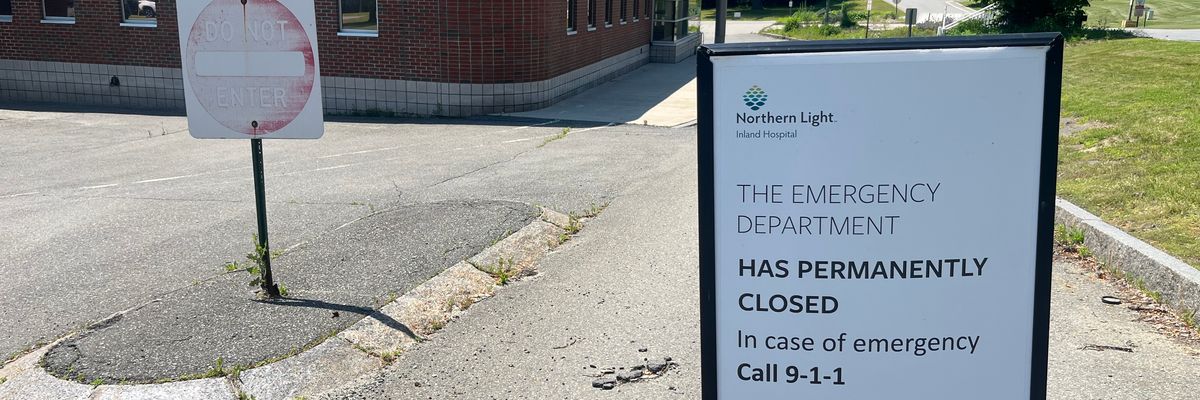
Joined by medical professionals, patients, and local healthcare advocates outside a hospital in central Maine that was forced to shut down last year, Democratic US Senate candidate Graham Platner on Wednesday highlighted the human impact of the crisis that he said Sen. Susan Collins is actively making worse by prioritizing “health insurance companies, Big Pharma, and private equity firms” over Mainers—even as the Republican claims to bring crucial funds to the state’s struggling rural hospitals.
Platner held a press conference outside the former Northern Light Inland Hospital in Waterville, Maine, which closed last May along with its associated primary care centers.
The closure left roughly 5,000 patients without general practitioners and further away from an emergency department and inpatient care, as well as putting more than 300 local residents out of work.
The hospital system said last May that it was closing Northern Light Inland due to rising operational costs, stagnant or reduced reimbursement rates, and a tight labor market with more competition for a smaller pool of qualified healthcare workers. A hospital official told Maine Public last year that the 48-bed facility was losing more than $1 million per month due to operating costs.
Since Northern Light Inland closed, said Platner, “Waterville Fire and Rescue has tripled its out-of-city ambulance transports,” as there is no regular public transportation between Waterville and Augusta, where the nearest hospital is. Patients who were once charged $50 for a ride to the hospital now have to pay $400, the combat veteran and oyster farmer-turned-Senate candidate said, “and a ride that is longer means higher mortality rates.”
One former patient of the healthcare center, Kyla Mihalovits, said her family was “thrown into a state of uncertainty regarding our access to healthcare” after Northern Light Inland closed and her primary care provider relocated to Unity, Maine.
“When your community no longer has access to high-quality [healthcare], it doesn’t matter if you identify as a Democrat or a Republican or an Independent. You have lost something that your community needs to survive.”
“We consider ourselves lucky to get an appointment once a year for our annual checkups. Many of my friends and neighbors lost their doctors and are on excruciatingly long waiting lists,” said Mihalovits, adding that she no longer has access to women’s healthcare and does not know where she will obtain her first mammogram after she turns 40 this year.
“Because my hospital closed, I no longer have any semblance of continuity of care available for me at this crucial time in my life,” she said. “For women, especially since we are very often not listened to, dismissed, or even believed by certain healthcare providers, especially when we see them for the first time, continuity of care is crucial. Because our community hospital closed, it will take years for my family to establish care outside of our community.”
Stories like Mihalovits’, said Platner, show that “rural healthcare is not collapsing sometime in the future. This isn’t some vague thing we talk about that may happen someday. It is happening now, but it is not an accident. No rural hospital closes by chance. It’s the outcome of policy, and it is a choice that people in places of political power like Susan Collins have made.”
Rural hospitals in Maine are projected to continue closing due to nearly $3 billion in Medicaid cuts that are expected to hit the state over the next 10 years—cuts that were included in the One Big Beautiful Bill Act (OBBBA), a law that also included tax cuts for corporations and the wealthy and whose passage Collins helped ensure by casting a decisive vote to send it to the Senate floor.
“Before the bill’s passage, nearly half of Maine’s rural hospitals were found to be at risk of closing while some, like the one here today, had already shuttered,” said Platner. “The One Big Beautiful Bill is doing exactly what the experts warned it would do. It is throwing gasoline on a crisis that was already raging in Maine’s rural hospitals.”
The Senate candidate emphasized that Collins voted to advance the bill out of committee “one day after a private equity billionaire, Stephen Schwarzman, the chair of [Blackstone], and a man who will personally reap huge profits from the bill, gave $2 million towards her reelection campaign.”
Collins frequently emphasizes that she ultimately voted against the OBBBA almost exactly a year ago—after Republican leaders had secured enough votes to pass the legislation without her—but Platner stressed that “her vote was pivotal to advancing it and paving the way for its eventual passage. She knew what she was doing. She was profiting off of her vote.”
He also took particular issue with the five-term senator’s “bragging” about the Rural Health Transformation Program, a $50 billion fund also included in the OBBBA through which, Collins said in a recent ad, she secured $190 million for Maine rural health systems.
“She likes to brag,” said Platner, “that she uses her power to bring money to Maine to help the state, except that the money she brings is a pittance. It is a pittance in comparison to the money sucked out of the state through tax cuts for corporations and billionaires that she happily goes along with. It is a pittance to the money sucked out of our system in the forever wars that we send trillions to year after year that she has always supported. A pittance toward the billions of dollars we continue to send to Israel to fund a genocide in Gaza.”
The candidate, who is a proponent of Medicare for All, added that “people see through” Collins’ claims that she is a “moderate” Republican.
“The idea that she stands up for the needs of Mainers over that of corporations is really laid bare with something just like the Rural Health Transformation Program,” Platner told Common Dreams. “The numbers don’t lie. It’s very obvious what she’s doing. And I am seeing in every single corner of the state and hearing from not just Democrats, but Independents and Republicans, who fundamentally understand that Susan Collins is someone who, for decades now, has represented not their interests, but the interests of those who donate the most money to her. And they’re sick and tired of it.”
While Collins has boasted that the program included in the OBBBA is helping rural Maine residents, the law is already harming millions of people across the country and making it harder for them to access crucial healthcare a year after it was signed by President Donald Trump. According to Protect Our Care, 3.8 million Americans have lost coverage through Medicaid and the Children’s Health Insurance Program since the law was passed. Fifteen million people are projected to lose their healthcare by 2034. More than 1,000 hospitals, clinics, and nursing homes have shut down since the OBBBA was passed, as well as 40 maternity wards.
“When your community no longer has access to high-quality [healthcare], it doesn’t matter if you identify as a Democrat or a Republican or an Independent,” said Platner. “You have lost something that your community needs to survive and you have lost it because establishment politicians like Susan Collins have for decades fought not for your community, have fought not for the needs of working Mainers, but have fought to protect the profits of health insurance companies, corporations, and private equity, and that must come to an end.”
From Common Dreams via This RSS Feed.