

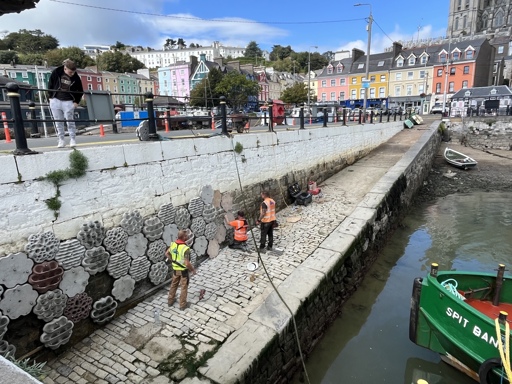
COBH, Ireland — On a bright, warm day in April in Cobh, Ireland, I step down a centuries-old cobbled slipway that descends into a harbor packed with fishing boats. Halfway down, something interrupts the weathered wall: an installation of 60 hexagonal concrete panels bolted into the stone. Some panels are ridged or textured; others are pitted with holes and crevices that either trap water or let it filter through with the changing tide. Bright green algae drapes across many of the panels. When I look closer, I notice a few marine snails, including periwinkles (Littorina littorea) and dog whelks (Nucella lapillus), stuck to the tiles. These panels were installed at Kennedy Pier in Cobh, a seaport town in Ireland’s County Cork, in September 2025, as part of the Living Seawalls project. Spearheaded by the Sydney Institute of Marine Science and the company Reef Design Lab, both in Australia, the Living Seawalls project aims to create biodiversity-friendly panels, boulders and pilings that can be installed on seawalls, marinas, piers and other hard coastal infrastructure to make them more hospitable to marine wildlife. Living Seawalls principal investigator Louise Firth, right, with postdoctoral researcher Soli Levi at the Living Seawalls installation in Cobh, Ireland, in April 2026. Image by Elizabeth Claire Alberts/Mongabay. Louise Firth, a senior lecturer in environmental sustainability at Ireland’s University College Cork and one of the principal investigators of the Living Seawalls project, is on site to show me the Cobh installation, Ireland’s first. (Since my visit, a second Living…This article was originally published on Mongabay
From Conservation news via This RSS Feed.