


By Australians for War Powers Reform, July 1, 2026
Australians for War Powers Reform (AWPR) is a civil society organisation whose membership includes a wide range of qualifications and experience. We have since 2015 advocated for greater transparency and accountability from the federal government in its decisions for deployment of Australian forces to overseas wars. Since the government’s announcement of the AUKUS project in 2021, AWPR has concentrated on seeking details about it and assessing its implications. We welcome the initiative of the Australian Peace and Security Forum in establishing a community-based, independent inquiry and offer our submission below in response to its terms of reference.
AWPR has already made a submission to the inquiry by the Defence Subcommittee of the Joint Standing Committee on Foreign Affairs, Defence and Trade into the Department of Defence Annual Report Parliamentary Inquiry (Defence Annual Report 2023–24). Its focus areas were Sovereign Defence Industrial Priorities: Evaluating the workforce and infrastructure required to build and maintain the submarines in Australia, Defence Estate & Security: Assessing the development of naval bases (such as HMAS Stirling in WA and infrastructure in Port Kembla/Adelaide), nuclear stewardship frameworks, and Uncrewed/Autonomous Systems: Examining the integration of Pillar II autonomous systems into the broader Australian Joint Force.
AWPR Submission
1. Strategic & Security Risks: Examining how AUKUS impacts Australia’s relationships in the Indo-Pacific, whether it makes Australia a nuclear target, and the implications of joining the US in potential conflicts.
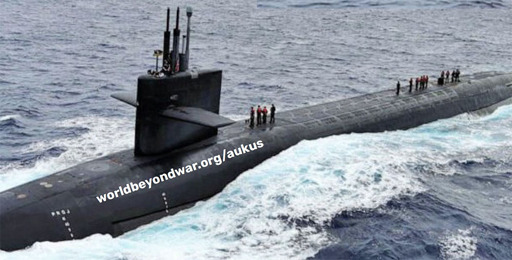
This inquiry into AUKUS is four years overdue. It should have been held as soon as the agreement was announced, if not by the Coalition government, then by the ALP. There was no urgency to justify giving the then Opposition 24 hours notice to agree to it, and there is none now. While the US and UK governments have both held inquiries into AUKUS, Australia has not. Such an inquiry could have acted to ensure that Australia respects and complies with the deeply-held rejection of nuclear weapons by our Pacific neighbours – by insisting that US (or UK) nuclear weapons are never brought into our territory. Instead, we have the likely prospect of US Virginia-class submarines at HMAS Stirling being equipped with new nuclear cruise missiles from the early 2030s.
An inquiry would also have considered the escalated risk of nuclear proliferation in the region, which Australia is committed to oppose as a signatory of the Treaty on the Non-Proliferation of Nuclear Weapons (NPT), signed in February 1970 and ratified in 1973. Under the NPT, Australia is recognized as a non-nuclear-weapon state and has committed to never acquire, manufacture, or receive nuclear weapons. Despite repeated assurances that Australia’s AUKUS submarines will not be nuclear-armed, their use of highly-enriched uranium fuel – which can also be used to fuel nuclear weapons – is a provocation to other nations to consider the same pathway for submarine propulsion.
Such an inquiry would have found that expanding the US military presence in Australia, including naval, air force and Marine deployments, far from making Australia safer from foreign attack, instead makes Australia a surrogate target for an attack on America and therefore less secure. Australia could become a proxy fighter in a war between the US and China, with disastrous results.
Such an inquiry would have sought the facts about China’s intentions in our shared region, and queried the basis of successive fluctuations in Australian perceptions of China as an economic partner and as an enemy. It would have revealed the disproportionate influence on Australian policy-makers of the US-dominated intelligence that informs the ‘Five Eyes’. It would have recognised that American aspirations for global hegemony are doomed, and that it is in Australia’s interests to improve relations with China by non-military means, accommodating it as many of our Indo-Pacific neighbours seek to do.
The Australian Submarine Agency states that the primary purpose of Australian submarines (and their interoperability with US submarines) is to protect vital trade routes. Given that most of our vital trade in the Pacific is with the nation that we are spending a fortune to protect ourselves from, the objectives of the AUKUS agreement are highly contestable.
Furthermore, the US military has been unable to protect the vital trade route of the Strait of Hormuz, demonstrating yet again that Australia has no influence over – but suffers the consequences of – such US political and strategic miscalculations.
An inquiry now would question the inability of the US to protect or to utilise its bases in its allied Middle Eastern nations in their current war with Iran. Australia has agreed to join Pacific nations including Guam, Japan and the Philippines in a US-led confrontation with China, with no Parliamentary debate or public consultation. This places Australia in a position where Australian military assets could be used in conflicts that are contrary to our interests and furthermore put Australian infrastructure and indeed the Australian population at great risk. The US Middle East allies were all first strike targets for Iranian retaliation in the recent conflict in the Gulf region.
Two fundamental questions therefore face Australia: they concern ANZUS and AUKUS. The 1951 ANZUS Treaty commits Australia and the US to do nothing more than to consult in accordance with our Constitutional processes in the event of an attack on either party in the Pacific area. The AUKUS agreement, however, commits Australia in effect to subsidising the US and UK nuclear submarine industries with no escape clause, although they can terminate it with a year’s notice. By locking Australia into our allies’ hostile intentions towards China, the AUKUS agreement clearly endanger Australia more than it protects us, and ANZUS doesn’t protect us from being drawn into a unilateral US action in the region, as happened in the Vietnam War in 1965
The Australian Commonwealth Government has military asset procurement rules including an assessment of the risk of the project failing during its lifetime. That neither the US nor the UK have the capacity to meet their own submarine construction needs should have been a red flag at the time the AUKUS agreement was entered into and yet this was not disclosed to the Australian public or to the Australian Parliament.
2. Economic Costs: Assessing the opportunity cost of the program, impacts on the domestic labour market, and if the project can realistically be delivered on time and on budget.
The quoted cost of AUKUS, like all defence contracts, can be expected to rise significantly over the life of the program, if it continues. The capacity of suppliers of submarines to the US and UK is already stretched, and Australia has no guarantee from either that what we are paying for will ever be delivered, nor that Australia will be compensated if it is not.
Australia is already investing heavily to build facilities for submarines in Western Australia and South Australia. With no experience of nuclear power and limited access to expertise in modern submarine technology, the likelihood of distortions in the labour market is obvious. If the project is abandoned, further workforce disruptions are likely. The same could apply if an east coast submarine base is built at Port Kembla or Newcastle.
Claims about job creation in all these ports are irrational: the same money could be spent on developing more skilled labour to meet existing shortages for peaceful purposes, not for building offensive weapons. The balance could be spent on cheaper, more appropriate non-nuclear submarines.
Australia is currently experiencing a shortage of infrastructure workers that is predicted to blow out to 300,000 by mid-2030. Australia currently has an unemployment rate of 4.5%, which is rising. Australia also has a severe housing construction shortfall, needing 116,000 by 2030. Where are the workers for all the promised jobs in the construction and extension of military bases and the accommodation of US personnel coming from and how does this
effect Australia’s housing crisis?
3. Nuclear Waste: Investigating the safety, storage, and handling of high-level nuclear waste in Australia.
None of the AUKUS partners has the capacity to store nuclear waste safely for the hundreds of thousands of years (in the case of high-level waste) in which it should be isolated from the biosphere. The waste includes not only spent fuel, but decommissioned equipment and contaminated material. Experience in the US at Yucca Mountain and elsewhere, and in the UK at Sellafield, shows how intractable this problem is. Australia should not add to the radioactivity still present after the British nuclear tests at the Maralinga site. A high-level nuclear waste facility is a dangerous ambition which should not be considered, and yet that’s exactly what we’re committed to with nuclear-powered submarines.
Remote sites proposed for waste disposal are likely to be on Commonwealth and indigenous land. Transportation of waste is hazardous and would be likely to cover long distances, increasing the danger of accidental release.
4. Environmental & Social Impact: Reviewing the ecological consequences of submarine base locations and community engagement.
Concern about the proposed nuclear submarine bases has been expressed by communities in the four proposed locations – Rockingham, Osborne, Port Kembla and Newcastle. We urge the Inquiry to recognise that ecological concerns are widespread in Australia about damage to humans and wildlife, and air, land and marine environments. Public resistance to bases is likely to divide communities and heighten disaffection with governments, both Federal and State. Opposition to AUKUS is creating hostility to foreign forces in Australia and is focussing on the US alliance.
A potential rise in CO2 emissions as a result of AUKUS activities should be quantified and taken into account as a negative factor. Defence operations are notorious polluters – including with PFAS – and Australia should be prepared to impose more rigorous controls on them than it has so far done.
In Earth’s Greatest Enemy, her 2026 film, American Abby Martin shows the extent of toxic chemical contamination of water, air and soil around US military sites. She also documents the common US military practice of incinerating unwanted munitions and equipment, and of discarding naval garbage at sea. She cites quotas in the thousands of large marine species that are allowed for US naval ‘target practice’. If this is what the US military does in its own territory, we cannot expect them to be more careful about trashing Australia’s environment. Will Australian governments stop them?
5. Workforce and Social Impacts: Analyzing the effects of the program on domestic employment, workforce upskilling, and local communities.
Defence contracts are often justified by claims that the skills and employment opportunities they will provide will flow on to create economic growth. As argued above, Federal and State governments can do this for less than the cost of AUKUS by increasing funding for training and infrastructure programs, and having more left for climate action, housing, health, education and even for Australia’s Future Fund.
The 2007 UN Declaration on the Rights of Indigenous Peoples (Article 29) states that such people must have ‘free, prior, and informed consent’ over storage of hazardous materials on their lands.
Australian sovereignty, so often cited by Ministers as being strengthened by AUKUS, will instead be reduced by US command and control of the project. This is an intangible but fundamental consequence of the agreement, and one for which government must be held to account.
AWPR advocacy
AWPR urges the Inquiry to seek answers from government to the following questions about AUKUS:
- What Australian interests does provoking China serve?
- What is the view of AUKUS among Australia’s neighbours?
- What defensive purpose can AUKUS achieve?
- What will its real cost be?
- What will it cost Australia to cancel the agreement?
- Can it be renegotiated?
- Where and how will nuclear and other American waste be isolated from the Australian environment?
- What consultation and agreement will be sought with Indigenous people affected by AUKUS?
AWPR recommendations
In the event that the Australian government does not respond adequately to these questions, AWPR recommends that:
- Australia give notice to the United States and British government to terminate the AUKUS agreement.
- the Australian government reformulate a national defence strategy aimed at avoiding any wars in our region.
- the Australian government cease substituting military production for a genuine national industry development policy, which should include a sovereign defence industrial base.
- the Australian government confirm that it will not develop a nuclear industry in Australia.
- the Australian government affirm its adherence to the United Nations Declaration on the Rights of Indigenous Peoples, including its Free Prior and Informed Consent provisions.
- the Australian government affirm that the unity of the Australian people is the strongest base for national security and that it will prioritise programs to reduce rather than increase social inequality.
- the Australian government confirm to Pacific Island Nations and ASEAN Member States that it will uphold the spirit and the letter of both the Treaty of Rarotonga and the Treaty on the Non-Proliferation of Nuclear Weapons (NPT) by prohibiting any nuclear weapons from being brought into Australia.
- and that the Australian government immediately sign and ratify the Treaty on the Prohibition of Nuclear Weapons (TPNW).
This submission was produced by Australians for War Powers Reform (AWPR)
info@warpowersreform.org.au | www.warpowersreform.org.au
June 2026
The post Submission by Australians for War Powers Reform to the National AUKUS Public Inquiry appeared first on World BEYOND War.
From World BEYOND War via This RSS Feed.