

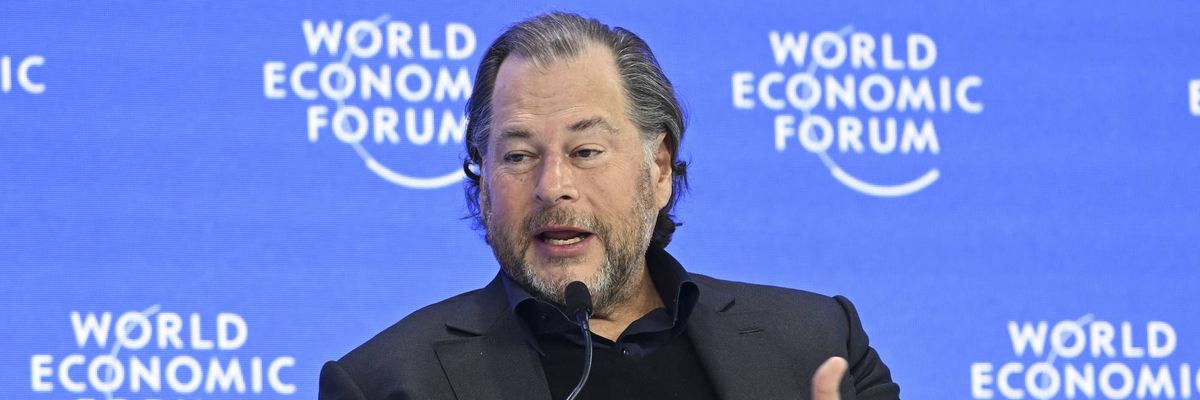
A week after United Nations Secretary-General António Guterres called on artificial intelligence companies to “come clean” about the full costs of power-sucking data centers, and as a UN panel on Wednesday released a report detailing the risks and impacts of AI, Axios revealed the creation of a related commission that’s full of Big Tech executives.
**“**The UN and its International Telecommunication Union (ITU) are convening the AI for Good Global Commission, which will hold its first meeting on July 8 in Geneva, Switzerland,” according to the outlet. It will be co-chaired by Salesforce CEO Marc Benioff and Rwandan President Paul Kagame, with other tech and policy leaders joining as members.
So far, Axios reported, they include ITU Secretary-General Doreen Bogdan-Martin, Estonian President Alar Karis, Amazon CEO Andy Jassy, Anthropic co-founder Jack Clark, Cohere co-founder Aidan Gomez, Microsoft president Brad Smith, Nvidia founder and CEO Jensen Huang, and AI and tech policymakers from Kazakhstan, Namibia, Nigeria, Saudi Arabia, and Singapore.
“AI is the most profound technological transition in history. And our values have to guide every step, because responsibility is the core of AI ethics,” Benioff said. The commission will bring together “the people who build AI, deploy it, shape policy, and represent communities.”
He added that “our inaugural meeting will focus on where this group is uniquely positioned to act together: strengthening AI infrastructure, accelerating AI’s impact on health, education, food security, and disaster response, and ensuring trust and safety.”
However, given recent polls showing that the public has limited confidence in large technology companies, opposes constructing data centers for artificial intelligence in their local area, is wary of AI’s impact on daily life, and has concerns about politicians having a “cozy relationship” with Big Tech, the commission may be met with skepticism or even backlash.
In the lead-up to the commission’s meeting next week at the ITU’s AI for Good Global Summit, the UN plans to hold the inaugural Global Dialogue on AI Governance, featuring a presentation of the “Preliminary Report of the Independent International Scientific Panel on Artificial Intelligence,” published Wednesday.
Established with a UN resolution last August, the panel is the first global scientific body on AI—and, as Guterres said in a statement about its new report, “the panel is intended to help the world separate fact from fakes, and science from slop.”
“We are looking to them to provide an authoritative reference point at a moment when reliable, unbiased understanding of AI has never been more critical,” the UN chief explained. “I am pleased to say that they have delivered a down payment on that commitment—in record time.”
The panel’s co-chair, Canadian computer scientist Yoshua Bengio, noted that “AI capabilities are outpacing both scientific understanding and governments’ ability to adapt. With growing evidence of deceptive AI behavior, science currently cannot guarantee that as capabilities continue to increase, AI will not cause catastrophic harm, either on its own or due to malicious users.”
“To act effectively, global policymakers must understand these systems,” he asserted. “This panel provides exactly that: a rigorous, shared scientific foundation to guide our collective way forward.”
The report discusses AI’s recent advances and expected trajectories; societal applications, from agriculture to education to healthcare; economic implications; security and environmental concerns; impacts on democracy, human rights, and information; potential harms to child safety and culture; and governance of the rapidly developing technology.
“The technology is transformative, but if the world keeps moving along this trajectory, humanity will fail to realize the gains it promises. The risks—to societies, to security, and to our species—are too high, and the forces driving AI forward are not the forces that will deliver its benefits,” said Maria Ressa, a panel’s co-chair and Nobel Peace Prize-winning Filipino-American journalist.
Guterres, whose term ends this year, similarly stressed the need for urgent action on a global scale. He said that the “single lesson” he wanted to highlight from the multifaceted report is that “the more AI advances without shared rules, the less say governments and people will have in the outcome. So my message to governments is simple: Do not wait.”
“Next week in Geneva, the first Global Dialogue on AI Governance will begin to turn science into shared action—with every nation at the same table,” he said. “I look forward to joining member states there to help carry this work forward. And soon, I will set out proposals to help countries build the capacity to adequately deal with this technology—and share in its rewards.”
Guterres’ Wednesday comments came after he publicly took aim at artificial intelligence companies last week, proposing the AI Environmental Transparency Initiative during London Climate Action Week, as the second heatwave in as many months scorched the United Kingdom and various other European countries, killing at least hundreds of people.
“I am calling on every major AI company to measure and publicly disclose the full environmental impact of its systems—carbon, water, and land footprints—and to commit to power every data center with renewable energy by 2030,” he declared. “No more hidden costs. No more shifting the burden onto those least able to bear it.”
From Common Dreams via This RSS Feed.