

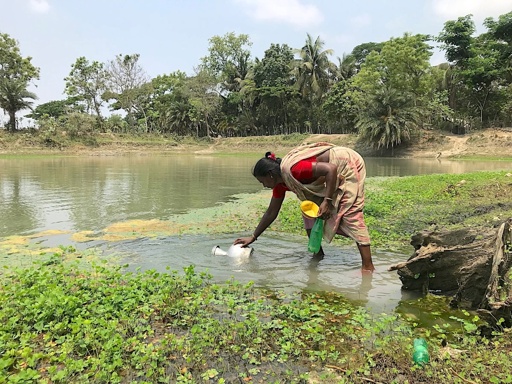
Every morning, before the sun has fully risen over the tidal flats of Satkhira in southwest Bangladesh, women begin walking. They walk two kilometers, sometimes five (about 1.2 to 3.1 miles) and sometimes more, carrying empty vessels that they will fill with water fit for drinking. Then they walk back. Then, some days, they walk again. A UNDP study found that women in coastal Bangladesh spend up to six hours a day on this task alone, six hours that cannot be spent earning, learning or caring for their children, and this is not even a drought zone. This is one of the largest deltas on Earth. The women walk past rivers, channels and flooded fields. The water is everywhere, and none of it is safe. Approximately 20 million people along Bangladesh’s coast cannot safely drink the water that surrounds them. Yet, a UNDP survey found that 73% of residents in five coastal sub-districts of Satkhira consume saline water every single day. The crisis does not make the front pages of international newspapers the way droughts in East Africa or floods in Pakistan tend to. It is slow, structural and unglamorous, which is precisely why it has been allowed to continue for this long. A woman collects water from a pond about 1 km from her home in Shyamnagara, Satkhira district, Bangladesh. Image courtesy of Abu Siddique. The intrusion of saltwater into Bangladesh’s coastal mainland is not simply a consequence of rising seas, though the seas are certainly rising. Studies project…This article was originally published on Mongabay
From Conservation news via This RSS Feed.