

Trump 2.0 has been marked by a barrage of attacks on social movements. A key pillar of this repression has been the use of extreme legal measures against individuals who represent broader progressive sentiments.
Consider Kilmar Ábrego García, the immigrant who resisted his wrongful deportation to El Salvador, or Mahmoud Kahlil, the former Columbia University student and Palestine activist who was one of several pro-Palestine university activists targeted by ICE.
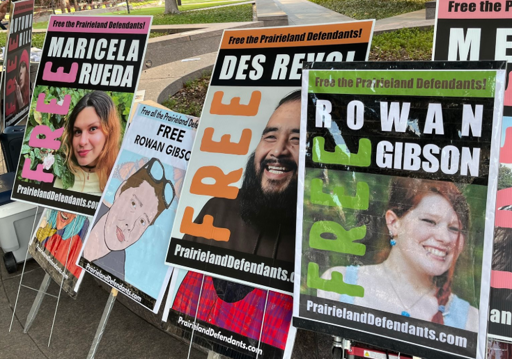
The shocking life sentences against immigrant rights activists who protested an ICE facility in Prairieland, Texas, must be understood as part of this broader strategy in which the administration uses select individuals to pave the way for further attacks on those who have most actively resisted its far-right agenda. But the Prairieland sentences are not just another example of this repressive strategy; they represent an escalation that will have severe implications if not resisted.
What these community members did was participate in a noise demonstration outside of the Prairieland Detention Center, one of the many ICE jails across the country where immigrants are held in dehumanizing, unsafe, and deadly conditions. ICE facilities have been exposed for their inhumane conditions in which imprisoned immigrants, including children, have been psychologically tortured, physically and sexually assaulted, and served spoiled food.
Some of the Prairieland Defendants didn’t even participate directly in the protest. As Jacobin aptly put it:
Meagan sat in her car playing Nintendo, waiting to drive demonstrators home.
Daniel transported a box of magazines.
The DOJ just successfully sentenced them and seven others to 30+ years in prison what they’ve called “justice” against “Antifa terrorists.”
Sufia Khalid, deputy director of the National Security Criminal Defense Center at the Muslim Legal Fund of America, further explained the case on Democracy Now!:
the government in this case sought a novel — first time that this has happened — use of a rarely used statute: the provision of material support to terrorists. And that has not been used in the purely domestic context for this kind of conduct. That statute also does not require any connection to a domestic terrorist organization or any kind of a domestic terrorist organization. When the government sought prosecution under this statute, they sought to seek a very dangerous precedent, that now allows them to target any American engaged in protest that results in even the most minor damage to property, property destruction. Any American can be targeted that way now.
The same administration that bombs girls’ schools in the Middle East and fishing boats in the Caribbean, terrorizes immigrant communities in the United States, and kills those who defend them, such as Renée Nicole Good and Alex Pretti, has the audacity to suggest that these activists are the real perpetrators of violence. ICE and the police who collaborate with them are responsible for the violence. Even Benjamin Song, the one activist who was sentenced to 100 years for firing a gun during the protest, did so only in self-defense, since he reasonably believed police were shooting at the peaceful protesters.
The legal precedent is set. The smear campaign against anti-ICE activists is in full swing. And this is not an isolated case.
A Weaker, More Aggressive Trump
The Prairieland convictions follow several other cases that show how the administration is preparing to carry out more extreme forms of political repression. Just before the Prairieland sentencing, the federal government indicted 15 Minnesotans who participated in the profound solidarity movement in the Twin Cities against Operation Metro Surge.
Then there are the June 10 FBI raids against eight pro-Palestine activists in Michigan who are now facing felony conspiracy charges. The FBI also recently raided an Ohio voting rights organization, and a poll worker in Syracuse shared that she was confronted by DHS agents over social media posts she made criticizing the ICE agent who murdered Renée Good.
These are just a few examples that, together with the Prairieland convictions, show how Trump is using intimidation and trumped-up charges to try to suppress those at the forefront of organizing against the Far Right and for democratic rights. But these escalations come from a position of weakness.
Trump has suffered important defeats. First was the class struggle in Minneapolis, which forced the administration to retreat and which turned people across the United States against Trump’s most extreme attacks on immigrants. This domestic defeat was followed by Iran’s defeat of the United States, in what was the most domestically unpopular war in U.S. history. Disapproval of Trump’s handling of the economy is also growing, fueled in large part by the consequences of the war on Iran. And all this comes ahead of midterm elections with commentators declaring that the Republicans have already lost. This has led to important splits in the MAGA coalition with the high-profile departures of Marjorie Taylor Greene and Tucker Carlson.
Trump is a lame-duck president whose high-profile blunders domestically and abroad have sparked outrage. Now sectors of his coalition are, if not ready to jump ship, at least starting to look for the exits. To put it simply: his administration is weak.
Now Is the Time for a Movement in the Streets against Repression
Given Trump’s political weakness, and given the severity of the repression his administration is carrying out, there’s no reason there shouldn’t be more outrage. It’s widely acknowledged by First Amendment advocates and legal experts that the Prairieland sentencing should sound alarm bells about the future of basic democratic rights.
But right now, the focus is midterms. In their typical efforts to direct outrage against the Right out of the streets and into the ballot box, the Democratic Party is leaving the activists under attack out to dry. In this way, the Democratic Party plays a key role in allowing the Right to separate the vanguard of our movements — such as the Prairieland Defendants, the Minnesota 15, and the Michigan 8 — from the broader sectors of society who sympathize with the fights that these activists represent but are more inclined to follow the lead of traditional leaderships connected to the Democrats.
But this does not mean a movement against repression isn’t possible. The No Kings marches, for example, have shown that the base of the Democratic Party isn’t content to wait for November to express their opposition to the Far Right. This dynamic of a base prepared to fight, despite the tepid approach of organizations that are looked to for leadership, also has expressions in the labor movement, as was shown by the Labor Notes conference earlier in June.
Millions have mobilized in the streets against Trump’s attacks. Similarly, the rise of DSA as a major player in national politics, with an army of thousands of canvassers, shows how a combination of socialist ideas, anti-imperialism and solidarity with Palestine, hatred of ICE, and hatred of the rich is politicizing more and more people across the country.
And while the immigrant rights movement hasn’t seen anything as profound as the January 23 economic shutdown in Minneapolis, it remains a part of the national political landscape, threatening to spark new expressions of class struggle at any moment, as was shown in the confrontation with ICE at Delaney Hall in New Jersey, and in ICE’s recent decision to sell seven warehouses, in part because of the movement’s work to oppose detention centers.
For the various sectors under attack and that have shown an interest in fighting Trump, it’s necessary to build a resistance to these attacks in the streets, clearly demanding freedom for the Prairieland Defendants and all those imprisoned by ICE, as well as an immediate end to the persecution of the Minnesota 15, the Michigan 8, and all activists under attack.
It’s key that unions take up this fight. We’ve already seen what that could look like. SEIU, for example, has mobilized with force when this administration has attacked its members, from David Huerta to Rümeysa Öztürk. That solidarity and power to mobilize must be deployed against all those under attack by Trump, and every union that claims to oppose Trump must do so, using the resources and members they put toward campaigning for Democrats to instead build demonstrations against political repression. The same must be done by the NGOs that routinely use their role in the social movements to direct everyone back into the Democratic Party through electoral campaigns.
DSA, with its more than 100,000 members, its army of canvassers in NYC, and its national spotlight, also has a key role to play in building this fight, but every organization of the Left must join, given that socialists, communists, and anarchists can expect to be targeted by further attacks.
Everyone, however, can play a role in building this much-needed movement. The experience of Minneapolis showed what happens when outrage builds from below and community members organize themselves instead of waiting for specific organizations or political figures to take the lead.
It’s time to act. Confronting and defeating this repression is as possible as it is existential.
The post Sentencing of the Prairieland Defendants Necessitates a Massive Movement against ICE and Repression appeared first on Left Voice.
From Left Voice via This RSS Feed.