

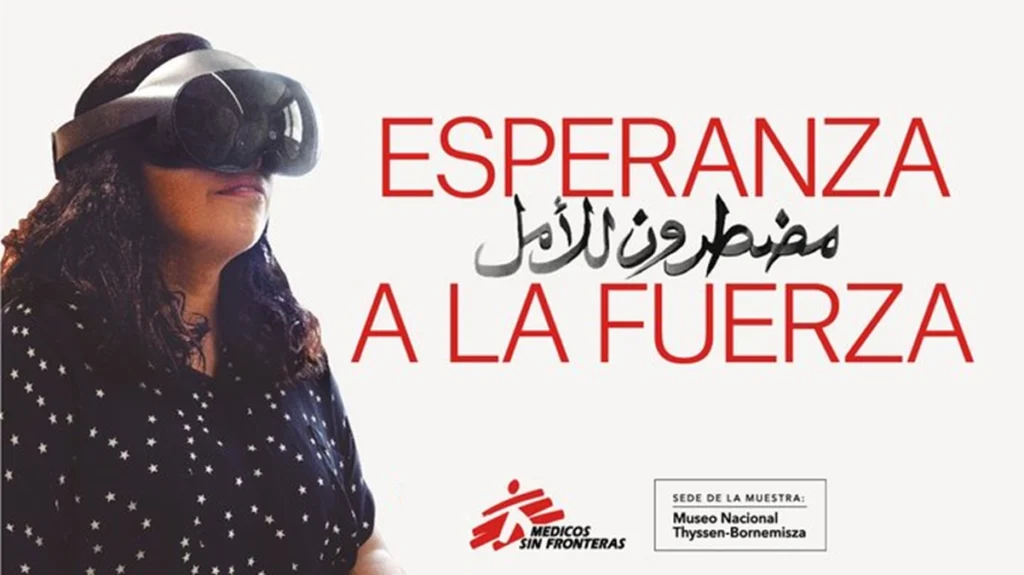
An immersive experience follows the journey of a Sudanese aid worker displaced by war.
At Madrid’s Thyssen-Bornemisza National Museum, Doctors Without Borders (MSF) is implementing an innovative way to raise awareness about the suffering of 14 million people displaced by the war in Sudan since 2023.
RELATED:
Sudanese Bureaucratic Obstacles and Insecurity Delay Aid Arrival to Blue Nile
Using virtual reality headsets featuring real footage and 3D illustrations, visitors can experience “Forced Hope,” a 12-minute exhibition that puts them in the shoes of people forgotten by the world.
The immersive exhibition, which will be open free of charge through July 15, follows Mohammed Dafallah, an MSF anesthesia technician who was forced to flee El Geneina, the capital of West Darfur, and later arrived at the refugee camp in Chad where he now works.
The experience begins with 3D drawings by Sudanese artist Rashid Diab depicting the interior of Dafallah’s home. Visitors can pour themselves tea, as on any ordinary morning in a Sudanese household, before hurriedly packing a suitcase with a handful of belongings as the village catches fire.
The forced displacement then begins across arid terrain, where visitors see the bodies of the dead along roadsides, orphaned children, and soldiers carrying weapons.
Upon arriving at the refugee camp in Chad, the exhibition transitions to 360-degree real-life footage portraying Dafallah’s new life with his family, a new life marked by the pain of losing loved ones and leaving their home behind.
Before virtually experiencing those distressing situations, visitors enter a room providing background information about Sudan, the African country bordering Egypt, South Sudan, Eritrea, Ethiopia, the Red Sea, Libya, Chad, and the Central African Republic.
Sudan, where the current conflict between the Sudanese Armed Forces and the Rapid Support Forces erupted on April 15, 2023, is home to 53 million people. Islam is the country’s predominant religion, and Sudan has more pyramids than any other country in the world.
The exhibition concludes with a presentation on MSF’s work since the organization began operating in Sudan in 1979, in a country now facing a critical situation.
Three years of war in Sudan have left more children orphaned and living on the streets of Omdurman, where they sell water and work on buses to survive amid rising hunger, abuse and exploitation.
Al Jazeera’s Hiba Morgan reports. pic.twitter.com/dL8Fs1XlUr
— Al Jazeera English (@AJEnglish) June 22, 2026
A War Against the Civilian Population
“The situation in Sudan is the world’s largest humanitarian and displacement crisis,” MSF Spain President Paula Gil pointed out during the exhibition’s presentation, explaining that many actors and governments have an interest in prolonging the war.
“There are many economic interests,” she said, summarizing the backdrop to a conflict marked by indiscriminate violence against civilians, a war that corporate media do not often highlight.
Rashid Diab described the conflict as a “cultural war” intended to ensure that “many tribes fall,” while anesthetist Carla Agullo recounted her experience during a recent stay in Sudan and at the refugee camp where Dafallah works.
She described malnutrition as an “endemic disease” affecting children, the use of “sexual violence as a weapon of war” against women and girls, and the spread of diseases such as cholera, measles, diphtheria and tetanus in a country whose health care system is “broken.”
“Sixty percent of medical facilities have been bombed,” Agullo emphasized, referring to a war in which both sides use drones to attack each other, causing severe burns, amputations, and multiple traumatic injuries.
teleSUR/ JF
Sources: MSF – EFE
From teleSUR English via This RSS Feed.