

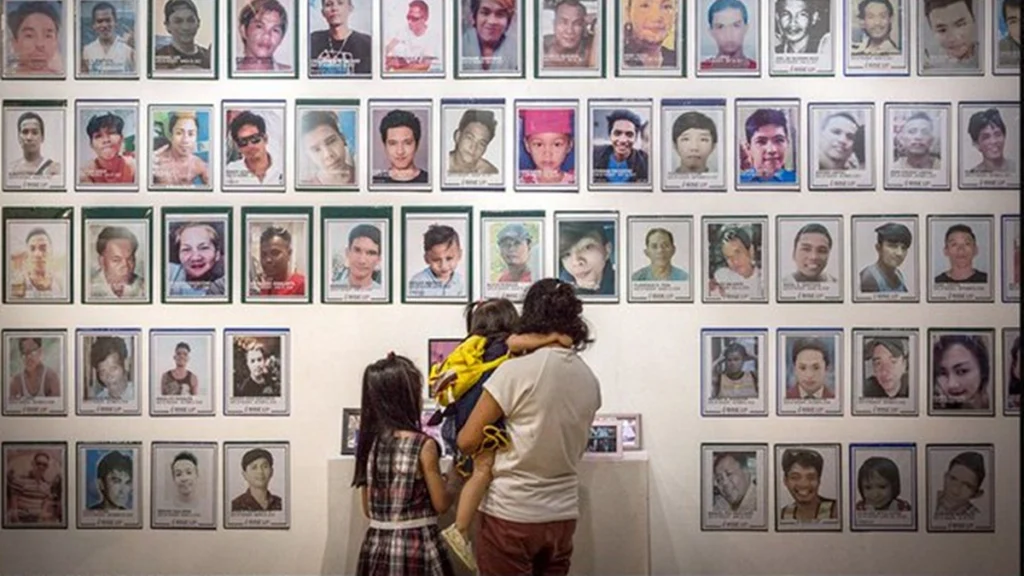
Former president awaits trial in The Hague as deaths linked to anti-drug operations mount.
When the Philippines marks 10 years since the start of the war on drugs, launched at the beginning of Rodrigo Duterte’s presidency (2016-2022), the former president is in The Hague awaiting trial.
RELATED:
ICC Confirms Trial Against Former Philippine President Duterte
The changes in the country, however, have fallen far short of expectations. NGOs have reported that police abuses have continued, while a civilian commission investigates crimes committed during the campaign.
Duterte’s anti-drug operation resulted in the extrajudicial killing of about 6,000 people, according to police figures, although NGOs estimate the death toll at as many as 30,000.
The number of deaths has continued to rise since the arrival of his successor, Ferdinand Marcos Jr., although at a much slower pace: 1,273 people have been killed since July 2022, according to data compiled by the Dahas Project at the University of the Philippines.
A commission was launched in the Philippines on Wednesday led by a former International Criminal Court judge to investigate a bloody “war on drugs”, aiming to document alleged extrajudicial killings and compile evidence for potential legal cases.https://t.co/FMPcJQgXm7
— Interaksyon (@interaksyon) May 31, 2026
The Beginning of an Abuse Campaign
On July 1, 2016, his first day in office, Duterte granted police broad authority to eradicate drug trafficking, including permission to use deadly force if they felt threatened, in what is widely regarded as the beginning of the war on drugs.
“Carry out your duty, and if in the process you kill 1,000 people because you were defending yourselves, I will protect you… If you go to jail, I will go with you,” he said during a speech before the Philippine National Police.
The bloody anti-drug campaign began with brutal intensity. During the first 100 days of Duterte’s presidency alone, about 3,700 deaths were recorded, according to official figures, including small-scale drug dealers, leaders of criminal organizations and drug users.
By the end of his term on June 30, 2022, authorities put the total number of deaths at 6,000. International organizations, however, estimate the number of victims could reach 30,000 if killings carried out by paramilitary groups known in the country as “vigilantes” are included.
Duterte in The Hague
In an attempt to avoid international justice, Duterte announced in 2018 that he would withdraw the Philippines from the Rome Statute, the founding treaty of the International Criminal Court. Following the required timeline, the withdrawal took effect in March 2019.
He consistently argued that the alleged crimes committed during the war on drugs should be tried by Philippine courts.
Despite efforts to avoid the ICC, Duterte was arrested in March 2025 at Manila’s international airport upon his arrival from Hong Kong under a warrant alleging possible crimes against humanity committed during the bloody anti-drug operation. Duterte’s trial, after his detention in The Hague, is scheduled to begin on Nov. 30, 2026.
GILBERT Andres, a lawyer representing victims of the drug war of former president Rodrigo Duterte, said the International Criminal Court’s (ICC) order to freeze money connected to the former head of state does not cover his bank accounts but only cash and items taken from him at… pic.twitter.com/6WNNymx7Fd
— The Manila Times (@TheManilaTimes) June 30, 2026
Domestic Investigations
Philippine courts have prosecuted only a handful of cases linked to the war on drugs. In 2018, three police officers were sentenced to prison for the killing of a 17-year-old a year earlier, while two officers were tried in 2024 over deaths that occurred in 2016 and 2017.
Philippine courts are currently trying three police officers over the killing of Diego Bello, a Spanish citizen who was shot dead in 2020 on the island of Siargao during an alleged anti-drug operation.
Since Duterte left office, Marcos has not revoked the directives issued by his predecessor, resulting in a steady stream of deaths: 126 during the first six months of 2026, according to the Dahas Project.
Civilian Commission and the Fugitive Senator
In mid-May, the ICC ordered the arrest of Sen. Ronald Dela Rosa, who led the Philippine National Police from 2016 to 2018 and played an essential role through public statements that “authorized, tolerated and encouraged” the killings.
Dela Rosa’s whereabouts have remained unknown since May 14, when he fled the Senate following a night of chaos during which a shooting was reported inside the building.
Meanwhile, in May, a civilian commission in the Philippines, known as the “Truth Commission” and led by former ICC judge Raul Pangalangan, began work with the aim of investigating and documenting killings committed during the Duterte era.
“This is not about replacing the courts or determining who is guilty. It is about building a truthful and credible record that can guide accountability,” Pangalangan said during the commission’s founding.
teleSUR/ JF
Source: Xinhua
From teleSUR English via This RSS Feed.