

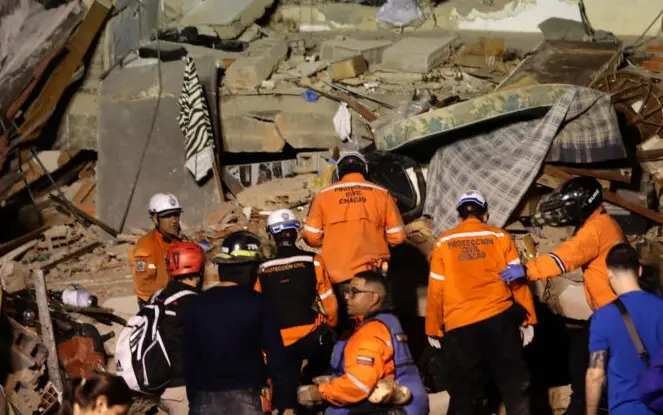
Official figures report 1,943 deaths, 10,571 injuries and nearly 20,000 survivors following rescue and evacuation efforts.
Six days after twin earthquakes struck Venezuela, government authorities reported that national and international rescue teams have pulled 6,461 people alive from the affected areas since June 24, while the official death toll has risen to 1,943 and the number of injured to 10,571.
RELATED: Venezuela Receives Brazilian Technical Support Post-Quake
Presenting the latest official assessment, National Assembly President Jorge Rodríguez said search and rescue operations continue in the disaster zone, led by Venezuelan emergency agencies with support from international brigades.
Rescue operations
According to government census data and drone surveys conducted in La Guaira state, which remains under a disaster declaration, an estimated 30,000 people were in the coastal communities of Caraballeda and Catia la Mar when the earthquakes struck.
Hospital surveys and witness testimonies indicate that between 13,400 and 13,500 people evacuated the affected areas on their own or with assistance from relatives and others. Combined with those rescued by emergency teams, authorities estimate that 19,861 people survived the disaster in the central coastal region.
Rodríguez described the work carried out by rescue brigades as “heroic, marked by courage, patience and perseverance.”
He said that 2,407 people were rescued during the first day of operations in the disaster corridor covering Catia la Mar, Macuto, Caraballeda, Los Corales and Tanaguarena, following the immediate deployment of Venezuelan emergency units and assistance from relatives.
A seis días del doblete sísmico que golpeó a Venezuela, el país ha demostrado una inmensa respuesta humana y solidaria. En las zonas más afectadas, a pesar de los graves daños estructurales, las comunidades se han convertido en una fuerza vital.
La organización popular, la…
— teleSUR TV (@teleSURtv) June 30, 2026
Text Reads: Six days after the double seismic event that struck Venezuela, the country has demonstrated an immense human and supportive response. In the most affected areas, despite the severe structural damage, communities have become a vital force. Popular organization, community unity, and the Venezuelan Government, along with civil society initiatives, sustain a collective effort to cope with the catastrophe, embracing the survivors and respectfully accompanying those who have suffered irreparable losses.
On the second day, rescue specialists from the states of Mérida, Barquisimeto, Zulia, Falcón, Trujillo and Táchira joined the operation alongside the first international rescue teams, leading to the rescue of another 2,973 people. Joint operations recovered 731 survivors on the third day and 345 on the fourth day, while four additional people were rescued on the fifth day.
During the early hours of the sixth day, rescue teams located and extracted a two-year-old child alive from the rubble. According to Rodríguez, the child is receiving specialized medical care in Caracas.
The operation has involved 26,121 personnel from Civil Protection, the Bolivarian National Police, fire departments from several states and the Bolivarian National Armed Forces, supported by 51 international delegations, 3,660 foreign rescuers, 148 search dogs, 49 support vehicles and 15,467 registered volunteers.
Casualties, humanitarian assistance and damage
The official assessment confirms 1,943 fatalities, 10,571 injured people and 15,866 displaced residents.
The government has established 14 temporary camps in La Guaira and another 55 shelters across Caracas, Miranda and other affected states.
Rodríguez said that 28,380 people are currently receiving comprehensive assistance through hospitals and temporary shelters, while overall government assistance has reached 80,870 families.
Authorities also reported the distribution of 3,191,692 liters of drinking water and 707,000 tonnes of international humanitarian aid to communities in the disaster zone.
Technical assessments identified damage to 855 buildings nationwide. Of those, 189 collapsed completely—including 158 in La Guaira—while another 666 sustained severe structural damage or partial collapse.
Rodríguez said that most of the buildings destroyed in Caraballeda were vacation properties, whereas the heaviest impact in Catia la Mar fell on permanently occupied residential buildings.
Aftershocks decline
Rodríguez said seismic activity has continued to decrease since the main earthquakes, with authorities recording a total of 689 aftershocks since the emergency began.
From teleSUR English via This RSS Feed.