

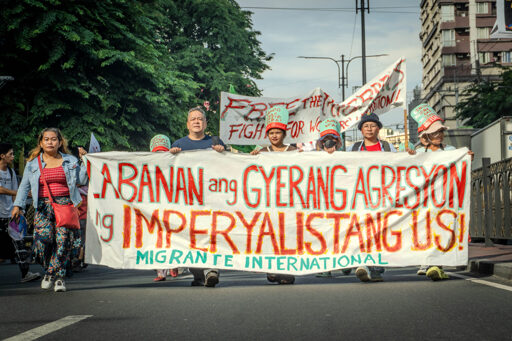
Three-part series
Part 1: From unbridled globalization to controlling supply chains
Part 2: Unprecedented deepening of US military intervention
Part 3: Luzon Economic Corridor and Pax Silica: Defense-industrial imperialist project
Part 1: From unbridled globalization to controlling supply chains
For almost half a century, US imperialism relied on unbridled neoliberal globalization to assert and maintain its global hegemony. Trade and investment liberalization, privatization of public services and government functions, and deregulation of state control over key industries, sectors, and activities of the economy were promoted to facilitate the monopoly capitalist accumulation of U.S. financial oligarchs. U.S. imperialism also maintained a vast network of foreign military bases and a massive deployment of its troops to project its might and safeguard U.S. monopoly capital around the world.
Under this model, the integration of economies into a U.S.-led global order enabled American corporations and financial institutions to dominate markets, plunder resources, and exploit labor while maintaining geopolitical influence. Its financial oligarchy increasingly turned to financialization and speculation to quickly and massively generate profits while focusing on the production of high technology and expanding the U.S. military-industrial complex for corporate profit-making and global power projection. It outsourced most of its industrial production to take advantage of cheap labor and raw materials in poor countries and to meet the needs of its industries.
Controlling strategic supply chains
However, the rise of China exposed vulnerabilities in this strategy. As the US outsourced industrial production and relied on financialization and war for profits and domination, China has become central to global manufacturing, using concentrated state intervention and an enormous army of cheap labor to steadily build its industrial base, acquire technology, and accumulate capital. China’s economy has expanded to become the world’s largest today in terms of the absolute volume of physical goods and services produced. The U.S. holds the top position in nominal gross domestic product (GDP) primarily because of its tech industry (software development) and financial sector, but China trumps it in actual manufacturing capacity and commodity exports.
China’s manufacturing dominance means it has asserted control over global supply chains for the production and distribution of many goods and services, including sectors that American strategic thinkers deem a threat to U.S. hegemony. Globally integrated supply chains, which the US promoted through neoliberal globalization that culminated in China’s accession to the World Trade Organization (WTO) in 2001, are now seen by U.S. imperialism as a national security risk amid China’s rise. The reason is that these supply chains include sectors that could ultimately undermine the supremacy of US imperialism in one field that allows it to keep its global hegemonic position—the military.
In the context of its strategic competition with China, U.S. imperialism considers certain sectors to be “national power industries” or “force multiplier fields” because they dictate not just economic dominance but also military superiority. These include advanced computing and semiconductors, artificial intelligence (AI) and autonomous systems, clean energy and advanced mobility, critical minerals and materials processing, biotechnology and biomanufacturing, and defense, aerospace, and telecommunications. Control over the supply chains of these dual-use sectors (i.e., sectors with commercial and military uses) explains recent major U.S. imperialist projects, namely the Pax Silica initiative and the Critical Minerals Ministerial.
Consequently, Washington began recalibrating neoliberalism within the framework of its national security strategy. The emphasis shifted from maximizing efficiency through unrestricted globalization toward securing strategic supply chains and maintaining technological superiority. Concepts such as “economic security,” “friend-shoring,” “ally-shoring,” industrial policy, and state intervention emerged as key pillars of U.S. strategy. While wielding various protectionist measures for its economy and key industries, U.S. imperialism continues to impose neoliberal policies on its semi-colonies to facilitate the plunder of resources and assert control over supply chains.
Economic-military strategic framework
The Philippines occupies a crucial position in Washington’s effort to contain China. Geographically, it lies within the so-called First Island Chain, a strategic arc stretching from Japan through Taiwan and the Philippines down to Indonesia. Control over this chain is viewed by U.S. strategists as essential for limiting China’s maritime expansion and military mobility.
As a result, the Philippines has become a key platform for U.S. power projection. The expansion of the Enhanced Defense Cooperation Agreement (EDCA), the exponential growth of large-scale military exercises such as Balikatan, record-high increases in military financing, unprecedented deployment of advanced missile systems and drones, and enhanced interoperability between the Armed Forces of the Philippines (AFP) and the U.S. military under the command of U.S. imperialism all reflect this strategic objective.
US imperialist machinations in the Philippines in the current period are characterized by the ever-deepening integration of U.S. military and economic agenda into a single strategic framework. So-called development initiatives, infrastructure projects, industrial zones, and digital connectivity programs are specifically designed to support U.S. military and strategic objectives. Economic projects such as the Luzon Economic Corridor and Pax Silica’s Economic Security Zone facilitate economic penetration, enable the plunder and exploitation of resources, and generate profits for American financial oligarchs while simultaneously strengthening U.S. military logistics, mobility, and operational capacity. This necessitates the exceptional puppetry and subservience to U.S. imperialism of the local elite’s ruling clique, represented by the regime of Ferdinand Marcos Jr. and the bourgeois compradors who benefit from these plunderous projects.
Part 2: Unprecedented deepening of US military intervention
Under the Marcos Jr. regime, U.S. military involvement in the Philippines has expanded dramatically. In February 2023, during then-US Defense Secretary Lloyd Austin’s visit to Manila, the regime announced the opening of four new EDCA sites, including three locations facing Taiwan (Camilio Osias Naval Base and Lal-Lo airport in Cagayan, and Camp Melchor dela Cruz in Isabela) and one facing the South China Sea (Balabac Island in Palawan). Two months later, Marcos Jr. paid a visit to then-US President Joe Biden and announced the signing of the Bilateral Defense Guidelines, which updated the practical implementation of the 1951 Mutual Defense Treaty (MDT). The guidelines include maritime security cooperation, cybersecurity cooperation, and even space-related cooperation. It also reaffirmed that an armed attack in the Pacific, including anywhere in the South China Sea, on either country’s public vessels, aircraft, or armed forces would invoke the MDT.
The language, priorities, and focus on multi-domain awareness found in the Bilateral Defense Guidelines directly mirrored those in the Philippines’ National Security Policy (NSP) 2023–2028, released through Marcos Jr.’s Executive Order No. 37 in August 2023. The NSP shifted strategic priorities toward external defense, maritime security, and regional stability, explicitly identifying Taiwan (cross-strait relations) and the West Philippine Sea as primary or major concerns.
The US-designed and US-sponsored NSP introduced the Comprehensive Archipelagic Defense Concept (CADC), officially adopted by the AFP and the Department of National Defense (DND) in March 2024, facilitating a strategic pivot from internal counterinsurgency operations to a supposed external defense role, including securing the country’s exclusive economic zone (EEZ) and sea lanes. As such, the AFP’s modernization program increasingly emphasizes maritime (Philippine Navy) and air defense (Philippine Air Force) capabilities rather than internal counterinsurgency operations (Philippine Army). The CADC effectively integrates Philippine geography into U.S. regional military planning by developing a network of strategically located, forward-deployed military assets and facilities, as well as island strongholds such as Batanes and Palawan.
Subsequent agreements deepened this integration. The Philippine Security Sector Assistance Roadmap (PSSAR), announced in July 2024 during the so-called 2+2 Ministerial Dialogue of Philippine and U.S. defense and foreign affairs secretaries, aligned AFP modernization with long-term U.S. support and financing. The U.S. immediately allocated $500 million in Foreign Military Financing (FMF) for fiscal year 2024 to implement the PSSAR. It scaled up joint military exercises between the US and the Philippines, with over 500 held during the 2024-2026 timeframe, including the largest Balikatan exercise, which took place this year. It also accelerated investments in and the expansion of EDCA sites, with allocations of $128 million in 2025 and $144 million in 2026.
Legally-binding deal on higher-level military intel, advanced weapons
To fully implement the CADC and PSSAR, the U.S. and the Philippines signed a landmark military agreement in November 2024 – the General Security of Military Information Agreement (GSOMIA). It is a legally binding accord that establishes protocols, clearances, and guarantees ensuring that both countries will safeguard shared classified military intelligence. The GSOMIA facilitates the transfer of high-tech systems that rely on classified technical data (like advanced missiles or real-time satellite feeds) from the U.S. to the Philippines. It allows the Philippines to qualify for Foreign Military Sales (FMS) of advanced US weapons, including long-range precision strike missiles, advanced air defense systems, and naval strike weapons.
Between 2024 and 2026, through war exercises, the U.S. has already deployed some of these highly advanced systems on a rotational basis and showcased their capability. During Salaknib 2026 (April 15-16), the US Army, for the first time, live-fired 12 rockets using its High Mobility Artillery Rocket System (HIMARS) in Nueva Ecija. The Balikatan 2026 saw the first live-fire of a U.S. Tomahawk missile from the Tacloban Airport, traveling around 630 kilometers, to Fort Magsaysay in Nueva Ecija using its Typhon Mid-Range Capability (MRC). During Balikatan 2025, the U.S. deployed its Navy/Marine Expeditionary Ship Interdiction System (NMESIS) in Batanes and again in Cagayan in this year’s Balikatan. In 2024 and 2025, the US Marine Corps’ MQ-9A Reaper drones were deployed to Basa Air Base, an EDCA site in Pampanga, to patrol over the South China Sea. The U.S. is funding the expansion of the Basa Air Base, including hangars for unmanned aerial vehicles (UAVs) and a tactical operations center, possibly to accommodate additional deployment of its Reaper drones. With the GSOMIA in place, the U.S. can now position these advanced systems in the Philippines permanently rather than deploy them on a rotational basis.
Permanent, coordinated operational readiness
Under GSOMIA, the U.S. and the Philippines also established a Combined Coordination Center (CCC) at Camp Aguinaldo in November 2024. It is a joint command-and-control hub between the AFP and the US Indo-Pacific Command (INDOPACOM), designed to enable real-time intelligence sharing, joint planning, and interoperability for both militaries.
By 2025 and 2026, the process of deepening U.S. military intervention accelerated further. The establishment of Task Force Philippines in October 2025, under the framework of the 1951 MDT, created a direct operational linkage between the AFP and INDOPACOM. This unit handles strategic planning, including deploying advanced missile networks and aircraft during Balikatan exercises. The task force is designed to institutionalize a permanent, coordinated operational readiness. It covers “all domains of warfare,” meaning it plays a foundational role in coordinating high-end capabilities, such as advanced U.S. missile networks increasingly deployed in the Philippines, while also being heavily involved in day-to-day, real-time maritime domain awareness.
U.S. imperialism is allocating a massive amount of military funding to realize its agenda of transforming the Philippines into an effective platform for its power projection in the region and a vital part of its First Island Chain strategy to contain China. In December 2025, the US Congress passed the Philippines Enhanced Resilience Act (PERA), which is directly embedded in the FY 2026 National Defense Authorization Act (NDAA). PERA is the most intensive US defense investment in the Philippines since the Cold War, allocating up to $500 million annually in FMF from 2026 to 2030, totaling $2.5 billion over five fiscal years, specifically for long-range coastal defense capabilities, maritime domain awareness, and cybersecurity.
Just earlier this month, the U.S. Senate introduced the First Island Chain Security Cooperation Initiative (FISCI) as part of the FY 2027 NDAA. If approved, the FISCI will structurally bundle Taiwan and the Philippines into a single unified defense theater. It signals to Beijing that the U.S. views the defense of the Taiwan Strait and the South China Sea as geographically and operationally linked. This new initiative will grant the Philippines full eligibility for the same security assistance framework as Taiwan, allowing the country to access joint defense assistance, training, and equipment previously tailored specifically for Taiwan. The U.S. Senate is allocating $1 billion for the initiative, with an additional $1 billion earmarked to replace defense articles and reimburse defense services. FISCI also aims to accelerate the delivery of arms to the Philippines, Taiwan, Japan, and South Korea under the US FMS.
Part 3: Luzon Economic Corridor and Pax Silica: Defense-industrial imperialist project
With U.S. patronage, the Philippines wants to transition from a buyer of foreign military hardware into a manufacturer of its own defense capabilities, as outlined in the country’s Self-Reliant Defense Posture (SRD) Revitalization Act of 2024. In March 2025, the two countries signed the Joint Vision Statement on US-Philippines Defense Industrial Cooperation, which identified priority areas for cooperation, including the production and logistics for unmanned systems; production, storage, and logistics for ammunition and energetics; maintenance and repair of ships and aircraft; production of system components and spare parts; logistics support; and refining of critical minerals.
But instead of fostering self-reliance, the joint vision will merely integrate the Philippine defense sector, as a neocolony, into the colonial master’s defense-industrial base. So-called defense industrial cooperation with U.S. imperialism will only bind the country more tightly to the U.S. war industry’s supply chain and U.S. strategic priorities, but it does not guarantee technology transfer, long-term modernization, or self-reliance.
This integration is actually underway through major ongoing and planned imperialist projects in the Philippines touted as “development initiatives” to attract investment, modernize infrastructure, and supposedly advance national industrialization. The Luzon Economic Corridor (LEC) and the proposed Economic Security Zone (ESZ) under the U.S.-initiated Pax Silica schemes are providing infrastructure for the U.S. defense industrial base, reinforcing the U.S. military presence in the country, and creating massive profit opportunities for Pentagon contractors and other American corporations.
The LEC, launched in April 2024, is a product of the trilateral development initiative of US imperialism, its junior imperialist partner in Asia, Japan, and its neocolony, the Philippines. It is part of the Partnership for Global Infrastructure and Investment (PGII), a project of the Group of Seven (G7), the traditional centers of imperialism (US, Japan, Germany, UK, France, Italy, and Canada), to counter China’s Belt and Road Initiative (BRI) in the imperialist competition to control and plunder the world’s resources and for spheres of influence.
The LEC involves major investments from various US agencies such as the US Trade and Development Agency (USTDA) and the State Department, as well as American private equity firms and U.S. defense contractors working in collaboration with local bourgeois compradors such as Ramon Ang, Manny V. Pangilinan, and the Aboitiz group. It involves big-ticket projects that aim to supercharge the connectivity and industrial integration of the country’s four major economic hubs—Subic, Clark, Manila, and Batangas.
The projects being advanced under the LEC are concentrated in areas already characterized by a substantial U.S. military presence, including EDCA sites, military exercises, maritime exercises, warship docking, and aircraft landing sites. The location and dual-use nature of these projects suggest that their purpose extends beyond economic development to strengthening the strategic infrastructure needed to support U.S. military presence and power projection in the region.
Across the energy sector, for instance, the LEC includes U.S.-backed civilian nuclear cooperation under the U.S.-Philippines 123 Agreement, hydropower development, and the construction of fuel storage facilities and a 72-kilometer pipeline linking Subic to Basa Air Base, an installation with clear military significance. In transport and logistics, major investments in railways, ports, airports, and cold-chain facilities are designed to improve the rapid movement of goods, equipment, and personnel. At the same time, digital infrastructure projects, including submarine fiber-optic cables, nationwide fiber networks, 5G expansion, and Open RAN technologies, are creating the communications backbone required for advanced logistics, data centers, and dual-use civilian-military operations.
The LEC’s advanced manufacturing projects further reinforce this strategic orientation. The Agila Subic Multi-use Facility, owned by US private equity firm Cerberus Capital, has evolved into a logistics and maintenance hub supporting the Philippine Navy, U.S. defense contractor V2X, and a large US-leased warehouse complex. Together with Hyundai Heavy Industries’ role in the Make American Shipbuilding Great Again (MASGA) defense-industrial and trade initiative and the Cerberus Maritime partnership, the Subic shipyard is being modernized into a strategic naval-industrial hub capable of manufacturing or servicing U.S. and allied warships. Meanwhile, the expansion of Collins Aerospace, part of RTX Corporation (formerly Raytheon Technologies), one of the largest US defense contractors, further integrates the Philippines into American defense supply chains. Taken together, these projects indicate that the LEC is not merely an economic corridor but also a platform for deepening US strategic, logistical, and industrial capabilities in the Philippines as part of its broader geopolitical competition in the region.
LEC’s strategic importance to the US imperialist agenda is underscored by the US International Development Finance Corporation (DFC)’s establishment of a regional office in Manila in 2025, serving as a hub to monitor and mobilize private-sector investments for the LEC. The DFC is a U.S. government development finance institution that provides businesses with financing, political risk insurance, and equity investments to spur private capital for major projects in other countries that further the US national security or strategic economic competitiveness.
Pax Silica and Economic Security Zone: Plunder for US wars
Further bolstering the strategic role of LEC in US imperialism’s scheme in the region is the 1,600-hectare Economic Security Zone (ESZ), announced in April this year, which the U.S. and the Philippines plan to build in the corridor’s New Clark City under the Pax Silica initiative. The Pax Silica is a U.S. project to bring together its allies and challenge China’s control over the global AI supply chains—from critical minerals mining, refining, and processing to semiconductor production to advanced software applications and platforms. For U.S. imperialism, AI, its computational power, and the minerals that feed it are to the 21st century what oil and steel were to the 20th century. Control over AI will determine an imperialist power’s industrial and military supremacy.
The ESZ is being described as “the first of its kind” and a “new model for AI-native investment acceleration hubs being developed under the Pax Silica Initiative.” It is designed to be a customized (“purpose-built”) manufacturing hub for U.S. allied countries. It means that what is actually built within the ESZ will depend on what the U.S. and the Pax Silica nations need. And what they need from the Philippines are its critical mineral resources that will be mined throughout the country and processed in the ESZ. The Philippines is exceptionally rich in critical minerals such as nickel (the world’s second-largest producer and fourth-largest reserves), cobalt (fluctuates between fourth and seventh-largest producer globally), and copper (holds massive underdeveloped deposits), all of which are highly vital for the modern high-tech and semiconductor supply chains that the US wants to control through Pax Silica.
In other words, beyond the 1,600-hectare industrial hub in New Clark City, U.S. imperialism intends to plunder tens of thousands of hectares more across the archipelago to supply these critical minerals, and potentially even rare earth elements, to the ESZ and its AI supply chains. Prior to joining Pax Silica and announcing plans to establish the ESZ, the Philippines signed a Critical Minerals Memorandum of Understanding with the U.S. that seeks to integrate the country’s mineral resources into supply chains controlled by the US and its allies.
Aside from critical minerals processing and refinement, the ESZ could potentially host high-tech manufacturers from the U.S. and allied countries. According to the Bases Conversion and Development Authority (BCDA), the main Philippine agency responsible for the ESZ, more than 50 companies, including “trillion-dollar tech titans,” are keen to invest in the planned industrial hub. The Department of Trade and Industry (DTI) and Board of Investments (BOI) also met with Israeli semiconductor and microchip design companies last May to sell them the ESZ. These companies include Pentagon contractors that supply the needs of the U.S. military and the Israeli Defense Forces (IDF), some of which are being used in its ongoing genocidal campaign in Palestine.
Creating a policy regime for US war and plunder
The implementation of U.S. imperialism’s geopolitical and economic agenda in the Philippines relies heavily on the collusion of a trusted and subservient puppet in the Marcos Jr. regime. To facilitate the LEC, Pax Silica, and the ESZ, Marcos Jr. actively crafted national laws and programs to create the best policy environment for US imperialist plunder of the country’s resources.
In November 2023, the Philippines signed a Memorandum of Understanding (MoU) with the US Agency for International Development (USAID) and the US Commercial Service for the Partnership for Sustainable Development and Investment in Mineral Extraction and Processing.
This agreement operationalizes a US-funded $5 million technical assistance program to exploit the Philippines’ critical minerals. By embedding USAID’s Regulatory Reform Support Program for National Development (RESPOND) Project directly within key Philippine government agencies, including the Department of Environment and Natural Resources (DENR), the Department of Finance (DOF), and the DTI, the Marcos regime has effectively institutionalized foreign bureaucratic control over native resource extraction. This mining initiative directly fulfills directives forged during Marcos Jr.’s May 2023 meeting with Biden in Washington.
To further smooth the path for foreign capital, the Marcos regime has systematically restructured the country’s legislative framework to benefit foreign investors at the expense of national sovereignty. The CREATE MORE Act, which Marcos signed in November 2024, aggressively slashes corporate income taxes for strategic investments from 25 percent to 20 percent and offers 100% tax deductions for power expenses, serving as a massive state subsidy for foreign-dominated, energy-intensive manufacturing, such as the expected activities in Pax Silica’s ESZ. Furthermore, the Philippines, long pressured by the American Chamber of Commerce (AmCham) and other foreign business interests to lift constitutional restrictions on foreign land ownership, signed the Investors’ Lease Act in September 2025, liberalizing land use and extending foreign lease terms from 50 to 99 years.
This legislative surrender extends deeply into national infrastructure through the new Public-Private Partnership (PPP) Code, in which USAID and the US Embassy in Manila directly train Philippine officials to navigate the rules and attract foreign capital. This is reinforced by the Accelerated Right-of-Way (ARROW) Act of September 2025, which expands the government’s aggressive power of eminent domain to private corporations. Crucially, Section 17 of the ARROW Act explicitly insulates foreign-assisted initiatives, such as large-scale infrastructure projects backed by the U.S., from local property disputes and court delays. Through these synchronized mechanisms, the Marcos Jr. regime ensured that Philippine land, laws, and resources remain entirely subservient to US imperialist ambitions and plans.
Opportunities for the anti-imperialist movement
U.S. imperialism in the Philippines today represents not merely a continuation of traditional neocolonial domination but a substantial deepening of imperialist control shaped by the intensifying U.S-China competition. The Philippines is increasingly being integrated into a unified military-economic architecture designed to contain China, secure strategic supply chains, guarantee access to critical resources, and preserve U.S. global dominance.
Military agreements, defense-industrial cooperation, infrastructure corridors, critical minerals partnerships, and economic zones are interconnected components of this strategy. Together, they transform the Philippines into both a logistical platform for US military operations and a strategic node in US-controlled supply chains.
They expose Filipinos to the dangers and destruction of regional conflicts, undermine national sovereignty and patrimony, and subordinate Philippine development and the rights and welfare of the people to the strategic interests of US imperialism in ways never before seen since the American colonizers granted the country its nominal independence 80 years ago.
However, the current landscape also offers significant opportunities for the Philippine anti-imperialist movement to strengthen and expand. For instance, the intensifying U.S.-China rivalry provides a crucial opening to educate the public and build broad support for an independent foreign policy. Furthermore, the aggressive push for resource-intensive projects tied to the US strategic agenda, such as the LEC, Pax Silica, and ESZ, creates new avenues for broad-based coalitions. These projects can serve as rallying points against foreign military bases, imperialist plunder, and war, effectively mobilizing environmentalists, land rights advocates, Indigenous groups, and peace activists, among others.
The post War & Plunder: US imperialism in the Philippines in today’s sharpening inter-imperialist contradictions appeared first on Bulatlat.
From Bulatlat via This RSS Feed.