

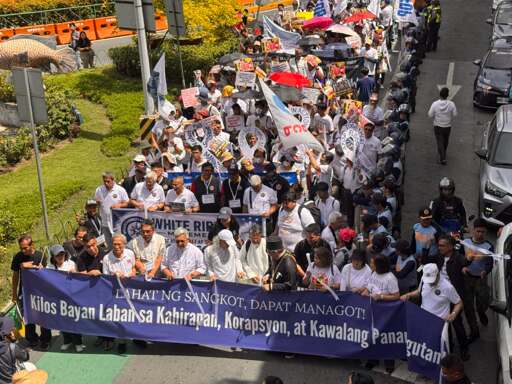
MANILA – Leaders from different religions and other civil society groups marched on Sunday, June 29, for the White Ribbon March, calling for truth, accountability and righteous governance.
Throughout the program, representatives from different religious traditions expressed a common message: corruption weakens public institutions, deprives communities of basic services and erodes public trust. Rather than calling for division, they appealed for peaceful action grounded in truth and accountability.
Organized by the Inter-Religious Leaders Council for National Transformation and the White Ribbon Movement, religious leaders and members of civil society delivered their prayers and speeches that were focused on moral leadership, justice and responsible governance.
The mobilization highlighted how systemic corruption inflicts direct physical and economic violence on the country’s most vulnerable sectors. “When the nation’s funds are stolen, the medicines of the sick are stolen. The food of the hungry is stolen. The education of our youth is stolen,” Kidapawan Bishop Jose Colin Bagaforo said in his opening message.
“Our call is simple, clear, and direct. If someone sinned, they must answer for it. No exemptions, no VIPs, no matter the alliance or party. The corrupt must be jailed from top to bottom,” the bishop added.
Bishop Ellie Mercado of the Philippine Council of Evangelical Churches (PCEC) also warned that corruption kills hope. He said, “Whether it is in the past administration, in the present or even in the future, we need to call for accountability. This is a divine demand, not just a political slogan… If we are believers in a living and holy God, we take action to fight this system.”
“We are calling for a radical change in our government and in our society. To the point of having true obedience to the truth. To the point of having true justice where the little ones, the poor, are not denied their due, but are truly given true justice,” Mercado said in a mix of Filipino and English.
Other religious groups expressed institutional repentance. Glofie Baluntong of the United Church of Christ in the Philippines (UCCP) noted that faith communities have sometimes chosen silence or feared the struggle, failing to uplift the vital role of the working class and farmers in forging a just society. She prayed for a nation where citizens walk humbly but stand firmly to defend basic healthcare, education, and labor rights.
Meanwhile, the Orthodox Church petitioned for leaders to recognize that material assets accumulated through graft have zero value before God and must be structurally redirected to empower the oppressed.
“There is no peace in corruption committed by leaders in society. There is no peace in poverty. There is no peace in human rights violations,” declared Sheikh Aleem Umar Bobis of the Imam Council of the Philippines.
Sheikh Bobis pointedly noted that when public funds are stolen, communities literally submerge in floods, and the basic taxes paid on a single grain of rice become the subject of greed among institutional “crocodiles” while the poor struggle to transition from lunch to dinner.
This sentiment was mirrored by Minnie Anne Mata-Calub of the National Council of Churches in the Philippines (NCCP), who stressed that generational poverty is not an individual failure of the poor but a condition dictated by an unjust system.
“Those in power use the law and authority to steal, pave the way for, and protect corruption,” she stated, calling for a return to the example of a faith that actively sides with the sick, the hungry, and the displaced.
Aside from religious leaders, speakers from different sectors of society were also invited to provide more context on the current Filipino situation. Invited were labor leader Luke Espiritu, who talked about employment, contractualization and other labor issues, Dr. Angela Sison-Aguilar of Doctors Opposed to Corruption who discussed the uneasy access to healthcare, Danilo Ramos of Kilusang Magbubukid sa Pilipinas, who also called for the release of sugar worker’s organizer Julie Ann Balora, and University of the Philippines Professor Danilo Arao of Kontra Daya who talked about the need for electoral reforms, among others.
Several Catholic institutions also called on people to participate in the White Ribbon Movement, outside the gathering at the EDSA People Power Monument.
In a pastoral message dated June 22, Archbishop Gilbert Garcera, president of the Catholic Bishops’ Conference of the Philippines (CBCP), asked bishops, priests and lay ministers to keep praying for the country’s “enlightenment, conversion and renewal.”
Bishop Gerardo Alminaza of the Diocese of San Carlos also issued a pastoral call the following day for parishioners to wear white or a white ribbon during Sunday Mass and to display white ribbons in homes, schools and workplaces. The request was echoed by churches all around the diocese including the St. Anthony of Padua Parish in Toboso, Negros Occidental, which called on the faithful to pray for the country and its leaders and to become “instruments of peace and unity.” (AMU, RVO)
The post Interfaith leaders unite to call for truth, accountability appeared first on Bulatlat.
From Bulatlat via This RSS Feed.