

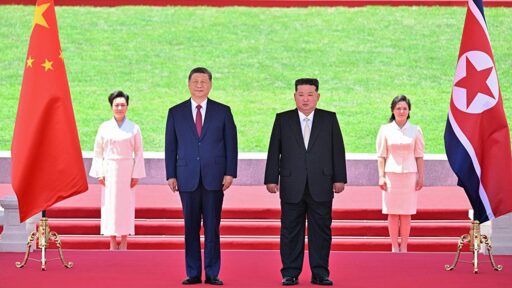
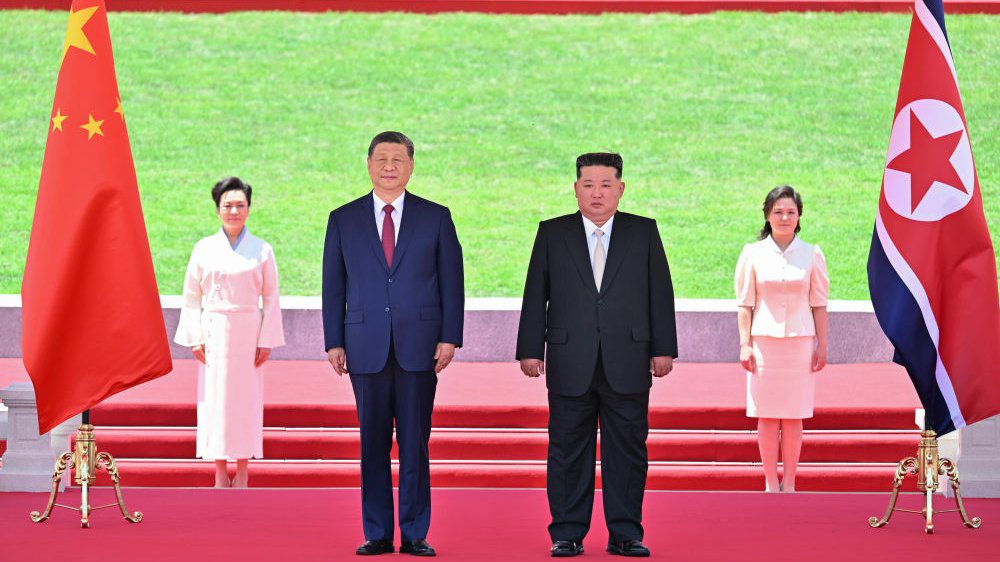
On June 8, President Xi Jinping arrived in the Democratic People’s Republic of Korea (commonly referred to as North Korea) for a two-day visit, his first since 2019. Accompanied by a high-profile entourage that included Foreign Minister Wang Yi, Defense Minister Admiral Dong Jun, and CPC Secretariat Member Cai Qi, Xi’s arrival highlighted the deepening strategic partnership between the neighboring socialist states, which have as of late entered a new chapter in their relationship.
Much was said from both sides about the profundity and unshakeability of their “invincible” friendship, along with pledges to expand bilateral cooperation, strategic dialogue, and economic and political coordination as fellow socialist states. Yet little emerged in the form of concrete and verifiable commitments. It can be assumed that the precise details of future joint efforts are still under discussion, or may not be considered necessary to announce at this time.
Silence, however, can be its own kind of statement. What was perhaps most noteworthy about the visit was Xi’s reticence on the Korean nuclear issue. This has revived speculation, in Washington and Seoul alike, that China may have unofficially decided to backtrack on its longstanding opposition to the DPRK’s nuclear armament. Underlying this is a growing push for strategic alignment between Pyongyang and Beijing, impelled by their common security interests in the face of a rapidly militarizing region, and growing prospects for economic collaboration.
China and the DPRK
Mao is said to have referred to the relationship between the Korean and Chinese revolutions as one of “lips and teeth,” borrowing an old Chinese proverb to explain the necessity of military mobilization to defend the DPRK in the Korean War. To this day, the DPRK is the only country with which China has signed a mutual defense treaty.
The relationship, however, has not always been rosy. In more recent decades, the teeth, at times, have bitten the lips.
After China’s Reform and Opening Up, economic and material contradictions superseded ideological and political disagreements. The 1990s brought severe challenges to the DPRK with the collapse of the Soviet Union and the Eastern Bloc. Shortly afterward, China suspended its interest-free loans and discounted prices to the DPRK. It also expanded its trade relations with the Republic of Korea (ROK), and normalized relations in 1992.
While China provided food aid and discounted prices to the DPRK in the difficult years of the Arduous March, which began in 1995, the crack that opened up in the 90s widened with time. China’s strategy of development required integration into the international liberal order and a drastic pivot towards a more anodyne foreign policy. China’s rise as a manufacturing and technological power could not have been achieved without this shift. In comparison, the DPRK rejected liberalization to the extent pursued by China. When its attempts to engage the world market were obstructed by US sanctions and military threats, Pyongyang redoubled its emphasis on military deterrence, best exemplified by its nuclear weapons and ballistic missile arsenal.
Divergences in the economic bases of the two countries and their respective relationship to world capitalism inevitably produced political tensions, particularly as the DPRK’s nuclear deterrence heightened its longstanding conflict with Washington. This presented a serious security challenge for Beijing, as a war in the Korean Peninsula would undoubtedly compel it to enter the fray. China therefore played the role of applying third party pressure to urge denuclearization, even as it acknowledged the historical reasons for the DPRK’s nuclear weapons program. China curtly reprimanded the DPRK for its sixth nuclear test in 2016, telling Pyongyang to “stop taking actions that worsen the situation.” As the DPRK faced tightening UN Security Council sanctions after its debut nuclear weapons test in 2006, China did not rally to its defense for many years, only beginning to wield its veto power to block future sanctions in 2022.
For its part, the DPRK refused to yield to pressure from any side, including from Beijing. Pyongyang’s embrace of enhanced ties with Russia can in part be explained by the frostiness that developed with China due to their differences over the nuclear issue. Expanding its roster of allies provided the DPRK with greater diplomatic space to maneuver, ensuring its political and military independence would be upheld.
Just days before Xi’s appearance in Pyongyang, DPRK state media published photos of Kim Jong Un’s visit to a newly built nuclear enrichment site. The implicit message was simple: despite diplomatic pressure, the DPRK remains committed to its nuclear deterrent. The message was clearly received in China as well.
At the level of policy, Beijing and Pyongyang were not technically at odds until quite recently. The DPRK remained officially open to denuclearization in its discussions with the US, granted that such denuclearization would encompass the Korean Peninsula rather than just the DPRK. Pyongyang took concrete steps to demonstrate its good faith in this position, freezing its nuclear reactors as Yongbyon after the signing of the 1994 Agreed Framework, and adopting a self-imposed moratorium on ballistic missile tests during its engagements with the first Trump administration in 2018-19. The lack of tangible returns from the US prompted a change in policy. In 2013, Pyongyang enshrined its nuclear status into law, and in 2022, extended its position to declare that its nuclear armament was a permanent decision that would not be subject to negotiation with any foreign power. The repeated failure of diplomatic engagement with Washington, accompanied by relentless military threats, were the key triggers for this decision.
Pyongyang now maintains, often vociferously, that no diplomatic talks premised on denuclearization will ever take place, and that repeated attempts by Seoul, Washington, and Tokyo to cling to this “anachronistic dream” constitute a violation of its sovereignty. The DPRK is also seeking to further expand its nuclear capabilities, which Kim’s visit to the new nuclear enrichment facility demonstrated. The Stockholm International Peace Research Institute now estimates Pyongyang’s nuclear arsenal numbers at some 60 warheads, with enough enriched material leftover to produce 30 more.
The long view of the DPRK’s nuclear weapons saga shows it has successfully managed to make its status as a nuclear power accepted over time. China’s pro-denuclearization policy has yet to officially change, but representatives of the government have avoided raising the matter publicly since 2023. Xi’s visit confirmed that this trend will continue, providing an important diplomatic victory for Pyongyang that comes at Washington’s expense. While Trump informally referred to the DPRK as a nuclear power at the start of his second term, his administration has stepped up its efforts to demand denuclearization since Xi’s visit. This may bring some turbulence to the Korean Peninsula in the short-term, but it also conveys desperation. Without China’s support, the US is unlikely to succeed in maintaining denuclearization as the basic framework for engagement. When Trump attempted to claim that Xi had expressed support for denuclearization during the summit in May, China’s foreign ministry responded by publishing its own summary of their discussion that excluded the topic, and exposed Washington’s dishonesty. If Pyongyang can succeed in redefining the terms of engagement with the US to leave the nuclear issue in the past, it will ultimately vindicate its policy of nuclear deterrence.
Mutual security and mutual prosperity
China’s tacit acceptance of the DPRK’s nuclear status reflects a renewed push towards strategic alignment. Kim Jong Un’s visit to Beijing last September for the 80th anniversary of the victory in WWII was notable for the pride of place given to him alongside Xi and Vladimir Putin. In a joint meeting between the two heads of state during that visit, Kim and Xi reaffirmed their countries’ ties, gesturing to both their shared history of anti-imperialist struggle in the Korean War, as well as their status as fraternal socialist states. This framework, which China has referred to as “inheriting the past to usher in the future,” was reiterated in Pyongyang by the Chinese delegation.
The strategic realignment taking place between Beijing and Pyongyang can be best understood by their mutual security and economic interests. East Asia has long been a site of contention between socialist countries and US imperialism since the end of WWII. The US Pacific Command (PACCOM) is the largest of the Pentagon’s 11 unified combatant commands, fielding 375,000 troops in over 300 bases spread across more than half of the earth’s surface. Over 170 of these bases are concentrated in the Korean Peninsula and Japan.
Some speculation over possible deescalation in the region emerged after Trump’s recent visit to Beijing. While Trump avoided any over-the-top statements during his summit with Xi, this is probably better explained by the strategic quagmire he has created with the US-Israeli war on Iran, which now dominates Washington’s attention. Moreover, rhetoric cannot be mistaken for facts on the ground. The US may calibrate and soften its rhetoric vis-a-vis China and the DPRK depending on the contingencies of the time, but its military posture in the region continues to harden.
Since 2021, the US has expended more than $60 billion on the militarization of the region through the Pacific Deterrence Initiative. In the age of Trump 2.0, Washington has given the green light for its regional vassals to rapidly expand their war budgets, build up their arms production capacity, and assist in US attempts to reorient supply chains for strategic minerals and chip technologies away from China. Japan currently leads the pack in escalating war expenditures, raising its military budget this year to a staggering ¥9 trillion (58 billion USD). Prime Minister Sanae Takaichi has also lifted her country’s ban on weapons exports, vowed to dismantle the country’s “peace constitution” which has been in place since WWII, and set off a diplomatic firestorm with Beijing after pledging to go to war in the Taiwan Strait if necessary.
As treasuries pump out money and factories assemble new arsenals, Washington is also assembling its alliances into a growing military bloc, using increasingly frequent and provocative military exercises to expand interoperability and heighten pressure on its adversaries. In April, the Balikatan exercises in Philippine waters saw the US fire long-range missiles within striking distance of the Chinese targets, along with Japan’s first overseas missile launch since WWII. The coming months will bring many more occasions for similar kinds of provocation: Valiant Shield between the US and Japan will take place in June. Over 30 nations, including Israel, will participate in RIMPAC in Hawai’i in June and July. REFORPAC will take place in Guam in July. Ulchi Freedom Shield is taking place in Korea in August. Finally, the trilateral Japan-ROK-US Freedom Edge naval drills are in September. These military exercises are not just keeping a steady beat to the drums of war; they also build the interoperability and coordination experience necessary to unite multiple militaries under Washington’s direction.
While Xi and Kim’s public statements during their latest meeting avoided direct references to US and Japanese military threats, the two leaders did speak on the need for “strategic coordination” to uphold regional peace and safeguard the international order from “hegemony and power politics.” The regional context makes reading between the lines simple: Beijing and Pyongyang are uniting to oppose the militaristic push from Tokyo and Washington. The Korean Peninsula, after all, is as much of a potential regional flashpoint as the Taiwan Strait or the South China Sea.
Security, however, is not the only motivation bringing the DPRK and China closer together. The DPRK is in the midst of an economic boom, a fact that now even The New York Times and the Wall Street Journal have been forced to admit. With this change in fortunes come important opportunities for both parties to expand their economic ties.
Watch: North Korea’s economy is booming – even US media can’t ignore it
Details, again, are scant, but it is likely that the two leaders discussed the revival of a joint economic project to develop the area surrounding the Tumen River, which flows along the border of the DPRK and Russia. The development of commercial river transport would open a new channel for Chinese exports from its northeast directly into the East Sea (known as the Sea of Japan internationally), drastically reducing export costs by shortening the current sea route from the Bay of Bohai, and providing a direct link to potential Arctic sea routes to Europe via Russian waters.
Such a project would take many years to materialize, but the reversal in the DPRK’s economic fortunes and China’s own need to diversify its maritime trade routes will be strong motivating factors for both parties. If completed, the project would have the potential to transform the DPRK into a commercial entrepot and a critical hub for global trade, with transformative effects for the country and the geopolitics of the region.
Ju-Hyun Park , July 1, 2026
From BT News via This RSS Feed.