

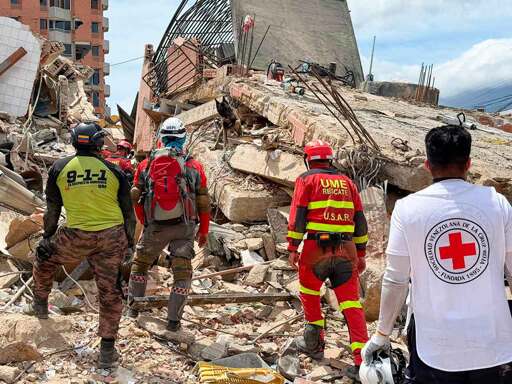
Caracas (OrinocoTribune.com)—On Tuesday, in the latest report on the emergency response following the double earthquakes that struck north-central Venezuela last Wednesday, President of the National Assembly Jorge Rodríguez stated that due to the tireless work of rescuers, more than 6,460 people have been rescued from collapsed buildings and houses. So far, the death toll has risen to 1,943, with 689 aftershocks recorded.
Rodríguez noted that the frequency and magnitude of the aftershocks have decreased: “On Sunday, June 28, we had 86 aftershocks,” and in comparison, “on Monday, June 29, we had 30 aftershocks, and the strength of the aftershocks has also decreased.” He explained that this does not mean that the probability of another dangerous event has been eliminated, but it has diminished greatly. “When the threat has completely diminished, we will let you know,” he stated.
Breakdown of rescue operations
The parliamentarian explained that government models and surveys estimate that approximately 30,000 people were in Caraballeda and Catia La Mar, the worst-hit areas of La Guaira, when the earthquakes occurred. In the immediate aftermath of the emergency, an estimated 13,400 to 13,500 people managed to evacuate on their own or with the assistance of relatives. Adding this figure to the number of rescued survivors (6,460) produces a total of approximately 19,960 people who are accounted for as alive.
During the first day, Civil Protection, the Bolivarian National Armed Force (FANB), police forces, and family members helped rescue 2,407 people across those two areas. On the second day, with the integration of rescue teams from other parts of the country and international delegations, an additional 2,973 people were saved, Rodríguez said.
The subsequent days saw the following rescue figures:
• Third day: 731 survivors rescued;
• Fourth day: 345 survivors rescued;
• Fifth day (Monday): Four survivors rescued;
• Sixth day (Tuesday): One two-year-old baby rescued thus far.
The numbers show a sharp decline in the number of rescued survivors over the last 48 hours, leading to a debate regarding when to conclude search-and-rescue operations to begin the reconstruction process. The Venezuelan government has reiterated that no search efforts will be halted if there is even the slightest possibility of finding survivors despite international evidence showing that the probability of finding survivors decreases sharply after the third day.
Discrepancies in missing persons data
Despite the high number of successful rescues, the data provided by Rodriguez indicates that the number of missing people in La Guaira remains close to 8,000 when subtracting the confirmed fatalities (1,943) from the total number of individuals who remain unaccounted for (10,040).
This estimation aligns with international statistical models but stands far below the figures published by informal, inaccurate websites—frequently cited by mainstream media outlets to dramatize the scale of the catastrophe—which claim between 40,000 and 70,000 missing people. Analysts emphasize that a simple review of these platforms reveals a total lack of verification mechanisms and a high duplicity of records, severely undermining their credibility as reliable sources.
Shelter, medical care, and humanitarian aid
To date, the official count confirms 10,571 injured individuals. The number of directly affected people stands at 15,866, who are currently being sheltered in 14 temporary camps in La Guaira state and another 55 camps distributed across Caracas, Miranda, and other affected regions.
Rodríguez noted that the number of citizens receiving comprehensive care, including those hospitalized and sheltered, amounts to 28,380, while the total number of families served reaches 80,870. To support communities within the disaster zone, authorities have distributed 3.2 million liters of drinking water and over 700,000 tons of international humanitarian aid.
The Chavista leader explained that in Caraballeda, the majority of the collapsed structures were vacation units, whereas in Catia La Mar, the seismic impact primarily affected permanent residential buildings.
Psychological helpline
The 0-800-AYUDA-01 helpline has received 410 calls. Out of these consultations, 39% involved severe cases of psychological or psychiatric distress, including mood disorders, post-traumatic stress, insomnia, anxiety, anguish, sadness, grief, confusion, and lethargy. “These are natural consequences for people who survived a calamity of this magnitude,” Rodríguez stated.
Restoration of services and communications
The electrical grid in La Guaira is almost completely restored, the legislator reported. Regarding telecommunications, interconnection in the region has been significantly recovered, with service capacities operating as follows:
• Cantv: 70%;
• Digitel: 64.15%;
• Movistar: 26.86%;
• Movilnet: 24%.
Structural damage inspections
Francisco Garcés, head of the Presidential Commission for the Habitability Assessment of Affected Housing, reported that highly qualified engineers are already providing specialized training to enable local engineers and architects to conduct structural assessments of buildings damaged by the earthquake. He explained that this is an organized initiative coordinated alongside national universities, the College of Engineers, and various public entities.
The immediate strategy involves building a comprehensive database to recruit professors, graduates, and graduating students with the necessary technical profiles to join the damage inspection brigades. This is paired with rapid technical courses on post-earthquake inspection protocols. During the initial prioritization phase, these professionals will focus exclusively on critical facilities, including hospitals, fire stations, civil protection centers, and temporary shelters.
Alongside the trauma suffered by tens of thousands of directly affected Venezuelans, residents in the hardest-hit zones now face the difficult decision of whether it is safe to return to their homes alongside the challenge of addressing internal structural damage.
Caracas Government Inspects 300 Buildings Following Earthquakes, National Commission Established
On Monday, Garcés published a video providing details about the first evaluation conducted on a social housing project built by the Bolivarian Revolution located across from the Simón Bolívar International Airport. He indicated that after several hours of thorough evaluation by 22 inspectors, the commission determined that the buildings suffered no structural damage. Garcés also provided highly educational instructions on how technical teams systematically evaluate structural damage in residential infrastructure.
Special for Orinoco Tribune by staff
OT/JRE/SL
From Orinoco Tribune via This RSS Feed.