

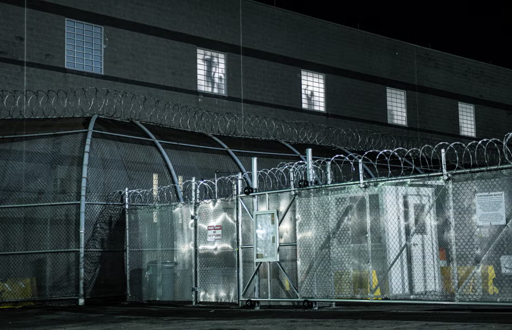
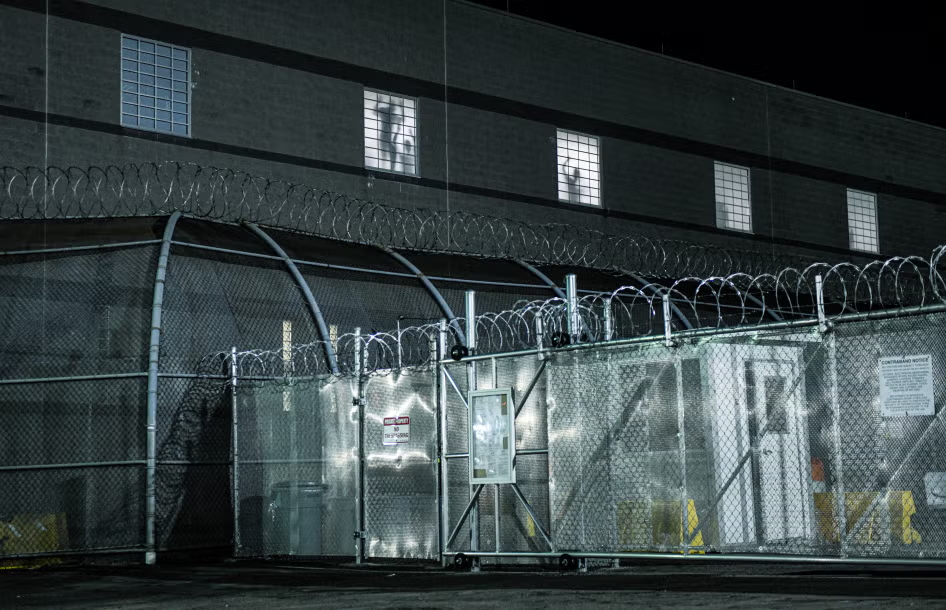
Nowhere is ICE’s true nature as a weapon of class warfare and a vehicle for ethnic cleansing more obvious than at the Delaney Hall concentration camp, which has put Newark, New Jersey’s mostly immigrant and working-class Ironbound neighborhood on the frontline of Trump’s mass deportation campaign. Protests outside the facility have been near-constant. But the greatest wave started on May 22 as a result of the groundbreaking hunger and labor strike by the men and women within the facility—bringing with it the harshest crackdown by the repressive forces of the state.
The Long Siege of Delaney Hall
Delaney Hall opened like a slap in the face on May 1st, 2025. GEO Group (the contractors charged with running the facility) and ICE began operations without having passed a single building or safety inspection, and they immediately began to fill up their newest concentration camp—the largest of its kind on the East Coast. That same day, New Jersey DSA marched through Newark alongside immigrants’ rights-based community organizations like Movimiento Cosecha, New Labor, and Resistencia. That May Day march was billed as a “Workers’ Memorial Day,” honoring the working people who had already lost their lives to ICE. Although we certainly dreaded the possibility, we did not know how many more losses we’d have to grieve by the same time this year.
Since its opening, there have been multiple flareups of protest against Delaney Hall. On May 9, 2025, Newark Mayor Ras Baraka attempted to inspect the newly renovated facility, accompanied by Representatives Bonnie Watson-Coleman, LaMonica McIver, and Rob Menendez, Jr. All were denied access despite their constitutional authority to inspect any federal facility at any time. ICE agents then kidnapped Baraka, effectively holding him hostage through the following night. Rep. McIver still faces spurious assault charges from her attempt to enter the building.
Barely a month later, frustrations with the failure to provide adequate food boiled over, leading to an uprising by detainees. In the commotion, four men escaped through a shoddily constructed wall. This prison break and the protests that followed drew Senator Andy Kim to Delaney Hall for the first time. Also for the first time, Sen. Kim and Rep. Menendez were allowed to enter for a limited inspection. In the aftermath, ICE demonstrated its willingness to use transfers to other facilities as a means to break immigrant resistance. These punitive transfers triggered an intense wave of protests as some tried to block the buses from carrying ICE’s victims off to the Moshannon concentration camp in Pennsylvania and detention centers as far away as Texas.
During Delaney Hall’s first winter, ICE admitted to the death of a detainee in their custody: Haitian immigrant Jean Wilson Brutus, age 41. They offered little to no explanation for Brutus’s death beyond a “medical emergency,” which sparked outrage. Somber crowds came to mourn the senseless loss of life, demonstrating that a large number of people in our communities were willing to turn out to resist ICE even in the below-freezing temperatures of the dead of winter.
Over the course of the year, several community organizations and immigrants’ rights groups coalesced to keep up the pressure at the facility. Two overlapping coalitions—Eyes on ICE, and Labor Eyes on ICE—formed. The former focused on mutual aid; providing food, clothing, and connection to services. The 24/7 Eyes on ICE “Radical Hospitality” tent became a space for rest and solace for the visiting families of detainees. Labor Eyes on ICE brought together several unions in northern New Jersey to take shifts during the 24/7 vigil and to conduct regular weekly pickets outside the camp’s gates. This all marked the near-constant presence of protestors.
That’s where things stood when Delaney Hall’s prisoners announced a hunger and labor strike on May 22, 2026.
An Inside Outside Strategy
Word of the strike first reached the community through the families of striking detainees. Gabriela Soto, the wife of Martin Soto, called for those on the outside to bring greater numbers out to the facility in solidarity. NJDSA’s statewide Immigration Justice Working Group (IJWG) immediately mobilized for an all-hands-on-deck situation.
It did not take long for ICE and GEO to cancel visitations. This was almost always the first punitive measure ICE turned to against detainees and those who fought for their freedom. By denying detainees access to their families and lawyers, they also deprived them of their most direct line of communication with the outside world. Throughout the strike, however, detainees still managed to get out four letters describing the conditions they faced and the demands of their strike.
The first two letters describe harrowing conditions where “people with mental health issues, physical disabilities such as deaf and non-verbal, elderly individuals, and young people with juvenile status” are indiscriminately confined in close quarters. Flu is a “constant problem,” and detainees are “tortured physically and psychologically due to the poor food resources provided.” The strikers demanded freedom for all residents of Delaney Hall, prioritizing the immediate release of the young, the pregnant, the sick, and the elderly. They also demanded a meeting with Governor Mikie Sherrill to discuss their conditions. When Sherrill tried to tour the facility, ICE denied her entry, asserting that they were only legally required to offer access to federal elected officials.
Increasingly large crowds gathered outside Delaney Hall in the following days. We chanted to make sure those imprisoned inside knew we were with them. They responded in all the ways they could; pressing themselves against windows so their silhouettes could be seen, flipping lights on and off quickly, raising their fists and waving their hands. It was a beautiful display of solidarity.
By Memorial Day Weekend, a rhythm had taken shape between ICE and protestors. At the North Gate, things remained relatively calm. Eyes on ICE’s mutual aid tent provided a place of respite for families awaiting the release of detainees. There were children, wives, relatives, volunteers with immigrant rights organizations, and people involved in their legal support and defense. GEO’s staff also came and left through the North Gate, meaning the driveway had to be regularly cleared. At the South Gate, ICE agents remained in a semipermanent standoff with a larger crowd of protestors. ICE agents often pushed people into the crowd as large trucks passed by—one can only assume that this tactic was meant to either indirectly kill protestors or to use that possibility as a means of intimidation. The night usually ended when ICE agents deployed pepper spray and tear gas to disperse the crowds, already dwindling due to the late hour.
These attacks became more aggressive as the protests continued. A protester’s foot was crushed under the wheel of a truck on the night of May 27 after having been pushed by an officer. The next night, ICE pepper-sprayed the crowd at the South Gate multiple times before the sun had set, a sign that their patience was wearing thin.
As ICE escalated its dispersal tactics outside the facility, it also grew more brutal and depraved in its attempts to break the strike within. In their fourth letter, the strikers wrote that GEO staff threatened to deport the strikers, transfer them to “punishment units,” and begin moving them to other facilities. Martin Soto, whom ICE claimed was the strike’s “leader,” was transferred to the Elizabeth Detention Center (EDC) under the cover of tear gas, nearly blinding Sen. Andy Kim as he tried to broker a deal between protestors and ICE. The second strike letter reported that agents indiscriminately launched tear gas inside the facility against detainees, beat strikers in their cells, and denied them access to common and outdoor areas.
Mikie Sherrill Reports for Duty
The New Jersey State Police (NJSP) arrived on the night of Friday, May 29, Governor Sherrill’s most forceful intervention in the conflict yet. As events unfolded, public statements by the Governor, and Attorney-General Jennifer Davenport, seemed to emerge from a parallel universe of the administration’s own making, disconnected from the all-out assault the NJSP launched against protestors over the following days.
Ostensibly ordered to create “peaceful protest zones” in preparation for the arrival of pro-ICE demonstrators on Saturday morning, the NJSP set up a web of grated metal barriers outside the facility, also closing off roads. Towards the end of the night, NJSP deployed dozens of state troopers on horseback, in full riot gear and armed with tear gas, pepper spray, batons, and rubber bullets. The police shot indiscriminately into the crowd. Sherrill still has not attempted to justify this level of violence, which was repeated every night that weekend.
The next day, a vanishingly small crowd of Republican Party agitators set up in a “protest zone” towards the south end of Delaney Hall. This crowd included a strange gaggle of Proud Boys; ironically, the only boy among them was a young child, who the mostly middle-aged white nationalists firmly planted in front of themselves like a human shield. Where ICE agents had “held the line” outside the south gate at Delaney Hall, there were now barriers erected by NJSP. Behind them stood a combination of State Troopers and Essex County Sheriff’s deputies. Even as she publicly repudiated private detention facilities, Sherrill’s forces had taken up the role of security for Trump’s ICE agents.
Tensions remained high throughout the day as State Troopers made ostentatious displays of power during shift changes. In the afternoon, they kettled protestors without warning or explanation. Police took up a position on top of the medical staging area, and stayed there just long enough to watch medics and others scramble to pick up all their supplies and move them in a panic. Almost as soon as they did so, the State Troopers retreated back to their original position, leaving behind a mess of medical supplies and inflamed tempers.
This reflected a disturbing pattern from the NSJP of targeting medics, and a growing number could show us their bruises from rubber bullets. Meanwhile, as the Sun began to set, more and more horse transports for mounted State Troopers pulled into their staging area in preparation for another assault. A reporter’s arm was broken during that evening’s brutality. NJSP and Mayor Baraka’s Newark Police Department declared a curfew on May 30 within the half-mile radius around Delaney Hall, and the NPD joined the NJSP in dispersing protestors.
Governor Sherrill and Attorney-General Davenport could only muster pathetic defenses of their new roles as Quislings for the Trump administration’s deportation machine. The former fell back on tired old lines about “out-of-state agitators” and insisted that the protests overall remained peaceful, without acknowledging that State Police had launched a continued and unprovoked assault on protestors. Davenport’s public statement even suggested that tear gas canisters had magically appeared at the feet of protestors to be kicked at police.
Rather than “turn down the temperature”—Sherrill’s stated goal—the protests did not subside, and the crowds were angrier than ever. Mayor Baraka, although he had collaborated in the declaration and enforcement of the curfew, publicly criticized the brutality of the NJSP, even going as far as to compare their tactics to ICE. Journalists who had been attacked and arrested by the NJSP were released.
Mayor Baraka lifted the curfew around Delaney Hall on June 3. Newark Police maintained a presence over the next few days, but, according to the Mayor, they were under orders to use “community policing tactics” to de-escalate the situation rather than obstruct protestors. This belied the fact that for at least a day NPD turned away anyone arriving to the area with a face covering of any kind, whether it be an N-95 or a keffiyeh. Things came to a head on June 7 when protestors attempted to block GEO Group employees’ cars while they were leaving at the end of their shifts, and officers made an arrest.
In a public statement on the matter, Mayor Baraka admitted that “some officers were over aggressive.” Soon after this the NPD presence began to dwindle down to the minimal levels seen prior to the strike.Things have returned to the status quo ante of a daily standoff between protestors along Doremus Avenue, and ICE agents and GEO Group staff at their gates. With it, the reckless violence and attempts at vehicular manslaughter by agents has returned.
With Friends Like These
Gov. Sherrill’s first instinct was to sic the NJSP on protestors until they dispersed. Many Democrats’ first statements rarely if ever foregrounded the hunger and labor strike, and instead trotted out stereotypes of peaceful protests infiltrated by outside agitators. Never mind that in every instance ICE initiated the violence against protestors. Never mind that Sherrill’s deployment of NJSP blatantly violated the Immigrant Trust Directive, which strictly prohibits any coordination or cooperation between state and local authorities and federal agencies carrying out immigration enforcement.
For moderates like Sherrill, the Democrats are part of the “Party of Order,” same as the Republicans. All the lies and hypocrisies, and the violent repression, were justified in the pursuit of “peace:” one that can only be described in the terms of Dr. Martin Luther King, Jr in his Letter from Birmingham Jail: a “negative peace, which is the absence of tension,” and not a “positive peace which is the presence of justice.”
If the NJSP’s intervention was designed to make Sherrill’s perceived political problems go away, the sheer scale of the violence only brought down more pressure on her administration. In response, Sherrill turned to a second instinct: opportunism. Facing a cascade of criticisms from progressive groups claiming she “failed” her first test as governor, Sherrill gave a $12 million funding boost to New Jersey’s Detention Deportation Defense Initiative (DDDI), sued ICE for not permitting NJ Department of Health officials to inspect, and was ultimately granted a limited tour of the facility. Sherrill continues to insist that her and her administration’s position is that Delaney Hall must be shut down.
The strike and protests at Delaney Hall made it impossible for NJ and NY Democrats to avoid the issue. Josh Gottheimer, one of the most conservative members of the Democratic Caucus, felt the need to appear alongside Leader Hakeem Jeffries and Reps McIver and Menendez on an oversight visit. Even Cory Booker found it in himself to overcome his allergy to being seen in his hometown of Newark, and joined to visit. Representative Dan Goldman (who just lost his own primary to Brad Lander) accompanied retiring Representative Jerry Nadler on a trip to the facility the same day Adriano Espaillat (who also just lost a primary to DSA member Darializa Avila Chevalier) made the journey to Delaney Hall.
Most of the Democrats who visited Delaney Hall and called for its closure fell short of calling for the abolition of ICE. Some of these Democrats have even voted with Republicans on immigration bills, like Rep. Gottheimer, and Gov. Sherrill while she was still in the House. Support for half-measures is unsurprising; it also makes no real sense. As the strikers laid out in their letters, shutting down the facility without freeing those inside is meaningless. It would simply mean the transfer of interned immigrants to other facilities with the same exact inhumane conditions and abuses. All ICE detention centers share Delaney Hall’s inhospitable living conditions, and must all be shut down, and their detainees released.
Long Live the Strike!
Over 300 detainees signed the “S.O.S.” letter declaring themselves a part of the hunger and labor strike. On May 27 Gabriela Soto told the AP that “every single detainee inside…is participating.” At their peak the protests on Doremus Avenue made it more difficult for ICE to punitively transfer strikers, and ICE even released a number of striking detainees back to their families, including an 18-year-old high school student. The State Troopers’ deployment disorganized the protests, however, keeping large crowds away. And when the NJSP left, so too did many reporters. Punitive transfers were carried out unimpeded as numbers dwindled throughout the month. Through these transfers, the targeted use of solitary confinement, and through sheer brutality, Eyes on ICE reported on June 22 that the strike had been broken.
Yet this does not mean that ICE has won an indisputable victory. There are still hundreds imprisoned in a concentration camp under unimaginable conditions. But the strike demonstrated the incredible power of collective resistance, and both those who participated in it and those who mobilized in solidarity have gained invaluable experience. It is now necessary to step back and survey the strategic landscape of the struggle against the mass deportation machine in New Jersey and across the country. Where do the forces involved now stand? What new fronts may be opened? Where will the next flashpoint be? What lessons must be learned for next time?
The conditions which sparked the strike at Delaney Hall are by no means unique; 52 people have died in ICE custody since 2024, killed by criminal neglect and abuse. This result is inevitable when Trump and his personal Reinhard Heydrich, Stephen Miller, set absurd deportation goals in pursuit of plans to redefine American citizenship and remove a large part of the working class from the country. On May 19, 3 days before Delaney Hall’s strike began, another hunger strike was called at a concentration camp in Adelanto, California. There, too, solitary confinement, the threat of immediate deportation, and punitive transfers have been used to punish and isolate strikers.
These repressive measures have not impeded the outbreak of strikes, and transfers to other facilities may very well spread the know-how and will-power of experienced strikers throughout the concentration camp system. The ACLU confirmed on June 11 that strikes have broken out at three other ICE camps in El Paso, Texas, Philipsburg, Pennsylvania, and Baldwin, Michigan. Conditions are ripe for detainee resistance to spread like wildfire; but they will not be able to win their demands without community support.
As the detainees themselves argued, their imprisonment is intrinsically wrong. They have been denied due process, arrested while pursuing legal paths to residency and citizenship, and are subjected to conditions no human deserves to live in. This is all for what is, at worst, a civil infraction. There is no choice but to unceasingly fight for the closure of every one of ICE’s concentration camps, the prosecution of those who run them, and the dismantling of the whole deportation machine. “Abolish ICE” is the only battle cry for the resistance to the Trump regime.
Light & Air / Marxist Unity Group
Liked what you read? Subscribe to stay plugged in.
From Light & Air via This RSS Feed.