

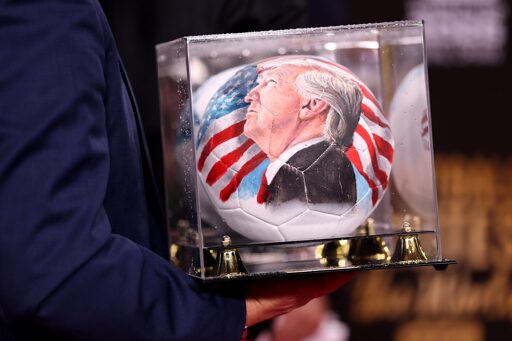
The 2026 World Cup has captured the world’s attention.
The highs and lows. The surprises. The United States’ defeat of Paraguay 4-1 in their first game. Cabo Verde’s tie with Spain. Ecuador’s defeat of Germany. Fans cried in the stadium and around the world from joy and disbelief.
Here in Brazil, it is an obsession. Around-the-clock coverage. Watch parties on huge screens in cities across the country. People glued to their TVs.
But the 2026 games in the United States, Mexico, and Canada have also been overshadowed by US President Donald Trump’s administration—specifically, his anti-immigration crackdown and authoritarian backslide.
Fans, players, and even world-class referees have been barred from entering the United States for the World Cup. Players have been detained, questioned, and had their luggage searched by dogs. Videos have gone viral of African players facing extended searches and security checks. The Democratic Republic of Congo’s most avid supporter was forced to return home after he failed to obtain a visa.
US officials forced Iran’s team to stay in Mexico, even though their games were played in the United States. Their logistics people were blocked from entering the US at all because they couldn’t get visas.
“This is a disaster World Cup,” Mehdi Taremi, the Iran National Team captain, said in a press conference. “We can’t stay in the country and have to travel every time we play without any recovery. Now we can’t stay in Seattle and have to return to Tijuana. This is not fair.”
The captain of Iran’s National Team, Mehdi Taremi, calls out FIFA and the U.S.:
“This is a disaster World Cup. We can’t stay in the country and have to travel every time we play without any recovery. Now we can’t stay in Seattle and have to return to Tijuana. This is not fair.” pic.twitter.com/z0gLN07bkB
— Power to the People ☭🕊 (@ProudSocialist) June 27, 2026
After tying all three games, the Iranian national team was knocked out of continuing on to the next round of play after controversial officiating.
It is not the image of unity that you usually find at the World Cup. But it is on par with everything that Trump has rolled out under his second term.
This is far from the only time that an international tournament has been held in a country run by an authoritarian leader undermining the rules of democracy.
The 1934 World Cup in Italy under dictator Benito Mussolini, the 1936 Olympic Games in Germany under Adolf Hitler, and the 1978 World Cup in Argentina under the military dictatorship were all used to give a positive spin to the image of each host country.
Soccer was used as propaganda by the South American dictatorships of the 1960s, ’70s and ’80s to unite the countries under authoritarian and military rule despite the violence, detentions, kidnappings, disappearances, violence, and human rights abuses.
To understand how Trump’s 2026 World Cup fits into the long history of authoritarian governments using international sporting events to distract from the evils of their administrations, I spoke with Fabiano Neme.
He’s a Brazilian lawyer, an avid soccer fan of the Brazilian soccer club Sport Club Internacional, and the author of the 2022 book Condor Football Club: The Political Use of Soccer in the Dictatorships of Latin America.
The title “Condor Football Club” is a nod to Plan Condor or Operation Condor, a US-backed secret security and terror network among the South American dictatorships of the 1960s, ’70s, and ’80s that detained, disappeared, tortured, and killed political opposition to the authoritarian regimes.
Fabiano Neme spoke from his home in Porto Alegre.
Michael Fox: What does the World Cup mean for Brazil? What does it mean for South America? I feel like people forget that the first World Cup ever was held in Uruguay in 1930. South America has a long history in the World Cup.
Fabiano Neme: It means a lot not only to Latin America, but to the world as a whole. Because you see, there are more countries so that sign up to FIFA — 211 — than to the United Nations — 193. It’s information that’s often forgotten. And for us in Latin America, football is a chance to express ourselves. It’s kind of hard for me to explain using English words, because football for me is so Latin. English is so rigid and it doesn’t contain the fluidity of football.
For us, football is like water. It’s how we move. It’s how we pass through things. It’s how we crash. It’s how we break. It’s how we flow.
Michael Fox: I love that metaphor. Talk to me a little bit about your book, Condor Football Club. And I think the subtitle is so important here: The Political Use of Soccer in the Dictatorships of Latin America. Because we oftentimes think of sports, or soccer, or futebol in Portuguese —futbol, in Spanish — as something that’s devoid of politics. Like, we’re here celebrating the World Cup in the United States and we don’t have to think about politics. But what your book reminds us is that it is actually deeply political. Can you talk a little bit about your book, where the idea came from, and the importance of politics in football or soccer?
Fabiano Neme: The idea for the book came to me when I was complaining to a friend about not having books about the subject. I saw a documentary that YouTube recommended to me that blew my mind. It’s called Memories of Lead, Football in Times of Condor. It’s a four-part documentary. And oh my God, I needed to know more about this. But there are almost no books on the subject in Brazil.
And my friend told me since there are no books about it, you should write it.
I kept that idea brewing inside of me. That’s when I met Matheus Bellé. He’s my co-author. He’s an archaeologist and he researches concentration camps in Latin America and during the dictatorships.
We met and we wrote the book during the pandemic. The main focus of the book is football in the dictatorships of Latin America during the ’60s, ’70s, and ’80s. What happened to the clubs, what happened to the national teams, what happened to the players. So it’s a book that’s not very fun to read, but I think it’s important.
Michael Fox: How did you get interested in this history and what does it mean today for people still?
Fabiano Neme: Well, my family is deeply tied to it. Before the coup happened in Brazil in 1964, there was an attempted coup in 1961. And an uncle of mine, he was the right hand man of Leonel Brizola, who was then the leftist governor of the state of Rio Grande do Sul, and he organized the armed resistance here in Porto Alegre.
My father always got arrested by the dictatorship, because his company used to support families here in Porto Alegre whose parents or husbands or other family members were abroad in exile.
And so this is deeply tied to my family and myself. I was questioned during the dictatorship. I was six years old, but I was questioned. Some guys took me from my classroom and asked me about my father, about my uncle. So, yeah, I was, like, born into it.
Michael Fox: Wow. That’s crazy. I’m constantly shocked that the dictatorship is so close. Like you said, you were six years old. And they could pick you up and they could take you out and interrogate you as a little boy. And how ingrained was this authoritarian rule in society and in schools and everywhere, and so much of it backed by the United States?
Fabiano Neme: There’s a book written by Vijay Prashad called Washington Bullets. I think that in order to understand Plan Condor, you need to read this book and understand why the US acted like it did.
Michael Fox: Fabiano, talk a little bit about some of the chapters in your book, like the 1978 World Cup in Argentina, because I feel like this underscores this question of how football is used by these authoritarian governments to lift up their image abroad in the world even while they’re detaining, they’re killing, and they’re torturing people. The World Cup was used like PR, right?
Fabiano Neme: Argentina was chosen as the host for the 1978 World Cup under Juan Peron. A couple of years after that, there was a coup. They removed the government and established a military dictatorship backed by the USA. And they used the World Cup to dismiss allegations from abroad about state terrorism and denials of basic human rights and torture and murder and disappearance of politically engaged people.
It kind of, kind of, worked. But at the same time, it kind of didn’t. Because there were some radio broadcasts that sometimes got into the TV transmission denouncing the dictatorship. Some protests occurred involving the Mothers of Plaza de Mayo.
And, for me, the most bizarre element is that the main stadium of the World Cup was Monumental Stadium. That was just half a mile away from the main concentration camp in Buenos Aires in the ESMA. So it was so bizarre. It was so bizarre because the prisoners were asked to celebrate the win with those who were torturing them. It was so strange. It dehumanized them so much. Because they said, “We’re not going to torture. You’re going to come with me. We’re going to watch the game. We’re going to celebrate. And then you go back. You go back into jail. Back into the cell. And now you’re going to die.”
So it’s so wrong. I don’t even have the words to describe it, because it’s insane.
It’s insane, what they did to Graziella, one of the prisoners. That they took her to a barbecue to celebrate and she was a prisoner. And she had the chance to open the rooftop window of the car. And she said, “If I scream here, nobody will notice, because of all the celebration happening around there.”
So it was such a strange event with so many contradictions and so much pain and glory at the same time. And I’m not even mentioning what happened on the playing field. Because Argentina made a big score to classify for the final. And there’s a rumor. I didn’t put it in the book, because I couldn’t confirm it. But the rumor says that the former US Secretary of State Henry Kissinger and the president of Peru went to the Argentinian dressing room to tell them, “OK, you’re going to win the game. You’re going to score so many goals and everything will be OK.” So it it was a rigged game from the start. The 1978 Argentine World Cup was a mess. It was terrible. It was great for the dictatorship, but bad for everything else.
“In this 2026 World Cup they are confirming the accusations. They are not denying it. They are saying clearly, ‘Non-white foreigners are not welcome here. Latinos are not welcome here. Africans get the F out of here.’ It’s very strange for me, because they had the opportunity to change the image of Trump’s regime, but they’re choosing to confirm it.”
Michael Fox: Why is this story about the 1978 World Cup so important today? What do we have to learn from it within the context of what we’re seeing during the World Cup games in the United States now?
Fabiano Neme: We chose to open the book with the 1978 World Cup because it summarizes the subject. It summarizes how football was politically used by the dictatorships in Latin America.
At that time, in 1978 — as well in the 1934 World Cup in Italy during fascism, under Benito Mussolini, and the 1936 Olympic Games in Berlin during the Third Reich — those three events were used to dismiss criticism from abroad about what was happening in those countries.
But what strikes me funny is that in this 2026 World Cup they are confirming the accusations. They are not denying it. They are saying clearly, “non-white foreigners are not welcome here. Latinos are not welcome here. Africans get the F out of here.”
It’s very strange for me, because they had the opportunity to change the image of Trump’s regime, but they’re choosing to confirm it.
Michael Fox: Do you think people are seeing that? I mean, I know that there’s been news stories. For instance, about the banning of the Somali referee Omar Artan. There’s the fact that the Iranian team can’t be housed in the United States. They’re actually in Tijuana. Even if they go to the United States to play their games, they have to leave the country, which is just insane.
Of course, we’re seeing the images of players from Africa and “third world” countries being manhandled and searched, whereas players from Europe are just flying in on their airplanes and being embraced. And so clearly those images are out there. But I wonder how how much those are being lifted up and being denounced at the same time as the games are happening.
In other words, do you think that those are actually getting into people’s feeds and that people understand just how authoritarian what we are seeing happening is right now?
Fabiano Neme: It depends. I think that this subject gets a lot of traction here in Latin America, in Africa, and in the countries where people are being denied entry into the US. But I don’t think that this information reaches most American eyes. I think that it’s being covered widely outside of the United States.
Michael Fox: What else are you seeing happening in the United States around this World Cup that kind of parallels what you’ve seen in the past and in some of these other situations around football being used politically to prop up the image of other authoritarian governments?
Fabiano Neme: I think it’s actually very different, in many ways. Because during the 1978 World Cup in Argentina and in the other games during dictatorships, the visitors were welcomed into the country. They had an easy time. They had a great time to see how beautiful the country was. Everything was great. But underneath this the people were suffering. Now, however, it’s the opposite. Now the visitors are not being welcomed. They are simply saying, “We don’t want you here. We are going to make you pass through hell to play your game and to support your team.” This is exactly what we saw happen to the Uruguayan national team. US security officers stopped their bus. They made all the players get out and they used dogs to sniff the luggage to see if they were carrying drugs. It happened just before their first game.
Michael Fox: Wow.
Fabiano Neme: And that messes with the game itself. Because it messes with the players’ concentration. So I think these past cases are very different from what’s happening now, because they’re [the Trump administration] not profiting politically from the World Cup. The profit is merely monetary, not political. The World Cup is going to be very bad for Trump’s regime in the long term.
Michael Fox: Why do you think that they’re taking this tactic and breaking from all these other authoritarian governments and these other moments where these other countries — deceptive or not — have lifted up their regimes and made it look like a pretty show. And now Trump’s saying, “I don’t need any of that.” Why do you think that they’re taking this new direction?
Fabiano Neme: I think it’s because they don’t care. I think that they see themselves as the greatest nation in the world, and that no matter what they do, people will still want to go there and spend money there. So they don’t care. They don’t want Latin American money. They don’t want African money. They want European and white money only. So they don’t care. I think that’s why. They don’t care. They are afraid that if people go there, they will say, “Oh my God, this so beautiful. There’s money everywhere. Oh look, there’s Mickey Mouse. There’s Steven Spielberg. I want to stay here.”
So that’s very different than what happened in Argentina. Argentina was a third world country. They needed to show the world that everything was fine there, that everything was good, as if to say, “Come, eat Argentine barbecue with us.” That’s why it’s different.
Michael Fox: Fabiano, talk a little bit about FIFA and FIFA’s connections or support for Trump. I mean, the fact that they gave him a ‘peace prize’ is just shocking in so many ways. Do you think that part of his thinking about this moment is just the fact that he feels like he’s completely supported by FIFA, and that they will do whatever he tells them to do?
Fabiano Neme: I think that the relationship with FIFA is very complex and we cannot restrict it to the FIFA president Gianni Infantino. We have to go to Joseph Blatter and all the guys, because they’ve constantly supported dictatorships in Latin America. They did everything to make the dictatorships look nice.
Michael Fox: Talk about the 1970 World Cup. It was won by Brazil. How did the dictatorship use this victory to try and show this image of uniting the country?
Fabiano Neme: Yes. The Brazilian dictator Emílio Médici invested a lot of money into bringing the 1970 World Cup live and in color to Brazil for the first time. It was the first big event that was broadcast live with color over television in Brazil.
He did his best to bind his image to the winning team. Some players liked him. Some players didn’t. Some players were, “OK, well, he’s the president, so let’s let the guy in.” And we had the presence of US Secretary of State Henry Kissinger, again. Henry Kissinger had, like, an omnipresent presence here during the dictatorships of Latin America. He was everywhere. He talked to everyone. So the dictatorship used the Cup to say, “Okay, let’s all come together. Let’s forget about the bad. Let’s focus on the good. We cannot distract the players.”
They would say, “Oh my God, you’re making Pelé sad. Pelé is not going to play well because of you, because of this mess.”
But in the end, we won the cup. And everything, like, melted away with the gold of the Mexico World Cup.
Michael Fox: When you say everything melted away, do you mean that they used the cup victory to try and hide all of the terrible things that were happening under the dictatorship?
Fabiano Neme: Yes. They used the World Cup to make people forget about AI-5 — Institutional Act 5. That was a law decreed by the dictatorship that strengthened the dictatorship. It suspended many basic human rights and established state terrorism as an institutional force here in Brazil. It was enacted in late 1968, and they used the 1970 World Cup to make people forget about it, to make people celebrate. Or at least make the majority of the people celebrate, while a good part of the people were being arrested, were being detained, disappeared, killed and tortured.
And they used it to make people forget about the bad and focus on the good. Because they had a great team. A great team. We cannot deny that.
“The least important part of football is what happens on the field, on the pitch. What happens around it is so much more interesting. It’s so much more important.”
Michael Fox: Can you talk a little bit more about the US role backing up the South American dictatorships. Henry Kissinger was there, and did Kissinger play any other role, or the United States play any other role, with relation to football and the politics of football during that time?
Fabiano Neme: Henry Kissinger was a very dominant person here. He was a very important person. He was everywhere. He had all the presidents in his pockets. He controlled the Latin American countries, so they wouldn’t join the Soviet side of the Cold War. And the political use of football was being used in parallel to the terrorism, state terrorism, and economic terrorism that was being done by the United States’ presidents.
For example, before the coup in Chile, when it was still under the presidency of leftist President Salvador Allende, there was a famous quote by Richard Nixon that he said— “Make the economy scream.”
He was willing to make people suffer economically in Chile so the democratically elected left-wing President Salvador Allende would lose any prestige, any kind of support. This was going to raise voices supporting the military or a right-wing government by itself. So Henry Kissinger was the bridge between Latin America and the United States at the time. He was going back and forth, sending documents, bringing documents. Bringing money to support dictatorships. Bringing money to build stadiums, bringing money to make championships, bringing money for the World Cup, and so on.
Michael Fox: Talk to me about the overall theme or themes of your book and the most important things that you want people to understand about the use of football during the period of the dictatorships of South America.
Fabiano Neme: What I wanted to tell is that the least important part of football is what happens on the field, on the pitch. What happens around it is so much more interesting. It’s so much more important.
And that’s what makes football so interesting as a study subject. So the way that, for instance, Uruguay’s Defensor Sporting Club won the championship of the Uruguayan national league in 1976, it was a celebration of freedom, a celebration of democracy, and they paid a hefty price for that. Because they were the only club in the Southern Cone that challenged the dictators. Because all of the others were, to say the least, complacent.
But Defensor was different. They won the Uruguayan league. And they used the space around the field around the field to exchange documents, to make plans. Their supporters were against dictatorship. There were some supporters from all other clubs who came to join the campaign that was happening around the game. So it’s so much more interesting to see what happens around the pitch than what happens inside the pitch. That’s what I wanted to show with the book.
Michael Fox: When they won in 1976, was Uruguay already in a dictatorship?
Fabiano Neme: Yes, since 1973.
Michael Fox: Wow. And you said they paid a high price. Was there pushback on that team for what they were doing politically off the field?
Fabiano Neme: Yes, there was this player. He was very young. It was only his first professional game. He scored, and after the game there was a reporter who was interviewing him, and he said, I’m going to dedicate this goal for my brother who’s in jail. And he named the location. It was called La Penal. It was a clandestine prison. And the kid was harassed or threatened by the government. It was his first and only game as a professional, because he had to go into hiding.
The year after they won the national championship, they were playing in the Libertadores, the South American club championship. Several players had their visas denied, their passports canceled, so they couldn’t travel to the other countries to play. So, yeah, they paid a high price for the freedom that they promised.
Michael Fox: Walk us back up to the World Cup today. Obviously, the United States kicked off the US portion of the cup against Paraguay. In your opinion, is it by accident that the United States ended up in a relatively easy group, that the United States ended up playing a relatively easy team in their first game? The United States clearly played well against Paraguay. They won 4-1, but I was a little bit shocked by the fact that it seemed like, during the game, you saw the referee constantly admonishing Paraguayan players while letting things that the United States was doing go. And then after the game was over, the US coach ran up to the referee, and gave him this huge hug and he celebrated with him and the other referees that were on the field. Could all of these things be just coincidence? Or do you think that, considering what the other authoritarian governments of the past would do to help their teams win, that there may be a push happening in the United States to kind of support the US team as much as possible, without actually throwing games or using other underhanded methods in order to help the United States win or to look better?
Fabiano Neme: I didn’t see the game itself. But I know that the US has a good team. But I wouldn’t be surprised to see the US team go beyond their capabilities in the World Cup. I would not be surprised. I don’t think they’re going to win the cup. It would be astonishing if they were to win the cup. But I believe that they’re going to go far, especially with some external help. Maybe through intimidation, or bullying, even indirect bullying. Because they don’t need to bully a referee from someplace else. It’s going to be automatic. He’s going to be bullied automatically, just by everything that he’s been through to get into the United States. Everything that he reads. Everything that reaches him from around the world. So, yeah, I think you’re right that it will have an impact.
Michael Fox: What do you think about the way the Iranian team was treated during this World Cup? And do you think this reflects what we’ve seen in the past with World Cups hosted by authoritarian regimes?
Fabiano Neme: I think it aligns with what I mentioned earlier — that the US is using the World Cup to validate the accusations leveled against them internationally. I think the situation with Iran is no different, whether it’s the issue of not being allowed to stay on US soil or the decisions made on the pitch.
I won’t get into the specifics of the offside call made [disallowing Iran’s goal in the final minutes in their game against Egypt, which resulted in a draw and their elimination from the tournament], because a line is a line, regardless of the country involved. But I find it very sad that the team was treated the way it was, and that undoubtedly impacted their performance in the tournament.
Michael Fox: Where do allegiances lie in the world right now? Clearly, everyone’s cheering for their own teams. Everyone likes the Brazilian team in the world. They have fans everywhere. But do you think that this moment and Trump’s authoritarian power over the country, and the blocking of visas of so many people, and the travel restrictions we’ve seen from so many different countries — do you think that that is playing a role in terms of what countries or what clubs other countries and fans elsewhere want to see winning? Do you think that that is playing a role in terms of who people are cheering for at this moment in this World Cup?
Fabiano Neme: I don’t think that the US national team has a lot of supporters abroad outside of the United States. It’s never been a country that has been important in football. I think that mostly Brazil, Argentina, and European national teams are going to be the fan favorites.
Although, I think that it was a very important moment to see that huge flag of Iran on the pitch in that first game. It was a huge moment. And having their anthem played on the field. I think that if not Trump, Trump’s master, Benjamin Netanyahu, was very upset about that. I can see supporters acknowledging the importance of that.
Michael Fox: Are there any other stories from your book that you think are important to remember, in particular right now at this moment with the World Cup happening?
Fabiano Neme: I think there are two very important issues. The first comes from a little book about how the Chilean dictatorship used the National Stadium of Santiago as a prison during the early years of dictatorship. It was right after the coup, because the police stations were filling up with prisoners and they didn’t have any more room for newcomers. So they used the stadium to put people there.
It happened here in Brazil as well. They used Caio Martins Stadium in Rio de Janeiro as a prison.
So in Chile there was a game that was going to be held in that stadium for a match of Chile versus the Soviet Union. They painted the stadium, but you could see bullet holes in the walls. You could see dried blood on the benches. But the game happened anyway without the USSR national team. It was only Chile playing on the field alone. They called it a game of shame.
And the other story is the Mundialito in Uruguay in 1980. It was a mini World Cup, because they were going to use that game in order to celebrate the continuation of dictatorship. But the dictatorship lost a constitutional referendum that would have legitimized the regime. So it was actually a celebration against the dictatorship. I think the Mundialito was a very important moment in Uruguay history.
I think that those two stories and the Argentinian World Cup are the top three stories in the book.
Michael Fox: Fabiano, thank you so much. Is there anything else to add that you think is important to understand about the past, and also this moment right now amid the World Cup in the United States?
Fabiano Neme: I believe that football is a great catalyst for emotions. I think that in sports nothing compares to celebrating a goal, because it’s so rare. So enjoy the game, but don’t forget about what happens around it. It’s as important as the game.
Remember who you are cheering for, both on and off the pitch. The bleachers are like a microcosm of society and all of its aspects. The World Cup is only for rich people, but in football as a whole there are poor people, rich people. There are fascists, communists. There is everyone. So remember that, go to the field, and enjoy the game with that in mind.
I hope Brazil wins. Because winning our sixth World Cup would be a big thing.
Michael Fox: Fantastic. Fabiano, thank you so much. I really appreciate it.
From The Real News Network via This RSS Feed.