

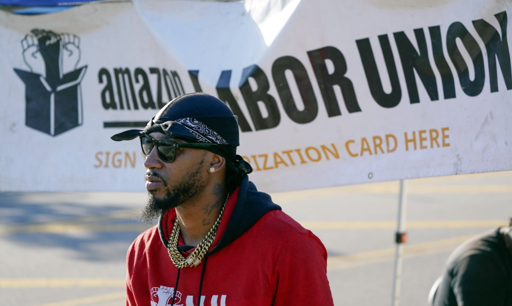
On June 4, Jacobin published a review of Chris Smalls’s memoir, When the Revolution Comes: A Fight for the Future of the Working Class. The review, titled “The Rise and Fall of Chris Smalls,” by Annie Levin, is less concerned with fostering discussion about rank-and-file organizing, workers’ democracy, or the actual state of organizing at Amazon than with fitting the Amazon JFK8 organizing experience into Jane McAlevey’s organizing framework. This framework’s tactics and strategy are part of a broader political approach that seeks to make unions the social base for reinvigorating the Democratic Party rather than agents of working-class destiny.
Back in 2020, Amazon workers on Staten Island made national headlines when Chris Smalls and a group of fellow Amazon workers — many of whom continue organizing in the union today — organized a walkout to protest the JFK8 facility’s handling of the pandemic. This occurred at a time when more than 6,000 workers and their families were being exposed to a deadly virus.
For many, the organizing effort was a life-and-death issue. The workers’ outspoken denunciation of Amazon policies during the pandemic and their labor action stood out amid the passivity and complicity of many union leaderships, which allowed business to continue as usual while the most precarious workers risked their lives and the lives of their loved ones.
Amazon workers joined nurses’ protests demanding adequate PPE and safer working conditions. They even organized a May Day action — at a time when May Day organizing was far from popular in New York City — to unite Amazon workers and healthcare workers. Together, they argued that the front lines of the pandemic were not only in hospitals but also in workplaces like Amazon warehouses, to which thousands of workers commuted daily from every corner of New York City and New Jersey, spreading and being exposed to the virus.
While Smalls was undoubtedly a central leader, the organizing campaign relied on many rank-and-file workers who took the struggle into their own hands. The movement was never simply about Smalls himself. He and his coworkers expressed a broader shift in consciousness among precarious sections of the working class — workers who did not want to die on the job and who believed that, after being deemed “essential,” they deserved respect, compensation, and safe working conditions.
Smalls’s contribution to the labor movement helped articulate a narrative that resonated with some of the most oppressed sectors of the working class. He seized the momentum created by the pandemic, connected the Amazon struggle to broader social movements — especially Black Lives Matter — and challenged many of the conventions that dominate union-organizing orthodoxy.
Unfortunately, Levin’s book review repeatedly centers Smalls’s background and personality — a common experience for many Black organizers — rather than the extensive organizing work behind the Amazon campaign or the significance of his political positions. It emphasizes his image — describing him as “flashy,” “charismatic,” and “a rapper,” highlighting his gold grilles and chains, and mentioning his previous work as a party entertainer — as though these traits constitute his primary contribution to the labor movement. In doing so, the article minimizes his more radical political perspective and the collective organizing that made the union campaign at JFK8 successful.
Chris Smalls and ALU
From the 2020 walkout to the union victory in 2022, a small group of Amazon workers, with few resources, organized a worker-led grassroots campaign to unionize JFK8. Big unions rejected their initiative, and the Democrats ignored them. They made enormous efforts to connect with the rank and file — from distributing food outside the warehouse and setting up a table to talk with workers almost every day to translating their flyers into multiple languages. They didn’t wait for a “supermajority”; instead, they relied on their organizing efforts, their organic connection to the workplace, and the momentum of a political moment shaped by both the pandemic and the Black Lives Matter movement. The key was not Smalls’s background as a “party promoter,” as Levin writes, but the fact that he and the ALU organizers were tireless workplace organizers who forged organic trust and solidarity with their coworkers in a moment of unprecedented societal upheaval.
This momentum helped propel the ALU’s historic victory. Of course, history is made by people, and in this Chris Smalls, along with many other Amazon workers, played a leading role in organizing the first unionized Amazon warehouse in U.S. history — something that established business unions and pro-Democratic Party organizations had failed to accomplish even to this day, six years later. Those who could only imagine working-class organizing through a narrow manual struggled to understand how it happened.
At the same time, the process contained contradictions from the beginning. Although it was rooted in widespread opposition to Amazon’s exploitation and was based on broad rank-and-file participation, it never developed sufficiently democratic structures for self-organization and collective decision-making. It makes a huge difference when the rank and file is organized through assemblies in which workers can share their grievances, ideas, and demands. Even if the rank and file’s decisions differ from those of the leadership, the labor movement is only strengthened when workers take ownership of the process, assume responsibility for making decisions, and take the reins of the struggle into their own hands.
This stands in stark contrast to strategies in which workers are treated as a mass to be manipulated in support of the Democratic Party’s agenda. At the time, however, Jacobin appeared less concerned with those shortcomings. There was no problem as long as Smalls and the ALU were sharing stages with Bernie Sanders and appearing at Labor Notes conferences.
In the years since the pandemic, no additional Amazon warehouses have been successfully unionized. Why is this? We might consider the difficulties of the contract fight at JFK8, which still grapples with high turnover, union busting, and worker firings, among other attacks. We might also think about the relationship between the ALU’s struggle and other organizing drives. Yet Levin’s review focuses on one single factor: Chris Smalls. Sure, he made tactical mistakes and offered little space to discuss the overall strategy, but the author, throughout her lengthy critique, doesn’t seriously discuss the many other organizing attempts against the giant Amazon that also suffered setbacks: RWDSU’s defeat in Bessemer, Alabama; the limitations of the Teamsters Amazon Division in establishing a strong presence inside Amazon warehouses; the Teamsters’ relationship with Donald Trump and Sean O’Brien; the inability of the UPS contract fight to inspire Amazon workers on a broader scale; or the role of progressives whose focus remains centered on legislative strategies rather than organizing from below.
Amazon Organizing and Class Independence
Levin’s review criticizes Smalls for not aligning himself more closely with Democrats like Alexandria Ocasio-Cortez, Bernie Sanders, and Zohran Mamdani. This reflects a broader political orientation within Jacobin and the Democratic Socialists of America (DSA): tying the labor movement to the party’s left wing. Ultimately, the goal seems to be less about building labor as an independent force for social transformation and more about using unions as sources of pressure, resources, infrastructure, and electoral support for a political realignment within the Democratic Party.
Progressive Democrats such as AOC and Jamaal Bowman voted to impose a contract on rail workers that those workers had explicitly rejected. Mamdani endorsed Governor Kathy Hochul while she was calling for replacement workers (scabs) to undermine the largest nurses’ strike in New York City history. Sanders and union leaders such as Shawn Fain rallied labor support behind “genocide Joe” Biden and later Kamala Harris, despite policies that many workers viewed as contributing to political disillusionment and creating opportunities for the Right to strengthen.
And yet Jacobin’s answer is to criticize Smalls for not thanking AOC for getting him out of jail after he was arrested at the Met. Do we really imagine that asking someone who sailed in solidarity with Gaza and was imprisoned and tortured by the Israeli military should be grateful to politicians who supported funding for the Iron Dome and continue to defend Israel’s right to exist and defend itself?
Why not use a platform like Jacobin that reaches more than 1 million readers to demand that O’Brien, Fain, progressive unions, and organizations such as TDU take direct action in solidarity with Gaza?
Smalls has been organizing in solidarity with Palestine. He joined the Global Sumud Flotilla, which attempted to break the siege and deliver humanitarian aid to Gaza. He also traveled to Italy to bring greater visibility among U.S. audiences to the historic strike by Italian dockworkers in solidarity with Gaza.
It is no coincidence that Jacobin recently published an article by leaders of Teamsters for a Democratic Union (TDU) outlining their strategy. In discussing the future of the labor movement and the role of a prominent figure such as O’Brien — who spoke at the Republican National Convention, praised anti-immigrant politicians, and has not taken any action against the genocide in Gaza — TDU leaders argue that union activity and politics should be treated as separate spheres. As TDU leader Antonio Rosario explains, “If you’re against Trump, I am personally 100 percent with you. But TDU is not for that.” TDU endorsed and campaigned for O’Brien without criticizing any of his reactionary actions.
According to this view, one can fight for a militant union while supporting a pro-Trump union leader, and union organizers shouldn’t challenge the political positions of their leadership. This creates a false division between union organizing and politics, as though politics begins and ends with elections and as though workers are limited to choosing between Democrats and Republicans. It ignores the possibility of building a working-class political alternative that is independent of both parties and the possibility of using working-class power to fight for the rights of the immigrant, Black, queer, and feminized working class.
On the one hand, Jacobin appears to believe that Smalls deserves an entire article criticizing him for not supporting progressive Democrats. On the other hand, it seems acceptable for TDU not to challenge O’Brien and his support for the Trump administration. The lack of compass is striking.
Teamsters and Amazon
It’s true that Smalls eventually lost much of his connection to the rank and file. After stepping away from day-to-day Amazon organizing, the slate associated with him was defeated in the union’s leadership election, and the new slate, ALU Democratic Reform Caucus, gained the leadership of the union.
One contradiction of the ALU’s strategy under Smalls was that it relied on a combination of factors: widespread hatred of Jeff Bezos, the symbolic impact of the JFK8 union victory, Smalls’s public profile, and support from progressive Democrats. There were rallies featuring Sanders and other Democratic politicians held outside JFK8, and the relationship between Smalls and Sanders was particularly close.
All that gave the illusion that more warehouses could be taken, starting a domino effect. Without sustained rank-and-file organizing, workers’ democracy, and political independence, however, it is impossible to defeat a trillion-dollar corporation.
But the wrong lesson would be to reduce the obstacles facing Amazon unionization to Smalls’s leadership, an alleged lack of “structure tests,” or the need for a closer relationship with the Democratic Party. For the new leadership of ALU-IBT, the central challenge is to deepen rank-and-file organizing, empower workers involved in the union, and create democratic spaces for discussion, debate, and collective decision-making. The pressure, instead, is often to orient the union toward elected officials and electoral priorities, compounded by the top-down Teamsters union bureaucratic structure and leadership — a pressure that will continue to grow under Mamdani and the new layer of DSA elected officials.
If there is one aspect of Smalls’s leadership that TDU and Jacobin are unlikely to criticize, it was his final major action as union president. As he prepared to leave office and became increasingly disconnected from organizing efforts at JFK8, he initiated the process of merging with the Teamsters before any meaningful discussion or debate had taken place among the membership. By the time members voted on the proposal, the machinery driving the merger was already well underway.
At a moment when workers should be drawing lessons from both the strengths and weaknesses of the early organizing efforts at JFK8 and throughout Amazon, the conclusion cannot be to place the labor movement in a Democratic Party straitjacket or force organizing into the rigid schemas favored by McAlevey’s followers.
Far from that, the labor movement is entering a new period. In that sense, Levin’s article contradicts all the lessons we should be taking from advanced examples like the Minneapolis labor and community struggle against ICE, Trump, and the complicity of their Democratic mayor and governor.
The Workers’ Movement and the Democratic Party
Levin mentions that Smalls “blames the two-party system for the state of the American labor movement,” but she does not offer her own analysis or counterarguments. Yet Smalls goes beyond merely criticizing the bipartisan system — the two parties of the billionaires. He also advocates for a Labor Party that breaks with the capitalist class and builds an organization of our own. On that point, I could not agree more: we need a new party of the working class, for the working class.
The Democratic Party — often described as the graveyard of social movements — and its close relationship with the union bureaucracy have a long history of attacking working-class interests. Large sections of the working class see it as simply the other party of the status quo. Recent research conducted by Leopold found that, among more than 3,000 workers in the Rust Belt, 57 percent supported the creation of a new political organization independent of the two traditional parties. There is growing dissatisfaction with the Democratic Party, to the point that even some Jacobin writers have begun engaging with the possibility of a third-party alternative.
The key questions are not only “bread-and-butter” issues but also struggles around immigrant rights, Palestine, and other major social questions affecting working people. This runs counter to the dominant sentiment among Jacobin’s class reductionists, who focus on an affordability agenda and argue that taking up issues such as race, gender, and imperialism divides the working class, rather than recognizing and fighting for the strong connections between these struggles.
The recent electoral successes of DSA candidates express opposition to the genocide in Gaza and a broader discontent with a system that allows the rich to get richer while working-class people struggle to make ends meet. Yet working-class organizations should not be appendages of the Democratic Party. If anything, the challenge for the labor movement is to connect the struggle on the shop floor with the need to build our own political alternative to the Democrats.
What is needed is a political project that fights to democratize unions, relies on the self-organization of the working class, maintains class independence, promotes international solidarity, and addresses the major issues affecting working people as a whole from an anti-capitalist and socialist perspective.
The post Jacobin’s Piece on Chris Smalls: An Attack on Class Independence in the Labor Movement appeared first on Left Voice.
From Left Voice via This RSS Feed.