

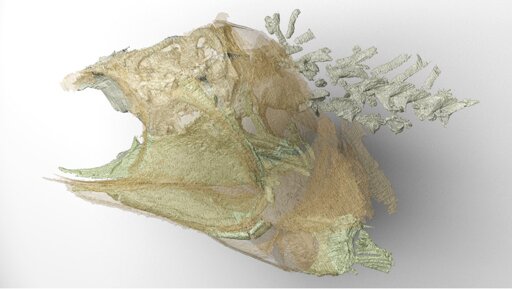
Over 300 million years ago, a minnow-sized fish died and fell to the bottom of a prehistoric swamp near the village of Trawden, Lancashire, in northwest England. The remains of this tiny fish—known as Trawdenia planti—became fossilized, embedding proof of its existence in a layer of soapstone sandwiched between coal seams in the Burnley coalfields. By some combination of marine chemistry, mineral composition of the seafloor, timing and luck, not only was the bony skeleton of this fish preserved, but also the soft neural tissues of its brain.
From Biology News - Evolution, Cell theory, Gene theory, Microbiology, Biotechnology via This RSS Feed.
Cool, lets map that neutral net and resurrect him in software. I bet he would be so confused to find he now lives in an iPhone.
