


“For all God’s children, there remains the opportunity to choose love over hatred, knowledge over ignorance, understanding over apathy, compassion over ambivalence – the chance to learn the sad melodies of the past so that we might create from them a hopeful song for the future.” —David Lee Preston, “Journey to My Father’s Holocaust”
Warning: This article contains graphic details of violence.
Read more about the Hershey family in a related story from ICT.
Charles Fox
Special to ICT
LANCASTER COUNTY, Pennsylvania — The steps descended into the darkness of the original cellar in the historic farmhouse. The cobwebs on the doorway and the arched ceiling indicated the area had not recently been disturbed, forming a gateway to a dark abyss from centuries ago.
The area was devoid of objects, as if decisions long ago had determined the cellar was too hallowed to disturb, a monument to preserve. It was the site where Michael and Mary, a revered Conestoga couple, found refuge in 1763 from the massacre of most of the Conestoga tribe in South Central Pennsylvania.
The couple was hidden for months by Christian Rhodes Hershey, a Mennonite farmer and bishop who came to know the Native American people living near his land. By then, Michael and Mary had been living and working on Hershey’s farm for 11 years, helping with child care and farmwork.

Michael and Mary are believed, at best, to be among only a handful of survivors after a band of marauding Whites in 1763 slaughtered the Conestoga people living in the Lancaster area. At least eight children were among those killed.
My visit to the dark cellar had become a pilgrimage of sorts, an attempt in this dark setting not only to illuminate the past but to find the light of friendship that burned in the darkest of times. Hershey, a distant cousin, was my first ancestor born on these shores.
The brutal slaughter of the Conestoga was a transformational moment in Native-White relations that forever altered Pennsylvania and William Penn’s so-called Holy Experiment. The massacres likely also influenced the political climate leading up to the signing on July 4, 1776 — 250 years ago this week — of the Declaration of Independence, with its not-so-veiled reference to “merciless Indian Savages.”

Shirley Hershey Showalter looks over the graves on June 20, 2026, of a Conestoga couple known only as Michael and Mary in Warwick Township, Pennsylvania. The Native elders survived the Conestoga Massacre in 1763 with the help of Showalter’s ancestor, Christian Rhodes Hershey. Credit: Charles Fox/Special to ICT
The massacres are often presented as an extinction date for the Conestoga-Susquehannock people, but that is a misrepresentation from a “colonial gaze” that dominates historical narratives, David L. George-Shongo Jr., director of the Seneca Nation’s Tribal Historic Preservation Office, told ICT.
“Colonial records and historical markers framework the Conestoga as a dying race,” George-Shongo said*.* “Declaring a tribe extinct allowed the state to cleanly absorb their lands. It effectively bypassed any legal obligations or existing treaty rights.”
Many of the remaining Conestoga people found homes with other tribes. Some families relocated north into Haudenosaunee territory, where they were naturalized into the Oneida, Seneca, and Cayuga Nations under the framework of the Great Law of Peace (Kaianere’kó:wa), the oral constitution of the Haudenosaunee Confederacy.
Others blended with Iroquois-speaking bands to form the multi-ethnic “Mingo” communities in the Ohio Valley, who later became part of the Seneca-Cayuga Nation and the Six Nations of the Grand Rapids in Canada.
Michael and Mary
Michael and Mary were likely in their 70s when the mob known as the Paxton Boys came thundering through the region looking to slaughter Native people.
Christian Rhodes Hershey had known the couple for decades, since he and his first wife, Barbara, grew up in close proximity to the Native community. His family had bought 500 acres in 1717 to farm, and local accounts describe a close relationship between the Mennonite farmers and Conestoga people. In compiling a history of the Swiss and German settlers, H. Frank Eshleman published an account in 1720 describing the children from both communities “playing in the most sportive and innocent manner… with the chiefs reclining on the ground looking on at the diversions and amusement of the children and laughing heartily.”
He and Barbara established their own farm in 1739 in present-day Penn Township, near Manheim. The farm was located by the fertile Indian Fields that the Conestoga farmed, and Chickies Creek, a source of aquatic food named after the Susquehannock word Chiquesalunga, meaning “place of the crayfish.”

Jess McPherson, Susquehannock, stands on June 20, 2026, beside the historical marker that commemorates Conestoga Indian Town in Lancaster County, Pennsylvania, the site where a marauding White mob killed six tribal members while they were sleeping in 1763. The marker, which wrongly states that the tribe was exterminated, was erected in 1924 by the Pennsylvania Historical Commission and Lancaster County Historical Society near Millersville, Pennsylvania. McPherson is interim executive director of Circle Legacy Center. Credit: Charles Fox/Special to ICT
It is likely that Christian Hershey offered Michael and Mary an opportunity to move onto his Manheim farm to help with the work and the raising of children after Barbara died shortly after giving birth to a daughter on June 30, 1752.
Moravian missionary Adam Grube recorded in his diary that Mary told him during his visit to the farm in 1767 that she and Michael had moved onto the Hershey farm in 1752. They remained on the farm after Hershey married Anna Hernley in 1761, and lived in a cabin along the banks of Doe Run stream.
Hershey would have been well aware of the risks he was taking by hiding them in the cellar on Dec. 27, 1763, as the sound of hoof beats and gunshots grew closer.
By then, Hershey had six children in the household, including 19-month-old Christian Jr., and Anna was pregnant with a seventh. As a pacifist, would have lacked the ability to protect them.
“However it happened, the bond between the Hershey family and the Conestoga family happened,” descendant Craig Hershey Stark told ICT. “We can speculate on all kinds of things, but there was a bond that caused Christian to risk his life, that of his family and his property, to give Michael and Mary a sanctuary.”
‘Ghost River’
The clandestine cellar on Christian Hershey’s farm was in stark contrast to the library-like setting in Philadelphia where my journey began in 2019.
The first steps were traversed when my wife, Theresa, overheard a conversation at the 2019 opening of an exhibit and release of the graphic book, “Ghost River: The Fall and Rise of the Conestoga,” by Laguna Pueblo author Lee Francis IV and Tongva artist Weshoyot Alvitre, at the Library Company of Philadelphia. The exhibit and book examined the 1763 massacre of the Conestoga in Lancaster.
“Wasn’t it the Hersheys who hid two of them away?” she heard someone ask.

The names of the Conestoga people slaughtered in two massacres in 1763 are displayed on the window of the Library Company of Philadelphia during a special exhibit, “Ghost River: The Rise and Fall of the Conestoga,” that ran from November 2019 to April 2020. In the window is a statue of Benjamin Franklin, the founder of the library company. Credit: Charles Fox/Special to ICT
With those few words, a new volume of family history opened for us. In recent years, as I covered the repatriation of remains from the Carlisle Indian Industrial School, my life had already intersected with that of my great-uncle, Dr. L. Webster Fox, a Philadelphia eye surgeon.
Webster had provided free eye care to Carlisle students for over two decades, and for several summers in the 1920s he performed hundreds of free eye surgeries to combat trachoma among the Blackfeet and neighboring tribes in Browning, Montana. Though he died in 1931, 28 years before my birth, our paths from Carlisle to Wyoming, from Montana to Alaska, have mysteriously crossed.
His mother, my great-grandmother, was Diana Hershey Fox. The brief comment my wife overheard seemed to indicate that the roots of my journey with Webster ran deeper, through many generations, older in years than our country.
There was uncertainty where the journey would lead, for this was a family history that was not passed along but rather left to gather dust in a cellar of our own creation. As stated in “Ghost River,” “Sometimes we only have echoes that lead us back toward our ancestors, our elders, our kin.”
Six weeks later, those overheard words, those symbolic pages, led to the farmer’s field in Lancaster County two days after Christmas in 2019, on the anniversary of the second of two massacres of the Conestoga in Lancaster in 1763.
Surrounded by the muted browns and greens of winter, I stood before two graves marked only by four stones and surrounded by an outline of four split rails. The gravestones are unmarked but the locations have been handed down through generations.
For me, however, the graves did not symbolize that horrific moment in history but represented instead the enduring bonds of friendship.
Simmering tensions
By 1763, which brought an end to the so-called French and Indian War and the inception of what was known as Pontiac’s Rebellion, an atmosphere of fear and tension hovered over the western frontier of Pennsylvania north and west of Lancaster and along the Susquehanna River.
Many colonists felt the frontier had become a tinder box ready to explode.
The Scots-Irish who populated the area resented that the farm-rich territory near Lancaster had been granted to Swiss Mennonites and occupied by the Conestoga Indians. They felt that because of prejudice against their Scots-Irish heritage, colonial leaders would not make lands available to them in the established colonial settings.

These fertile farmlands of Lancaster County, Pennsylvania, on June 21, 2026, are close to the location where Conestoga Indian Town once existed in the 1700s. Credit: Charles Fox/Special to ICT
Provincial leaders felt confident the Mennonites were likely to maintain peaceful relations with the Indigenous communities near Lancaster. Many of the frontiersmen believed the Pennsylvania government had purposely sold them land in the west believing they “hot-blooded Presbyterians” would serve as a defensive shield to protect Philadelphia and Lancaster from a Native uprising.
In July 1763, the Pennsylvania Assembly agreed to authorize Presbyterian minister John Elder, from the town of Paxton, to organize a force for defensive purposes. Elder was known as the “Fighting Parson” because he kept a rifle in his church pulpit.
It soon became clear, however, that Elder’s plan was to turn the unit into an offensive force to launch assaults on Native people. The vigilante group became known as the Paxton Boys, or the Paxton Rangers.
The Conestoga were a small remnant of the Susquehannock people, who had been led from Maryland back to their homelands along the Conestoga River by Chief Connoodaghtoh, the leader of the people living along the Susquehanna River in the late 1600s. The 1701 Treaty of Amity with William Penn reserved 3,000 acres for the tribe, which were later reduced to 400 acres by Penn’s sons and James Logan, the Pennsylvania Land Office agent and provincial secretary who later became mayor of Philadelphia.
The territory became known as Conestoga Indian Town, and became a crossroads for trade and diplomacy. By 1763, however, the numbers of Conestoga people living on the river had declined to approximately 20 because of factors such as smallpox and disputes with the Haudenosaunee over the fur trade in the 1600s. For income, they made baskets and brooms to sell at the local market. With their hunting territory depleted by the surrounding farms, they were considering moving north when Sheehays, the elder of the group and the son of the late Chief Connoodaghtoh, lobbied to remain in Indian Town. It is believed Sheehays witnessed his father signing the 1701 treaty and still felt connections to William Penn.
“A fire (of friendship) was kindled at Conestoga that burned a long while,” Sheehays has been quoted as saying, adding that he wished to “stay and lay his bones at Conestoga.”
The Conestoga had lived in peace in the region for three generations. As violence on the frontier increased, however, they wrote a welcoming letter in November 1763 to the new Pennsylvania governor, John Penn, the 33-year-old grandson of William Penn. They reminded him that they had proven their loyalty by living “in peace and quietness with our brethren and neighbors during the last and present Indian wars,” and included a string of wampum in support of that bond.
The Paxton Boys, however, felt otherwise. They did not see a distinction between “friendly” and “enemy” Indians, and claimed the most dangerous were those who lived near White communities claiming to be friends. They likewise considered Moravians, Quakers, and Mennonites who befriended Native peoples as adversaries in opposition to their agenda and the welfare of Pennsylvania’s frontier.
In December 1763, in two separate raids, the Paxton Boys, numbering approximately 60 men on horseback, rode along the Susquehanna River into Indian Town and later into the city of Lancaster and killed what were then believed to be the remaining men, women, and children of the Conestoga tribe.
The brutal violence and destruction detailed in Moravian sources has been brought to light by the research of Scott Paul Gordon, a professor at Lehigh University, making use of the letters and congregational diaries of Moravian ministers Albrecht Ludolph Russmeyer, in Lancaster, and Matthäus Hehl, in Lititz. The writings provide eyewitness accounts and details that have not been present in most books and academic papers written on the murders at Indian Town and the Lancaster workhouse.
Gordon’s academic writings, reviewed by ICT, offer great insight into the brazen actions of the Paxton Boys and the reactions of the Lancaster residents.
The first massacre
On the cold, predawn morning of Dec. 14, 1763, seven tribal members were still asleep in their wood plank cabins, with smoke rising from the chimneys and fresh snow on the ground, when the Paxton Boys arrived, firing their guns into the cabins and then rushing inside to tomahawk the survivors.
“My father and some others went down to see them buried, shocking indeed was the sight, the dead bodies lay among the rubbish of their burnt cabins like half consum’d logs,” Rhoda Barber wrote in a book, “Recollections Written in 1830 of Life in Lancaster County 1726-1782 and a History of Settlement at Wright’s Ferry, on the Susquehanna River’ relaying the account of her father, Robert Jr., who was one of the first on the scene. The Barbers were Quakers and one of the founding families of Wright’s Ferry.
Rhoda was born three years after the massacre, but her older brothers and sister remained unable to talk about the event their entire lives, she wrote in a memoir. The Conestoga children had been their friends.
Because of a snowstorm, 14 of the Conestoga people had not returned home the night before, sheltering instead in the homes of Mennonite friends after selling baskets in Martic Township. Among those missing was Will Sock (Tenseedaagua), who had been villainized by the Paxton Boys and was the main object of the offensive. Sock had been a Native diplomatic envoy for the British and served as an interpreter in treaty negotiations, but the mob circulated many allegations against him despite little evidence to support their claims.
The six killed were identified by provincial authorities as Wa-a-shen (George Sock); Tee-Kau-ley (Harry); Kannenquas (a woman); Te- a-wonsha-i-ong (Sally); Ess-canesh (a young boy); and the elder Sheehays. Chrisly (Tong-quas), an adopted child of Te- a-wonsha-i-ong, managed to escape and ran through the snow to seek help.
The Conestoga cabins were then looted and set on fire. It was perceived as a symbolic gesture evoking an incident from more than 30 years earlier, in 1730, when the provincial government burned cabins built illegally by the Scots-Irish on Native land.
In the burnt ruins of Indian Town, a copy of the treaty made with William Penn on April 23, 1701, lay in the snow, noting “that they shall forever hereafter be as one head & one heart and live in true friendship & amity as one people.”
In the end it was not the “fire of friendship” that Sheehays expected, but rather a fire of hatred that led to his demise.
The second massacre
The second, even more brazen act of racial violence occurred 13 days later after the remaining Conestoga people had been relocated to Lancaster for safety to a public workhouse that was connected to the local jail.
Workhouses, at the time, were designed to provide food and shelter for the destitute in exchange for labor.
On the evening of Dec. 20, 1763, at a tavern near Donegal, Benjamin Hershey, the father of Christian R. Hershey, encountered a number of the Paxton Boys as they gathered to plot a second massacre. He and a Mennonite neighbor overheard plans to break into the Lancaster workhouse to kill the Conestoga people.

This 1841 lithograph, “Massacre of the Indians at Lancaster by the Paxton Boys in 1763,” by artist James Wimer, is rephotographed by the back doors of the Fulton Opera House, which now sits on the site of the Old Jail where the Dec. 27, 1763, massacre took place. The lithograph inaccurately depicts the Paxton Boys mob in Victorian attire. Credit: Charles Fox/Special to ICT
The two men rushed to Lancaster by 8 p.m. to inform the jailer of the plot, assuming the attack would be thwarted.
Edward Shippen, the Lancaster magistrate and a former business partner to land agent Logan, sent two constables to investigate but decided there was no cause for concern.
On the afternoon of Dec. 27, 1763, while most of the town’s residents were attending a holiday celebration in church, the Paxton Boys arrived and stormed the workhouse door, wounding Sheriff John Hays. William Henry, Jr., a six-year-old at the time, wrote in a letter to a friend decades later about what he had witnessed.
“I saw a number of people running down street toward the gaol (jail), which enticed me and other lads to follow them,” he wrote. “I ran into the prison yard, and there, O what a horrid sight presented itself to my view!”
He described seeing Will Sock among the dead, with his wife and their two children, just toddlers. The victims had all been attacked and mutilated.
In all, three couples and eight children, including an infant, were killed. Chrisly (Tong-quas), the boy who escaped the first massacre, was among the dead.
After the murders, Russmeyer recorded in a letter to Moravian authorities in Bethlehem that the men “got back onto their horses, rode around the Court House, fired their guns repeatedly, screamed and made a horrid amount of noise.”
They then took their celebration to the town of Manheim 10 miles away, in search of Michael and Mary, described by Hehl as the “old Indians.” Unable to find the couple, the mob moved on to the town of Lititz.
“They were lucky to escape the search party,” Hehl wrote.

Ron Kreider explores the cellar of his family’s historic farmhouse, where ancestor Christian Rhodes Hershey helped a Conestoga couple known as Michael and Mary seek refuge from a White mob looking to slaughter Native people in 1763. The couple worked on Hershey’s farm for more than a decade in Lancaster County, Pennsylvania. Credit: Charles Fox/Special to ICT
The cursing of “God damn you, Moravians,” and gunshots could be heard interrupting Singstunden, an evening worship service featuring the singing of hymns. The clear message was that groups that befriended Indians, such as the Moravians, were at risk of being future victims of their violence, according to Hehl’s letter.
Those killed in the workhouse were dumped the next day into a mass grave as bystanders cheered, Russmeyer wrote, describing an event that Gordon states no other source recorded.
“In the afternoon they buried the fourteen Indians, who had been killed in the prison, in a large pit, accompanied by a crowd of several hundred people, who added their insults and reproaches,” he wrote.
Gordon detailed his findings in research papers published in 2014 and 2016. His findings were first presented at a two-day, 2013 conference held in Lancaster to mark the 250th anniversary of the massacre.
“Moravian writings are usually overlooked for a bunch of reasons. One is because they’re in this German script… so they’re hard to read,” Gordon told ICT. “They’re just rich. They’re full of all sorts of stuff that’s going on.”
“No one’s mined those,” he said. “I just knew I had this stuff that people had not talked about before. There were such interesting, horrible details.”
The one thing people know about Moravians, he said, “is that they lived among Indigenous people and kept meticulous diaries that reveal a lot.”
The writings indicate there had been warning signs of the violence. In a letter to Bethlehem before the massacres, Hehl disclosed that on Dec. 13, 1763, before the slaughter at Indian Town, ‘‘a group of armed men, mostly Irish from Paxtown, [sic] came to Lancaster in a total rage, stopping in front of the house of Mr. Shippen. They announced that they intended to kill all Indians living on Manor Land. Mr. Shippen tried to dissuade them but wasn’t able to prevent it. They did as they said they would, and fell upon the Indian village, murdering all who were there.’’
The description indicates the vigilantes had support among the townspeople, Gordon said.
“The Moravian records reveal a chilling echo of the jubilant murderers and the laughing townspeople,” he wrote in an academic paper, “The Paxton Boys and the Moravians: Terror and Faith in the Pennsylvania Backcountry.”
“By returning to Lancaster and displaying evidence of their violence, the men from Paxton boasted that they had done exactly what Shippen had forbidden,” he wrote. “The excursions to Lancaster not only challenged Shippen; they simultaneously recruited support from Lancaster’s populace for the killing of Indians.”
The Paxton Boys largely held Shippen responsible for their suffering on the Pennsylvania frontier. Gordon suggests in his writings that the Paxton Boys wanted to “cleanse the frontier of Indians and to strike a blow at Shippen.”
A third massacre
The Rev. Elder, who helped organize the Paxton Boys but apparently never directly took part in their actions, wrote Gov. John Penn after the massacres, in January 1763, saying, “The storm which had been so long in gathering, has, at length, exploded.”
The Paxton Boys’ threats convinced people that the Indian Town and Lancaster workhouse murders were simply a prelude to a coming storm to accomplish their vision of a Pennsylvania ethnically cleansed of Indians and groups such as the Moravians that befriended them.
It was believed that, in a matter of time, the Paxton mob would escalate their violence to the Philadelphia Barracks housing the Moravian Indians from Bethlehem, Lititz, and Hebron, now known as Lebanon, according to Russmeyer, who described the situation as “really quite desperate” in a Jan. 2, 1764, letter to Moravian Bishop Nathanael Seidel.
Just a few months after the massacres, the Paxton Boys had grown to as many as 250, and in February 1784 they headed to Philadelphia to repeat their actions to annihilate a group of Lenape Indians from Moravian mission communities. The Christian group had been relocated to Philadelphia from Nain and Wechquetank, in and near Bethlehem, as a precaution for their safety a month before the Conestoga Massacres.
Since Quakers were pacifists, Philadelphia had no militia. Benjamin Franklin rushed to organize a force of 500 volunteers augmented by infantry regiments, the British Highlanders and the Royal Americans, and to construct fortifications at Market Square near where the Moravian Indians were being housed.
On the morning of Feb. 7, 1784, Gov. John Penn, Franklin, and other officials rode to Germantown, about six miles outside of Philadelphia, where the Paxton Boys had camped. Franklin, the chief negotiator, assured them their grievances would be heard. Apparently realizing they would be greatly outnumbered by the forces in Philadelphia, the Paxton Boys turned around.
They then voiced their grievances in two documents, later published together as “A Declaration and the Remonstrance of the Distressed and Bleeding Frontier Inhabitants of the Province of Pennsylvania,” expressing their vision of racial separation and criticism of the governing elite.
The controversy of the Paxton Boys created America’s first social media war in pamphlets, the vehicle of the day. More than 60 pamphlets were printed, including Franklin’s “Narrative of the Late Massacres, in Lancaster County,” in which he referred to the Paxton Boys as “Christian white savages.”’ Others argued support for the Paxtons and justification for their actions. In many of the pamphlets the debate revolved around whether the Native people were “under His Majesty’s protection” or a separate people.
In the end, colonial officials agreed the best policy was to expel Native people westward past the ever-changing frontier line. The actions provided political support for Indian removal, western expansion, and, later, Manifest Destiny.
In the November 1764 election, the Proprietary Party, supported by frontiersmen such as the Paxton Boys rose in power, claiming 11 of the 36 seats in the Pennsylvania Assembly, diminishing the political power of the Quakers. Benjamin Franklin, who had made enemies with his harsh condemnation of the Paxton Boys, was voted out of office.
Despite the efforts to protect the Moravian Indians, fate did not treat them kindly. After 18 months of being held in Philadelphia, smallpox, dysentery and other diseases had claimed the lives of 57 of the 140. Frontiersmen had burned their villages near Bethlehem in their absence and threatened them with the same fate as the Conestoga if they returned.
After being led by Moravian missionaries to a new home along a branch of the Susquehanna River, they eventually relocated to the Muskingum Valley of eastern Ohio. They named their settlement Gnadenhutten, “Huts of Grace.”
In 1782, nearly 20 years after the efforts to save them, another Pennsylvania militia group massacred the entire village of Gnadenhutten, 42 men, 20 women, and 34 children. Former Paxton Boys were believed to have been involved with the group.
Congress ordered an investigation into the massacre, but, like the killing of the Conestoga, it ended quickly and without a conclusion.
A Peaceable Kingdom lost
The Paxton Boys’ acts of genocide were the final straw in the destruction of William Penn’s vision of a Holy Experiment and a “Peaceable Kingdom”
Penn, a Quaker, had presented a bold plan for a “Holy Experiment” of religious freedom and toleration, and in 1681, King Charles II granted Penn a charter for a new American colony, Pennsylvania.
Penn invited Swiss Mennonites to his colony. The Quakers, like the Mennonites, were Anabaptists that had suffered persecution and imprisonment in an intolerant England and Europe.
The area now known as Lancaster County, with its fertile land, was the perfect location to fulfill hopes of both bountiful agriculture success and peaceful human relationships. These beliefs and factors led the Quakers and Mennonites to have a close relationship and reside in close proximity to the Native population.
Penn wrote in “A Letter to the Indians,” “I have great love and regard towards you (Native people), and I desire to win and gain your love and friendship by a kind, just, and peaceable life…with your love and consent, that we may always live together as neighbors and friends.”
Penn died in 1718, however, and his sons, John, Richard, and Thomas, did not share his Quaker faith. The brothers, along with Logan, the land office agent, produced the Walking Purchase of 1737, a fraudulent land deal that cheated the Lenape out of more than a million acres.
After the Conestoga Massacre, William Penn’s vision of peaceful coexistence was stained by blood and racial violence, which Gordon describes as a “hinge moment.”
“Before, you could imagine Indigenous people being friends as well as enemies, but afterwards they were just racial enemies,” Gordon said.
‘Long-simmering hatred’
Daniel Richter, a University of Pennsylvania professor, wrote in his 2001 book, “Facing East From Indian Country,” that the events of 1763 “crystallized long-simmering hatred into explicit new doctrines of racial unity and racial antagonism.”
“Ghost River” author Francis, the founder and chief imagination officer of the Indigenous Imagination Workshop, said the massacres have not drawn the attention they deserved.
“It’s one of the earliest recognitions of what I will call a traitorous act, where people believed they were not engaged in warfare,” Francis said. “It sounded very similar to what we all studied with Sand Creek and the Sand Creek massacre. Where Black Kettle gathered all the people under the flag because he was assured that if you were standing beneath the American flag, you would be safe.”
He continued, “They [the Conestoga] had done everything right. They had done the treaties. They were not engaged in violent acts and yet they were massacred in their sleep… It was such a tragic, horrific, despicable act. And it’s so senseless.”

Shirley Hershey Showalter places her hands on one of four stones marking the graves on June 20, 2026, of a Conestoga couple known only as Michael and Mary in Warwick Township, Pennsylvania. The couple survived the Conestoga Massacre in 1763 after Showalter’s ancestor, farmer Christian Rhodes Hershey, hid them in his cellar for several months. Showalter placed some small stones and clover blossoms on one of the stones. Credit: Charles Fox/Special to ICT
Francis said the massacre illustrated what it meant to be in America in 1763.
“It was one of those defining moments that got buried in American history that I don’t feel that we discuss enough,” Francis said. “It’s a decade before [the American Revolution], and it’s one of the peak points of the Seven Years’ War [and Pontiac’s Rebellion] and the geopolitical conflict that goes on there, and the decline of the Quaker Empire…. All of those things that are happening and moving around and centered on this one particular moment. And this particular moment is about the massacre of 20 innocent people.”
The forecast of a storm of violence had been proven true, but the enemy in the midst was not the anticipated transgressor.
“The frontier did collapse in late 1763,” wrote Gordon. “The surprise was that the armed mob that descended from the frontier into Lancaster — and then to Philadelphia in 1764 — were White frontiersmen. Everybody had expected it would be Indians.”
Pennsylvania’s inability to apprehend and prosecute the Conestogas’ killers had created an “open season on Indians,” Benjamin Franklin wrote in his 1764 pamphlet, “A Narrative of the Late Massacres, in Lancaster County.“
“The spirit of killing Indians, friends and foes, spread amazingly thro’ the whole country,” he wrote.
The Pennsylvania frontier had become ungovernable. Tribes felt they could no longer trust the words and actions of Pennsylvania officials and that Indian-White relations had been poisoned because of the Conestoga experiences.
“Blood ran in streams into our [treaty council] fire, and extinguished it so entirely, that not one spark was left for us whereby to kindle a new fire,” wrote Moravian missionary John Heckewelder regarding Indian-settler relations.
Tribes relocated east to New Jersey, north to New York, and west to the frontier of Ohio.
In the wake of the violence by the Paxton Boys, more vigilante groups were formed, and more acts of violence took place. Perhaps the most notorious was the murder of 10 Lenape and Mohicans in January 1768 by Fredrick Stump and John Ironcutter. Though both men were arrested, an armed mob broke into the Carlisle jail to free them, allowing them to escape to Georgia.
And the words of the Paxton Boys lived on. In 1776, 13 years after the massacre, Thomas Jefferson and others used the phrase “merciless Indian Savages” in writing the Declaration of Independence, which will celebrate the 250th anniversary of its signing on July 4, 2026.
“Ghost River” author Francis said the wording was deliberate.
“‘Merciless Indian savages’ didn’t just spring from Thomas Jefferson,” Francis said. “He had been studying these people…He was very well aware of what was going on while he was writing the Declaration and courting favor because if you’re going to lead this rebellion, you’ve got to get everybody settled in [on board].”
In the end, Michael and Mary were likely deemed unimportant by frontier militia groups because they were past the age of reproduction, and they continued to live out their lives in a cabin built along Doe Run on the Hershey property.
It is believed Michael died first at the age of 90 sometime in the 1770s, and Mary a few years later at 87 years of age. Christian Hershey died at the age of 63 in 1782.
‘Asserting Native identity’
Today, Pennsylvania has no state or federally recognized tribes.
Jess McPherson, of Susquehannock descent, grew up west of the Susquehanna River in Winterstown, Pennsylvania. Many in that area were descendants from a community of Shawnee, Piscataway, and Susquehannock people who had chosen centuries before to isolate themselves from the main Conestoga community on the opposite side of the river. They lived along Muddy Creek or Codorus Creek in southern York County.
Growing up, she said, she was taught there “is not any value in asserting Native identity.”

Jess McPherson, Susquehannock, overlooks the Susquehanna River in Pennsylvania on June 20, 2026, from Chickies Rock, near Columbia, Pennsylvania. The Conestoga were a small remnant of the Susquehannock people, who once numbered up to 6,000. The creek draws its name from the Susquehannock word for “place of the crayfish.” McPherson, interim executive director of Circle Legacy Center, grew up west of the river. Credit: Charles Fox/Special to ICT
“I think often about how much I have been forced to think about how people believe we don’t exist,” said McPherson, interim executive director of the Circle Legacy Center. “I think that invisibility is a challenge, and that there is a continual fight to say, ‘Hey, yeah, we’re here,’ and if we’re so busy doing that, that gives us less time to do the things like we’re trying to do at Circle Legacy now, to try to allow for intergenerational transfer of knowledge and cultural exchange and just preservation.”
MaryAnn Robins, Onondaga, president of the Circle Legacy Center, had similar concerns.

MaryAnn Robins, Onondaga, president of the Circle Legacy Center, stands in a recreation of an Eastern Woodlands longhouse on June 24, 2026, near the historic 1719 Hans Herr House in Lancaster County, Pennsylvania. Credit: Charles Fox/Special to ICT
“If you have never experienced a war within your own self — meaning loss, prejudice, being disregarded, being unseen, being like a pebble on the ground to be kicked around — you’re never going to know how it feels to truly be unknown in history,” Robins said.
“And people can say, ‘Oh, I know how you feel,’” Robins said. “How do you respond without lashing out at them and being angry and saying hurtful words, other than making it a teachable moment for them to understand what you’re saying really truly matters.”
She continued, “It might take more than one time, but we have to keep doing it, and if people keep beating you down till you have no voice, then they’ve won.”
The silence
On an unseasonably warm day in March 2020, I made that first visit to the farmhouse cellar, leaving the sunlight and descending down the basement steps. My trip came after I discovered Christian R. Hershey’s involvement.
We were led by Ron Kreider, a descendant of Christian R. Hershey whose family has lived on the farm for nine generations. Craig Hershey Stark and I were seeing it for the first time. We were three distant relatives in search of the past.
Stepping inside, the pungent smell of the damp earthen floor burnt my nostrils and made it hard for me to breathe. Until we found a replacement bulb for the lone light fixture, the darkness quickly enveloped us.

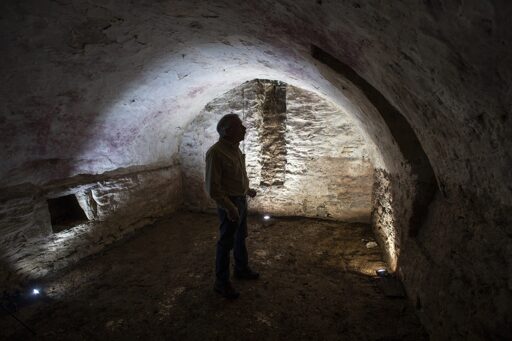
This old farmhouse cellar, shown in 2020, served as refuge for a Conestoga couple known as Michael and Mary from a marauding White mob who slaughtered Native people in1763 in Lancaster County, Pennsylvania. The farmer, Christian Rhodes Hershey, helped the couple hide in the cellar. Credit: Charles Fox/Special to ICT
The basement, measuring roughly 12-by-25 feet with an arched ceiling, had been a safe haven for Michael and Mary from late December 1763 to mid-August of 1764. In an atmosphere that seemed to render hopes and prayers flightless, it was hard to imagine being inside for a few hours, let alone eight months.
The room featured several unique features — what appeared to be air vents, a makeshift chimney flue, and a small opening just large enough for the passage of items. All the modifications had been sealed in the years since.
I can only speculate about the origins and details of the friendship between Christian Hershey and the Native couple, but its existence was irrefutable. In the end, there were no words to express as I stood there in silence. The darkness could not obscure the magnitude of what had taken place in this clandestine setting.
It stood in stark contrast to the brutal acts that had occurred on that December day — a monument to our better angels, a guiding light of hope.
Yet Christian Hershey is almost absent from the present. The graves of Christian and his family have disappeared over time, victims of decay and development. It is believed the graves now lie buried in an undeveloped lot near the intersection of Meadow Creek Lane and Abbeyville Road.
Nissley Cemetery, the location of the graves from the second Conestoga massacre, disappeared to make way for the Pennsylvania Railroad, and the burial site after the first massacre has always been a mystery.
In 1852, the Fulton Opera House was built on the foundation of the Old Jail, the site of the second massacre, making use of the stonework on the backside of the theater.
Indian Day was started as an annual winter event in 1893 for Doe Run Elementary schoolchildren, and included a memorial service at Michael and Mary’s graveside located just down the hill from the school. As well as being informed about the actions of the Paxton Boys, students studied Native history and made classroom presentations.
In 1897, the event underwent a name change to Indian and Flag Day to mask its purpose and present students with an erroneous account of the event. False narratives began to be published, with some describing the “gallant frontiersmen of Paxtang” as pioneers of democracy against “the copper-colored vipers in their midst.”
Epilogue
In June 2026, more than six years after I first stepped into Christian Hershey’s cellar, I found myself once again at the gravesites of Michael and Mary.
The muted shades of winter had changed to the vibrant colors of summer. The surrounding farmland was bursting with life, a reminder of nature’s cycles. Standing by the gravesite with thoughts of Christian Hershey served as a reminder of the things that connect us across generations, the things that are transmitted through heart and soul.
Just six years earlier, I had known nothing about Christian Hershey. Now, the knowledge , like the setting sun before me, cast a long shadow.

ICT contributor Charles Fox stands by the graves of a Conestoga couple known as Michael and Mary on the farm where they took refuge from a White mob looking to kill them. Fox is a relative of the Mennonite farmer who sheltered the couple in his cellar in 1763. Credit: Charles Fox/Special to ICT
Standing by these graves, visiting the cellar, I felt a tangible connection to what had been passed on by the generations that preceded me. I am humbled by the courage shown during a perilous moment when integrity could have easily become endangered, and friendships turned fragile by self-preservation.
“There are people who, without fanfare, decide that they’re not going to buy into a larger narrative of hatred and belittlement, and they’re going to instead see past that story to humanity and actually go one step further,” Shirley Hershey Showalter, a fellow descendent said, as billowy clouds passed over the gravesite.
“Christian would have felt that what the Paxton Boys did was a blotch on God’s eye and on God’s heart,” she said.
For years, I knew about the massacres and the Paxton Boys, yet I am left wondering why this story of bravery and friendship between Christian, Michael, and Mary stopped being passed along in my family.
Discovering it, I found the acuity to acknowledge “the sad melodies of the past,” the strength to overcome and proceed in positive fashion, and a benchmark and legacy to live by.
It helped me make sense of my own journey growing up a just over a mile upstream from the dark history of the Carlisle Indian Industrial School, along a stream whose banks were once lined by Shawnee villages. The affinity for Native people and the friendships that have surfaced numerous times over generations in my family has made me realize that I am part of something greater than myself and not an isolated exception.
I understand now that Christian Hershey was the fountainhead, the headwaters, and those of us that followed have been tributaries, rivers of remembrance reaching generations yet to come. As author Francis describes in “Ghost River,” they are the stories “told from the heart, carried on the current, and flow(ing) until the last sun sets forever.”
The post The ‘Peaceable Kingdom’ Lost: A Friendship Found appeared first on ICT.
From ICT via This RSS Feed.