


Read more about the Conestoga massacres in a related story from ICT
Charles Fox
Special to ICT
Long before the Hersheys came to Lancaster County in Pennsylvania, when the name was still spelled Hirschi, they resided in the Emmental Valley in the canton of Bern, Switzerland.
They were Mennonites, Anabaptists who strictly lived by Jesus’ teachings but suffered religious persecution starting in the 1500s for beliefs that conflicted with the government’s state-run church. They were burned alive, beheaded or imprisoned for beliefs including that only adults should be baptized when they could make a commitment to the faith. They were also pacifists who would not bear arms or swear allegiance to a king in a country with a conscripted Army.
They also understood the trauma of being forced from their homelands. When the government began confiscating their homes and farms, they joined a flood of Mennonites emigrating out of Switzerland in the mid- to late-1600s.
Christian Darig Hirschi was among approximately 700 Mennonites who left the canton of Bern in 1671 for the Palatinate region of southwest Germany. The Rev. Jacob Everling, a church elder in the Palatinate, described groups arriving “destitute with their bundles on their backs and their children in their arms.”

Shirley Hershey Showalter stands on the porch on June 20, 2026, of the historic farmhouse where she grew up in Lancaster County, Pennsylvania. Her ancestor, farmer Christian Rhodes Hershey. helped protect a Conestoga couple in the home’s cellar during the Conestoga Massacres in 1763. Credit: Charles Fox/Special to ICT
With the financial aid of Dutch Mennonites and the generosity of villagers, Hirschi and other Mennonites made a new start in Friedelsheim, Germany. Even there, however, they were granted only limited religious freedom. They could only worship in groups of 20 families or less, and were unable to proselytize their faith or own land. They also paid an annual fee, “Mennonite Recognition Money.”
No sooner did their efforts transform the land and rebuild the villages, however, than France invaded in 1688 in the War of the Grand Alliance, also known as the Nine Years War, torching the villages and farmland. With Roman Catholic electors coming to power and Louis XV less tolerant of their beliefs, many decided to relocate yet again.
In 1717, Hirschi and his wife, Adelheid (Oade) and their children, Benjamin, Andrew, and Anna, turned their sights westward. Following a boat ride of several weeks on the Rhine River to Rotterdam, Holland, and then a 7- to 12-week journey across the Atlantic Ocean, they relocated to what became known as the “Paradise of Pennsylvania.”
Hirschi was the forefather of the newly renamed Hersheys who followed in Pennsylvania. He was grandfather to Christian Rhodes Hershey, who became a Mennonite farmer in Lancaster County, Pennsylvania, and who stepped in to save a Conestoga couple from a marauding White militia targeting Native people in the mid-1700s.
And Christian Hershey was the great-great-grandfather to Milton Hershey, who made his name in the candy business that still produces chocolate from Hershey, Pennsylvania.
Pennsylvania offered Hirschi the ability to purchase land, as well as religious freedom, and in November 1717 Hirschi and Hans Brubaker bought a land grant for 1,000 acres along the Little Conestoga Creek. They split the acreage equally, with the Hersheys taking the northern 500 acres. The land was in close proximity to an area known as Indian Town, where the Conestoga people annually planted their crops…
It is believed that the land next to the Indigenous people was reserved for Mennonites because James Logan, the Pennsylvania Land Office agent and provincial secretary, believed they could live peacefully with the Native community.
“The Hersheys and the other Mennonites were able to better relate to the Indigenous philosophies than the Calvin philosophies [of certain Protestant denominations],” Craig Hershey Stark, a descendant now living in the area, told ICT.
“Because in their view, coexisting with Mother Nature was the objective of their religion and life,” Stark said. “The Calvinist objective was to conquer. And so I think that they probably felt more akin and closer to the earth, so to speak, with the Indigenous people than they did the Calvinists.”
Hershey traditions
The Swiss Mennonites were bishops and educators, men of faith and peace, who held strongly to their convictions. Their actions and interactions were guided by the Beatitudes, the Christian manifesto highlighting living as humble, merciful peacemakers. They wanted to leave behind the violence and persecution they had experienced.
Christian D. Hirschi’s son, Benjamin, a Mennonite bishop like his father and brother, erected the first meetinghouse in Lancaster County and a public school on the southeast portion of their land, predating the city of Lancaster by about 13 years. In time, it would become known as Abbeyville.
In 1775, Benjamin Hershey, as presiding bishop of the Lancaster Conference of Mennonites, made a presentation to the Pennsylvania Assembly to allow for conscientious objectors during the American Revolution.
“We have dedicated ourselves to serve all Men in everything that can be helpful to the preservation of Men’s Lives,” he wrote. “But we find no freedom in giving, or doing, or assisting in anything by which men’s lives are destroyed or hurt.”
Christian Rhodes Hershey, son of Benjamin, was born in 1719. In 1739, as a 20-year-old nicknamed “Langen” because of his lanky build, he purchased his own farm in present day Penn Township near Manheim with his wife Barbara Hostetter, who died 13 years later.
When a militant group known as the Paxton Boys targeted the Conestoga people in 1763 in what became known as the Conestoga Massacres, Christian R. Hershey and his second wife Anna hid a Native couple known as Michael and Mary in the cellar of their farmhouse, putting their own family at risk.

Dr. L. Webster Fox of Philadelphia, a descendant of the original Hershey family, provides free eye care to the Blackfeet and neighboring tribes in Montana during the 1920s in this undated photo. He performed hundreds of eye surgeries to combat trachoma, a bacterial infection that can cause blindness. Credit: Photo Courtesy of Princeton University Library Department of Rare Books and Special Collections
The ties and affinity for Native Americans has resurfaced occasionally throughout the generations of the Hershey family.
Philadelphia eye surgeon L. Webster Fox, the son of Diana Hershey Fox, provided free eye care to students at the Carlisle Indian Industrial School in Pennsylvania for more than two decades, and for several summers in the 1920s he performed hundreds of free eye surgeries to combat trachoma among the Blackfeet and neighboring tribes in Browning, Montana. Webster Fox was great-uncle to ICT contributor Charles Fox, and Diana Hershey Fox was his great-grandmother.
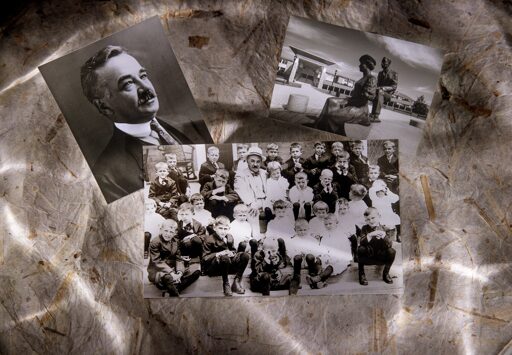
Milton Hershey, the chocolate entrepreneur and a childhood friend and cousin of Webster Fox, also founded the Hershey American Indian Museum in 1933. As the collection grew, it became one of the largest collections of Native American artifacts as Hershey hoped to bring a window into different cultures to the small South Central Pennsylvania town.
The collection became part of The Hershey Story Museum when it was created in 2009, but it has not been on display since 2012, when the museum shifted its focus to the various aspects of Milton Hershey’s life.
Unable to have their own children, Milton and wife, Catherine, set up the Hershey Industrial School in 1909 to serve orphaned boys. Like the Carlisle Indian Industrial School, the Hershey School days were divided between classroom academics and learning industrial and agricultural trades. The boarding school, renamed the Milton Hershey School, now serves students, both male and female, from many backgrounds.
A year before the Hershey school’s founding, at least 10 students from the Carlisle Indian Industrial School worked in the Hershey Chocolate Factory as part of the school’s outing program in 1908-1909. They were also recruited for their athletic ability to play on the Hershey factory baseball team and other Hershey teams during their stay. The Carlisle students came to Hershey because of a personal friendship between factory president William Murrie and Glenn “Pop” Warner, Carlisle’s renowned football and track coach. Some of the students opted to reside in Hershey after finishing their studies at Carlisle.
‘Gifts of our ancestors’
On Sept. 21, 2017, over 100 Hershey descendants came together to celebrate 300 years of the family being in America. As part of the weekend events, they stood by the graves of Michael and Mary, and remembered the heroic display of friendship that had taken place at the site.
On behalf of the Mennonite community, they apologized to Native representatives, including MaryAnn Robins, Onondaga, president of the Circle Legacy Center, for letting their ambitions keep them from doing more.
“The [Christian] Hershey Family, they did the right thing despite possibly causing peril for themselves,” Robins recently told ICT. “It makes you realize these were good people. They took a stance. … It takes a certain individual that will speak and stand up. Not everybody has the courage to do that.”

Craig Hershey Stark stands by the graves of Conestoga elders known as Michael and Mary in Lancaster County, Pennsylvania, on June 20, 2026. His ancestor, Christian Rhodes Hershey, provided refuge for the couple in the cellar of his farmhouse from a mob of militiamen looking to kill the Conestoga people in 1763. Today, the graves are marked by four stones and outlined by split rails. Credit: Charles Fox/Special to ICT
On Christmas 2022, Shirley Hershey Showalter, a tenth-generation descendant of Christian Rhodes Hershey, and her husband, Stuart, presented their grandchildren with books they had compiled highlighting previous generations and emphasizing that they carry within them “the hopes and dreams of all who went before you.”
Among the stories was the friendship between Christian Rhodes Hershey and Michael and Mary, and an age-appropriate version of the Conestoga Massacre. Despite growing up in a Mennonite home near Lititz, it was a story Shirley, now 77, had not known for much of her life.
“Why didn’t I know about Mary and Michael? The story got lost. And so did the Hershey connection,” Showalter recalled. “I knew zero about it when I was growing up. I knew what Mennonites believed and that this was a heritage, a tradition … . There simply was no knowledge of this incredible story that could have given identity and pride to all of us.”
Her grandchildren were asked what values they see in the lives of their ancestors and how they could honor them. Showalter revealed her own answers: to stand for peace, to look for ways to love everyone even in the face of hate, to use powerful words for just causes like Benjamin Hershey, and to have the courage and loyalty of Christian Rhodes Hershey and his wife, Anna.
“These are the gifts of values and stories. These are the gifts of our ancestors,” she later wrote in her blog.
For the Christmas holiday this year, three generations of the Showalter family will travel to Switzerland to see and feel where their Anabaptist ancestors survived persecution. Showalter and her husband said they are “expressing our hope that they will find ways to be as courageous and clear and kind as these people were.”
The post Hershey family ancestors understood the loss of homelands appeared first on ICT.
From ICT via This RSS Feed.