

“Suppressing academic freedom stifles the very spirit of education.”
MANILA — As Southeast Asian academics, students, and researchers face surveillance, harassment, criminalization, and political interference, educators and human rights advocates launched a regional initiative to defend academic freedom.
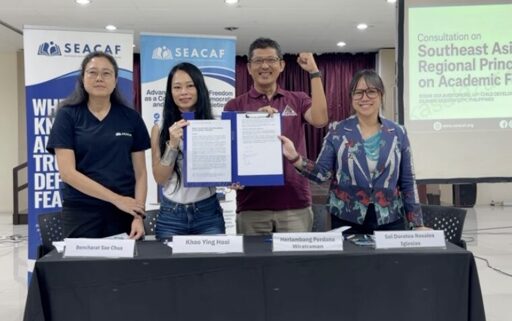
The Southeast Asia Coalition for Academic Freedom (SEACAF), together with academic institutions, unions, and civil society groups across the region, soft-launched the Southeast Asia Regional Principle on Academic Freedom during a consultation workshop at the University of the Philippines Diliman on June 25 and 26.
The launch came months after several incidents that academic freedom advocates said reflect growing threats to scholars, students, and researchers in the region.
“Across Southeast Asia, governments, institutions, and surveillance apparatuses are quietly reshaping what it means to think freely. Today, we push back,” said SEACAF regional director Bencharat Sae-Chua.
Under pressure
According to SEACAF, academic freedom in the region faces challenges ranging from state interference and surveillance to the use of national security laws against scholars, students, and universities.
The coalition pointed to recent developments in the Philippines where students who protested corruption faced criminal charges.
SEACAF also cited the killing of 19 people in Toboso, Negros Occidental in April, including individuals identified by organizers as University of the Philippines student leaders, a community journalist, and peasant rights researchers.
The coalition noted similar concerns in neighboring countries.
In Thailand and Indonesia, academics and student movements critical of government policies operate under laws that, according to organizers, treat dissent as a threat to national stability.
In Myanmar, SEACAF said that the military junta’s crackdown on democracy has targeted educational institutions, resulting in university closures, imprisonment of scholars, and the displacement of students.
“Academic freedom is not a Western privilege or an elite concern,” Sae-Chua said. “It is the condition under which truth can be pursued, power can be questioned, and knowledge can serve the public, not the powerful.”
Regional response
SEACAF said that the Southeast Asia Regional Principle on Academic Freedom seeks to establish a shared regional standard for protecting scholars, students, and educational institutions.
Organizers described the document as a living framework that remains open to revision as conditions across the region evolve.
The principle was developed through consultations involving academics, civil society representatives, and human rights advocates from Indonesia, Malaysia, Thailand, and the Philippines.
The framework draws from international human rights standards while addressing conditions specific to Southeast Asia.
SEACAF said that the principle addresses threats like direct state interference, self-censorship driven by fear, precarious employment conditions, and restrictions imposed through national security policies.
The coalition called on governments, universities, civil society organizations, and regional bodies, including the Association of Southeast Asian Nations (ASEAN), to formally endorse the framework and integrate its standards into institutional policies.
Defending freedom to think
For participating educators, academic freedom goes beyond campuses and classrooms.
“The university is not just a space for learning facts; it is where critical thinking and the questioning of norms thrive,” said Alliance of Concerned Teachers vice chairperson and University of the Philippines Manila professor, Carl Marc Ramota, during a public panel discussion on regional perspectives on academic freedom. “Suppressing academic freedom stifles the very spirit of education.”
Rommel Rodriguez, member of the International Advisory Council of Scholars at Risk and president of the All UP Academic Employees Union, said that the erosion of academic freedom reflects broader political choices across the region. “What we are seeing across the region is not incidental.”
“The erosion of academic freedom is a policy choice. Universities are being turned into instruments of conformity rather than engines of critical thought,” he said.
Rodriguez stressed that incidents involving students, researchers, and academics across Southeast Asia reveal a pattern that extends beyond individual cases. “This principle is a commitment from the academic community that we will not normalize (the stifling of academic freedom), and that solidarity across borders is both possible and necessary.”
SEACAF said that the launch marks the beginning of a continuing regional effort to monitor conditions affecting academic freedom and to call for stronger protections.
The coalition called on academic institutions, governments, and civil society groups to recognize academic freedom as a fundamental human right and an essential condition for democratic participation.
“The freedom to think is inseparable from the freedom to live with dignity,” the coalition said. (RTS, DAA)
The post Southeast Asian academics unite vs acad freedom attacks appeared first on Bulatlat.
From Bulatlat via This RSS Feed.