

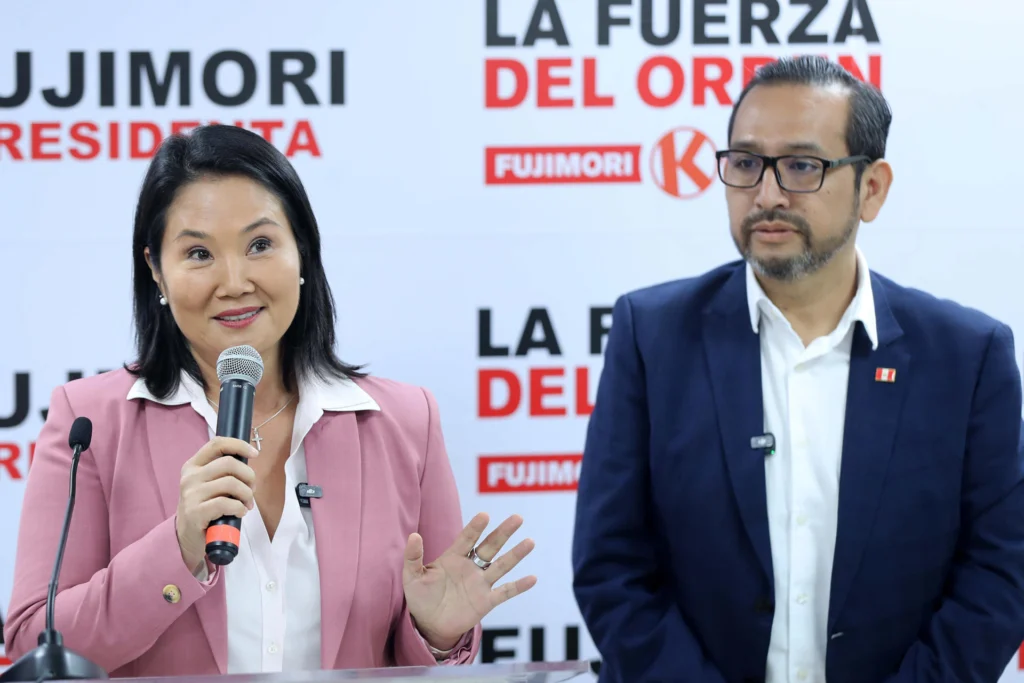
Keiko Fujimori achieves victory with 50.135% of votes, meanwhile Roberto Sánchez alleges fraud in a historically close election as Fujimorism returns to power in Peru after 25 years.
The National Office of Electoral Processes of Peru (ONPE, in Spanish) finalized the vote count this Monday, confirming the victory of Popular Force (Fuerza Popular, in Spanish) candidate Keiko Fujimori over Toghether for Peru (Juntos por el Perú, in Spanish) candidate Roberto Sánchez in the second round of the presidential elections held on June 7.
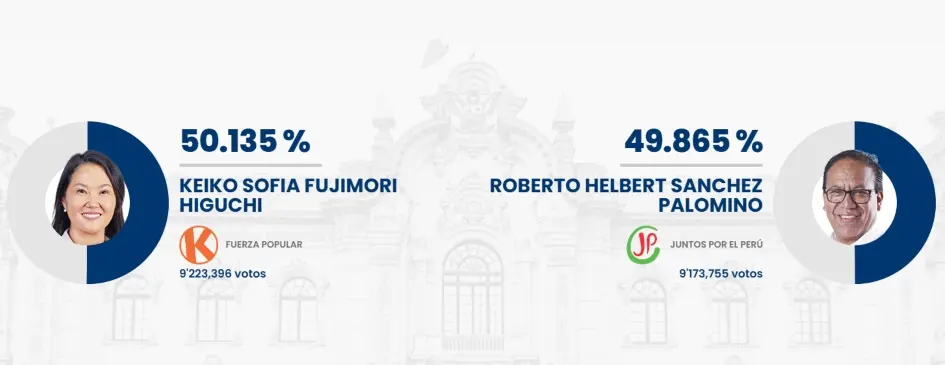
The official electoral data shows that Keiko Fujimori secured 9,223,396 votes, representing 50.135% of the valid ballots. Roberto Sánchez garnered 9,173,755 votes, equivalent to 49.865%.
RELATED: Peru’s Roberto Sanchez Denounces Fraud and Vows Not to Recognize Fujimori
Keiko Fujimori’s victory was decided by a razor-thin margin of 49,641 votes, making it one of the closest electoral results in the country’s history.
This marks the third consecutive presidential election in Peru to be decided by fewer than 50,000 votes, highlighting a deeply divided electorate.
Source: ONPE
The National Electoral Jury (JNE), in Spanish is scheduled to officially proclaim the results on July 3. Fujimori will receive her credentials on July 15 and will be sworn in as President in Parliament on July 28, coinciding with Peru’s National Day, to govern for the 2026-2031 period.
Fraud Allegations
Roberto Sánchez, the progressive candidate of Toghether for Peru, has announced that he will not recognize Fujimori as President. Sánchez denounced fraud in the overseas voting and unsuccessfully requested its annulment. He argued that those votes would have secured his victory, given that he was the most voted candidate within national territory.
The recent election was the most complex in Peru’s history, featuring 35 candidates in the first round. The dispersion of votes led to Fujimori leading the first round with 17.19% of the suffrages, followed by Sánchez with 12.03%.
The election of the daughter and political heir of former far-right President Alberto Fujimori (1990-2000) occurs in her fourth consecutive presidential candidacy. She had previously lost runoffs in 2011 against Ollanta Humala, in 2016 against Pedro Pablo Kuczynski and in 2021 against Pedro Castillo. The trajectory of the Popular Force candidate includes three prior defeats, four candidacies, over 500 days in preventive prison, and a prolonged anti-vote sentiment.
This electoral triumph marks the return of Fujimorism to power after 26 years, since the controversial resignation of dictator Alberto Fujimori by fax from Japan. His resignation followed a corruption scandal in his administration that led to his conviction for 25 years in prison for corruption and crimes against humanity.
During the campaign, Keiko Fujimori championed her late father’s legacy, citing achievements in economic growth and trade liberalization. This strategy was shared with her former advisor Vladimiro Montesinos, who is currently nearing release from prison. Fujimori’s central campaign promise was to “restore order” in the face of rising citizen insecurity due to increased organized crime.
Keiko Fujimori’s five-year term will commence after a decade of political instability in Peru, which saw eight presidents in ten years due to successive parliamentary impeachments, mostly driven by votes from the Fujimorista bloc.
From teleSUR English via This RSS Feed.