

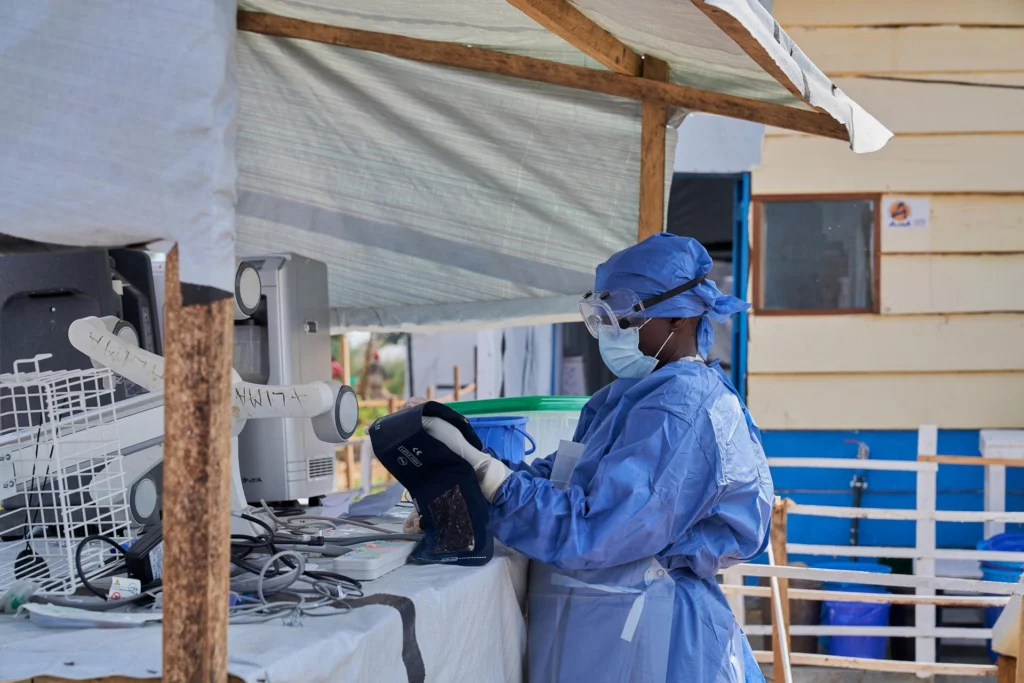
The Democratic Republic of Congo (DRC) on June 29 banned public gatherings, marches and demonstrations in the capital and three strategic provinces to curb Ebola transmission following health warnings of high community risk.
The Ministry of Interior of the Democratic Republic of Congo (DRC) this Monday has formally prohibited public gatherings, marches and demonstrations across the capital, Kinshasa, as well as within the jurisdictions of Tshopo, Haut-Uele, and Bas-Uele provinces.
This comprehensive restriction, issued by Interior Minister Jacquemain Shabani to provincial governors, aims to significantly reduce mass physical contact in densely populated urban environments.
RELATED: African Union Raises Funding to $1.4 Billion for Ebola Response in DR Congo and Uganda
The measure seeks to effectively halt the transmission vectors of the deadly Ebola virus, following urgent alerts from health authorities regarding an elevated danger of community transmission spreading to areas proximate to active disease epicenters.
The Democratic Republic of the Congo has banned public gatherings in Kinshasa, Tshopo, Haut-Uele and Bas-Uele provinces as the country battles a deadly #Ebola outbreak. pic.twitter.com/sp21vTBb4D
— CGTN Africa (@cgtnafrica) June 29, 2026
This governmental action has, however, provoked strong reactions from opposition blocs and social movements across the African nation.
Critics have swiftly labeled the ministerial order as unconstitutional, arguing that the decree is driven by political rather than purely public health motivations. They contend that the ban is primarily designed to neutralize the fundamental right to popular mobilization, a crucial element of democratic expression within the DRC. These groups emphasize concerns over potential abuses of power under the guise of public health measures, demanding greater transparency and adherence to constitutional norms during this critical period.
Despite the widespread criticism, official instances within the DRC Government have firmly based the implementation of these limitations on the latest assessment from the World Health Organization (W.H.O.). The international body has unequivocally classified the current Bundibugyo virus outbreak, which has affected both Congolese territory and neighboring Uganda, as an international public health emergency of significant concern. This designation underscores the severe nature of the virus and provides a robust justification for the stringent measures adopted by the Congolese authorities, aligning their actions with global health protocols designed to contain highly infectious diseases.
In response to the rapid expansion of this severe infectious disease, which is characterized in its initial stages by high fever, multiple organ failure, and hemorrhagic symptoms, the Africa Centres for Disease Control and Prevention (Africa CDC) is spearheading a comprehensive strategic regional contingency plan. This critical plan is structured to be deployed over the next six months, aiming to provide a coordinated and multi-faceted approach to containment and prevention across the affected regions.
The international preventative framework necessitates a substantial budget of $518 million dollars. This significant funding is earmarked for several critical initiatives, including the strengthening of mobile laboratories to enhance diagnostic capabilities, the establishment of robust epidemiological surveillance perimeters to track and monitor cases, and the implementation of stringent border controls to prevent cross-border spread.
These measures are designed to mitigate the devastating impacts of the virus, which has historically disproportionately afflicted disadvantaged populations residing in the central African territories, exacerbating existing vulnerabilities and health disparities within the region.
As the #DRC battles an Ebola outbreak caused by the Bundibugyo virus, WHO’s updated filovirus disease guidelines — covering all Ebola and Marburg virus types — are designed for frontline health workers.
The recommendations cover early detection of deterioration, dehydration and… pic.twitter.com/SOg7WJKHMr
— World Health Organization (WHO) (@WHO) June 26, 2026
High Mortality, Ebola Expanding
The Government of the Democratic Republic of Congo confirmed that the Ebola outbreak, initially declared on May 15, has tragically claimed the lives of at least 304 people. This grim toll comes after a cumulative total of approximately 1,155 confirmed cases were registered primarily in the eastern part of the African country.
Health authorities have provided detailed statistics, indicating that the overall fatality rate for the current outbreak stands at 26.3%. Despite the high mortality, there is a glimmer of hope as 138 patients have successfully recovered from the infection, while 326 citizens currently remain under strict hospitalization or in preventive isolation regimes within the comprehensive healthcare networks deployed across the various contagion hotspots.
The primary epicenter of this epidemiological emergency is situated in Ituri province, a region bordering Uganda and South Sudan. The virus has since demonstrated a troubling spread, extending into the provinces of North Kivu and South Kivu, further complicating containment efforts within the DRC.
Alarmingly, the Ebola outbreak has transcended continental borders, with 20 confirmed cases recorded in neighboring Uganda and the first positive case identified in France. This European case involved a humanitarian aid doctor who had recently returned from a mission in Bunia, underscoring the global reach and potential for international transmission of this virulent disease, necessitating urgent international cooperation.
How long does the #Ebola virus remain in the body after recovery?
Your question answered
#ViralFactsAfrica @viralfacts pic.twitter.com/EqWBW0BBQz
— WHO African Region (@WHOAFRO) June 29, 2026
From teleSUR English via This RSS Feed.