

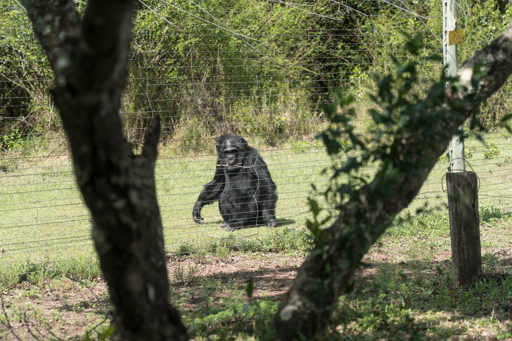
Max hears the plane before anyone else.
A low hum threads through the morning air above the Sweetwaters Chimpanzee Sanctuary in Kenya’s central highlands. As it grows louder — a small propeller drifting in from Mount Kenya — Max is already moving.
He snatches a dry branch, paces the electric fence, and begins shouting — ah-ah-ah — his cries rising into a scream at the sky. He swings his arm and sends the stick flying upward. His hair bristles along his spine.
“It’s because of the plane,” says Stephen Mukundi, the sanctuary’s head caregiver. “He is remembering Burundi during the civil war.”

An view of Sweetwaters Chimpanzee Sanctuary, set on the southeastern edge of the 360-square-kilometer Ol Pejeta Conservancy in Laikipia County — the only refuge of its kind in Kenya. Photo by Jaclynn Ashly.

A caregiver hands food through the fence at Sweetwaters. The sanctuary’s caregivers live on-site around the clock, learning each chimpanzee’s temperament so closely that they decide every evening who can safely sleep beside whom. Photo by Jaclynn Ashly.

Stephen Mukundi, the sanctuary’s head caregiver, walks the perimeter of the enclosure. He arrived at Ol Pejeta in 1996 and has known most of the chimpanzees here since they were infants — a second family, he says, that he has watched go from trauma to becoming chimpanzees again. Photo by Jaclynn Ashly.
Max was born in Burundi in 1988. Captured as an infant — his mother presumed killed — he spent his early years with a French film crew before being confiscated in 1990 at around two years old, and transferred to the Jane Goodall Institute’s rescue center in Bujumbura.
When the Burundian civil war broke out in 1993, the Institute evacuated — a crisis that led to the founding of Sweetwaters. Max was one of three chimpanzees airlifted across borders, a founding resident of what remains the country’s only refuge of its kind.
Today, Max is one of roughly 35 chimpanzees at the sanctuary — each rescued from the overlapping pressures of conflict, habitat loss, and the illegal wildlife trade. Some were repatriated from the Middle East, where they had been kept as pets or displayed in private zoos. Others arrived as infants with bullet wounds, or were discovered in crates at airports mislabeled as other animals.
The forces that brought them here are sustained by demand far beyond the forests they were taken from — wealthy buyers, private zoos, and commercial attractions that turn infant apes into status symbols and entertainment. While sanctuaries like Sweetwaters absorb the consequences, the trade continues to grow. For every chimpanzee rescued, many more are not.

Chimpanzees at Sweetwaters, the only sanctuary of its kind in Kenya — home to roughly 35 great apes, each rescued from the overlapping pressures of armed conflict, habitat loss, and the illegal wildlife trade. Photo by Jaclynn Ashly.

A mother and her infant at Sweetwaters. The sanctuary is not a breeding facility — females are placed on contraception — but occasional unintended births mean a small number of chimpanzees have been born here. Photo by Jaclynn Ashly.
Second Family
The sanctuary lies on the southeastern edge of the 360-square-kilometer Ol Pejeta Conservancy in Laikipia County, where the last two northern white rhinos on earth remain.
The Ewaso Nyiro River divides the sanctuary’s chimpanzee enclosures into western and eastern sections. Chimpanzees are not native to Kenya — their range extends from Senegal across the Congo Basin to western Uganda — making Sweetwaters the only place in the country where they live.
Chimpanzees arrive to live out their lives here. Sweetwaters is not a breeding facility; females are placed on contraception, though occasional unintended births mean a small number have been born at the sanctuary.
Max is 38 now. “He doesn’t like people — large groups, cameras, long lenses, anything that reminds him of the film crew that handled him as a baby,” says 49-year-old Mukundi. Max also moves against the grain of his own society, picking fights and disregarding the social codes that hold the group together. Although he distrusts adult humans, he shows a particular affinity for children.
“Maybe they were kind to him during his captivity,” says Mukundi, a father of five. When two children arrive during visiting hours, Max, lingering near the fence, looks up immediately and begins to play, running along it and urging them to follow.
Max plays with two children visiting the sanctuary. Distrustful of adults after his early years with a French film crew, he shows a particular affinity for kids — perhaps, his caregivers say, because they were kind to him during his captivity. Video by Jaclynn Ashly.
Mukundi has been at Sweetwaters almost as long as Max. He arrived at Ol Pejeta in 1996 at 19, starting as a gatekeeper, then a night guard, then a caregiver. The work is demanding. The sanctuary’s 16 caregivers live on-site around the clock; Mukundi’s family lives 30 kilometers away and he sees them once a month.
“I’ve grown to really love these chimpanzees,” Mukundi tells TRNN, smiling. “They’ve become like a second family. I’ve raised most of them, known them since they were babies. I’ve seen them go from trauma to becoming chimpanzees again.”
He knows each animal by temperament, and every evening decides who sleeps where in the holding house — a decision with real stakes. If the wrong two males are placed together, “they might kill each other at night.”
Each caregiver has a favorite. For Mukundi, it is Manno, who arrived in 2016 from Iraqi Kurdistan.
Manno was taken from his mother in Central Africa shortly after birth and trafficked through the Middle East to Iraq, where he spent three years at Duhok Zoo. He was kept alone in a small cage stacked above a crate of boa constrictors. He never saw, heard, or smelled another chimpanzee. Zoo staff dressed him in children’s clothes; visitors handed him candy, soda, and cigarettes, which he learned to smoke.
In his last months in Iraq, a Syrian refugee worker at the zoo took him home at night, where he slept in a bed and was treated as part of the family — reinforcing a childhood shaped entirely by human contact.
When Manno arrived at Sweetwaters — after a year of planning his rescue — he was terrified. “I stayed with him the whole time,” Mukundi recalls. “He had never seen or heard another chimp before. I was like his father and mother. Every morning, he would run to hug me. I had to wait until he fell asleep to leave.”
Integration follows a sequence the sanctuary has refined over decades. New arrivals are introduced in stages — first to a calm female, then to others, followed by juveniles and lower-ranking males. Dominant males come last; their reaction can determine whether integration succeeds.
Today, Manno is competing for dominance in the eastern group, and Mukundi believes he could become the next alpha. “He just has about two more males to fight,” he says, with quiet pride.
“He came here alone, knowing nothing — not even that he was a chimpanzee. Now look at him. He’s finding himself and fighting for his place.”
Inside the Supply Chain
Chimpanzees like Max and Manno are survivors of a trade that removes thousands of great apes from the wild each year — captured for the pet and entertainment industries or killed for bushmeat — with chimpanzees among the most heavily targeted.
There are as few as 170,000 chimpanzees remaining in the wild — down from about 1 million at the start of the 20th century. All four subspecies are endangered. The western subspecies, critically endangered, fell by 80% between 1990 and 2014. The International Union for Conservation of Nature says the subspecies is now on a trajectory toward extinction without drastic intervention.
The illicit great ape trade operates within the same forces destabilizing chimpanzee habitats: armed conflict, extractive industries that carve roads into once-remote forests, and the poverty they produce pushing rural communities into the low-paid end of the poaching chain.
Scientists attribute the decline to a combination of habitat loss, poaching, and disease — pressures driven by poverty, conflict, extractive industries, and infrastructure expansion. Africa has the highest rate of forest loss in the world, losing roughly 9.6 million acres each year.
The illicit great ape trade operates within the same forces destabilizing chimpanzee habitats: armed conflict, extractive industries that carve roads into once-remote forests, and the poverty they produce pushing rural communities into the low-paid end of the poaching chain. State officials, meanwhile, often do more than fail to stop the trade; in some cases, they profit from it.
Across Western and Central Africa, these dynamics are embedded in land use itself: more than half the range of western gorillas and chimpanzees now falls within active logging concessions, where new access routes and labor camps both expand poaching and create sustained demand for bushmeat — wild meat often sold to urban elites.
“Mining and logging don’t create the trade — but they accelerate it,” says Ofir Drori, a wildlife law enforcement strategist who has spent two decades pushing governments to prosecute wildlife crime. “They open the forest, build roads, and make transport easy. These industries are facilitators, and at times their own personnel are directly implicated.”
In the Democratic Republic of the Congo (DRC), armed groups embedded in artisanal mining for coltan and gold drive much of the bushmeat poaching that produces trafficked infant apes. A 2018 Global Financial Integrity report identified a similar pattern in Sierra Leone, where post-war mining expansion has been linked to sharp declines in chimpanzee populations.
“The profit margins for great apes are far higher than any other species,” Drori tells TRNN. “The rarer the species, the more valuable.” While armed militias are heavily involved in poaching, Drori says he has found no clear evidence linking them to great ape trafficking. The trade runs on a different infrastructure — organized crime families and corrupted officials.
At the center are trafficking dynasties — extended families spread across multiple countries in West and Central Africa, laundering wild-caught infants through fraudulent CITES documentation.
Under CITES — the Convention on International Trade in Endangered Species — chimpanzees are listed in Appendix I, prohibiting all commercial trade. However, captive-bred specimens of Appendix I species can be traded commercially — provided the breeding operation is formally registered with CITES. No such registered facility for great apes exists anywhere in the world.
Traffickers exploit this gap through what enforcement specialists call the “C-scam.” Corrupt CITES authorities in exporting countries stamp permits with a “C” source code — designating an animal as captive-bred — for apes that were taken directly from the wild. In some cases, wild-caught apes are funneled through unregistered breeding operations in the Middle East — along with private zoos and safari parks that pose as conservation centers — where their wild origins are rewritten as captive-bred on paper. But no facility in the world is recognized by CITES for great ape breeding — meaning any permit claiming a great ape is captive-bred is inherently fraudulent.
“A corrupt CITES authority can turn an illegal shipment legal with a single signature,” Drori notes.
Prosecutions of traffickers and corrupt government officials have followed, but the illicit network has adapted faster than the law, Drori explains. When one node is dismantled, smuggling routes shift while remaining largely intact, and corruption migrates with them — more recently to the DRC, where the US State Department sanctioned senior officials at the Institut Congolais pour la Conservation de la Nature (ICCN) for trafficking great apes and other protected wildlife to China on falsified permits.
According to Daniel Stiles, a leading specialist on the live great ape trade, ICCN officials continue to issue fraudulent permits for wild-caught great apes.
“For the first time, we’re seeing poaching bands specifically targeting great apes — not for the meat,” Stiles says. “They kill the adults, take the infants, and leave the carcasses behind.”
The supply runs through a short list of transit hubs. Kano, in northern Nigeria, has been a primary hub since the 1990s. Istanbul has emerged as a key transit point: on December 22, 2024, Turkish customs intercepted a flight from Nigeria carrying a five-month-old gorilla named Zeytin in a crate bound for Bangkok labeled “50 rabbits.” The investigation traced the syndicate back to Kano. Cairo, Sharm el Sheikh, Khartoum, and Dubai have also been documented as launder points.
For decades, poaching was driven by the elite bushmeat economy, where great ape meat is sold in urban markets as a status symbol — luxury “big man’s meat.” The infants orphaned in these hunts were a secondary product. That equation has now been inverted: what was once a byproduct of the bushmeat trade is now a targeted, high-value extraction. As prices for live infants have surged — rising roughly tenfold over the past decade — the infant has become the primary target of a demand-driven international trade, fueled by status-symbol pets in the Middle East and commercial attractions in Asia, and now outpacing the profits of any other forest commodity.
“For the first time, we’re seeing poaching bands specifically targeting great apes — not for the meat,” Stiles says. “They kill the adults, take the infants, and leave the carcasses behind.”
When poachers locate a troop in the canopy — anywhere between 10 to 150 individuals — they fire directly. The adults die defending their young. The infants are pried from their mothers’ bodies and sold alive, sometimes with gunshot wounds of their own.
Accounting for adults killed and infants who die in transit, researchers estimate each surviving orphan can represent up to 25 chimpanzees killed. By this measure, each chimpanzee at Sweetwaters stands as evidence of potentially hundreds of deaths.
Written on Their Bodies
The geographies of this violence are written onto the sanctuary’s residents.
Ali Kaka, current alpha of the eastern group, was kept as a pet by the South Sudanese army for his first 18 months; in 2003, soldiers handed him over when they learned chimpanzees were being rescued to Kenya. Safari, an elderly male, spent his early years in a small outdoor cage at a Burundi hotel, taunted by holidaymakers until the Belgian manager surrendered him in 1989.
And then there is Poco.
Poco was born around 1981 in the forests of Central Africa. Captured as an infant — likely around three years old, after his mother was killed — he was sold to a shop owner in Bujumbura, who kept him in a narrow cage hung from the ceiling to attract customers. Poco lived in that cage for nine years. It was too small for him to lie down or move on all fours. Over time, his musculature, spine, and shoulders adapted to that constraint, and he developed an upright gait.
Rescued in 1989 by the Jane Goodall Institute and later transferred to Sweetwaters, Poco, now in his late 40s, is the only chimpanzee documented to walk bipedally by default.

Poco at Sweetwaters. Captured as an infant in Central Africa around 1981, he was rescued by the Jane Goodall Institute in 1989 and later transferred to the sanctuary, where he has lived ever since. Photo by Jaclynn Ashly.

The cage that held Poco for nine years, now preserved at Sweetwaters as a teaching object for visitors. Hung from the ceiling of a Bujumbura shop to attract customers, it was too small for him to lie down or move on all fours — reshaping his spine and shoulders so that, decades later, he remains the only chimpanzee documented to walk upright as default. Photo by Jaclynn Ashly.
Poco walks upright through his enclosure at Sweetwaters — the only chimpanzee documented to do so as default, his gait shaped by the nine years he spent in a cage too small to lie down or move on all fours. Video by Jaclynn Ashly.
What Dr. Stephen Ngulu, a wildlife veterinarian and former head of the sanctuary, learned over a decade there is how to read a chimpanzee’s history in its body.
“When they arrive, they are often dehydrated, malnourished, and sometimes injured,” he says. “Behaviorally, they are always withdrawn. They don’t want anything to do with humans or other chimpanzees.”
Many injuries are not visible: stunted growth, unhealed fractures, muscle wasting from years chained in place, dental disease from diets of chocolate and fried food. Chronic stress leaves deeper damage — suppressed immunity, delayed sexual maturation, neurological impairment.
“You can at times see a traumatized chimpanzee stargazing — not looking at anything,” Ngulu explains. “Unable to have proper cognitive abilities.”
The behavioral signs are consistent across arrivals: rocking side to side, the same motion seen in humans under extreme distress. Research has shown chimpanzees who survived prolonged captivity exhibit symptoms closely matching human complex PTSD. Chimpanzees and humans also share more than 98% of their DNA — our closest living relatives.
“A frightened chimpanzee can recover with time,” Ngulu tells TRNN. “But a deeply traumatized chimpanzee will show persistent abnormal behaviors. Even with optimal care, those behaviors can last for many years.”
In 2018, an infant named Bo arrived from Guinea-Bissau, confiscated from traffickers who had killed her mother for bushmeat and intended to sell her. “She was missing one tooth,” Ngulu remembers. “She was fearful and withdrawn.”
Bo survived and is now 11. “But to this day,” says Ngulu, “you will still see her sometimes sitting alone and slightly rocking back and forth.”
But not all the chimpanzees arrive at the sanctuary carrying scars. Alley came from a private home that treated her well. Nicknamed “the engineer,” she is caretaker Martin Kinyua’s favorite.
“She’s so intelligent we had to separate her from the other chimps,” says 45-year-old Kinyua, a father of three who has worked at the sanctuary since 2000. “Whenever she’s in the group, she has a big influence on the other chimps, even helping them break out of their enclosure.”
By observing sanctuary staff, Alley learned that dry wood does not conduct electricity. She used sticks to hold the live wires of the electric fence apart, making a gap for herself and the others to pass through. Caretakers also observed other chimpanzees in her group collecting sticks and handing them to her to assist in the escapes.
Alley has a record of trying to bite people after her breakouts — but not Kinyua, who describes a special bond with her. He recalls standing alone in the holding house when she appeared in the doorway after an escape, close enough to grab him. She didn’t raise her hair or advance.
“Alley trusts me,” he says, with a grin. Alley’s ingenuity — and repeated breakouts — became such a persistent problem that the sanctuary was forced to rebuild, separating her during the day in an enclosure with elderly Poco and reinforcing it with chicken wire.

A caregiver feeds Alley and Poco at Sweetwaters. Alley — nicknamed “the engineer” for using sticks to hold the electric fence’s live wires apart and lead group escapes — is now housed during the day with elderly Poco in a reinforced enclosure. Photo by Jaclynn Ashly.

Martin Kinyua, 45, has worked at Sweetwaters since 2000. His favorite chimpanzee is Alley — “the engineer” — who has tried to bite others after her breakouts but, he says, has never turned on him. Photo by Jaclynn Ashly.
“The more you understand how intelligent these chimpanzees are, the more anger and grief you feel at the way they’ve been treated,” Kinyua says. “These are not pets. They are very intelligent beings.”
A Global Demand
While the supply chain runs across Africa, the demand that drives it lies largely outside the continent. In the Gulf, Russia, and Eastern Europe, infant chimpanzees are kept as status-symbol pets — sometimes gifted between elites — while in China and Southeast Asia, growing demand from private zoos, safari parks, and tourist attractions fuels a commercial market.
Across these contexts, infants function as luxury commodities and entertainment — appearing on social media in children’s clothes, posed on private jets, or used as selfie props — within a global trade driven by high-paying international buyers.
“Prices have quadrupled over the past decade,” Stiles tells TRNN. “An infant chimp can sell for up to $200,000, bonobos $300,000, and gorillas $550,000.” At the bottom of the chain, poachers are paid “peanuts,” often no more than $100.
For decades, the primary buyers were wealthy individuals in the Gulf who kept great apes as pets. That shifted in 2016, when the UAE banned private ownership of dangerous animals, restricting them to licensed facilities, Stiles explains.
“So these traders, who had been dealing in animals for years, started registering private zoos,” Stiles says. “To finance them, they opened them to the public. They make money through selfies and direct interaction — but for that, you need young animals, before they reach puberty and become dangerous.”
The result has been a proliferation of “private zoos” across China, the Gulf States, especially the UAE, Pakistan, and parts of South Asia — facilities that function as legal cover for private collections. Stiles alleges that major commercial operators in the Gulf have become significant players, relying on “a combination of legal and illegal acquisition.”
China has driven much of the parallel demand: roughly 10,000 zoos opened there between 2013 and 2020, nearly doubling the national total. Registered zoos can obtain import permits for strictly protected species far more easily than individuals — making them, Stiles notes, ideal laundering facilities for animals smuggled in and sold as captive-bred.
The pipeline also extends into India. Vantara — a vast private facility operated by the Ambani family and marketed as a wildlife rescue center — is alleged to have received chimpanzees exported from the DRC on CITES permits listing them as captive-bred. India’s Supreme Court ruled last year that Vantara’s imports were legal and barred further legal actions; however, a CITES Secretariat verification mission to India later flagged the captive-bred designations as questionable.
The United States is not immune to these dynamics. In July 2025, Bhagavan “Doc” Antle — owner of Myrtle Beach Safari and a figure popularized by the Netflix documentary Tiger King — was sentenced to federal prison for conspiring to violate the Lacey Act, a law prohibiting the illegal trade of protected wildlife. Antle paid $200,000 each for at least two chimpanzees and disguised the payments as donations to his conservation nonprofit — part of what prosecutors described as a years-long pattern of trafficking federally protected species.
Court filings described him as “a key player in the illegal chimpanzee trade” that others have sought to emulate. Yet despite the convictions, the United States still has no federal ban on private primate ownership. The Captive Primate Safety Act, which would amend the Lacey Act to ban private possession of primates, was reintroduced in May 2025 after previous attempts since 2005 failed to pass both chambers of Congress.
Stiles has advocated for legal accountability for social media companies facilitating the illegal trade in wildlife, and is currently working with a legal team on a lawsuit against Meta.
Social media has further accelerated the market. Since 2015, Stiles has documented more than 684 advertisements for great apes posted by at least 152 individuals across 19 countries, mostly on Instagram, Facebook, and WhatsApp. In 2014, most images showed apes in private homes. “Now it’s transformed,” Stiles says. “Ninety percent — they’re at a zoo.”
Stiles has advocated for legal accountability for social media companies facilitating the illegal trade in wildlife, and is currently working with a legal team on a lawsuit against Meta. “Meta could put a stop to this overnight,” he says. “But they’re allowing it because they’re making money from it.”
Enforcement outside Africa remains largely ineffective. Ofir Drori’s EAGLE Network has helped put more than 3,000 wildlife traffickers behind bars — mostly in Africa. Beyond the continent, he says, “there is no real enforcement. It’s a joke worldwide, especially in Europe.” At a CITES conference last year, member states moved to revive a long-dormant Great Apes Enforcement Task Force.
But Stiles believes supply-side enforcement alone is futile. “We have to put our attention on the demand side — the people buying,” he says. “You can arrest as many poachers as you want. But if the demand continues, those poachers will be immediately replaced.”
The enemy, Stiles says, is not a discrete set of criminals. It is a global market.
The Afterlife
Late afternoon at Sweetwaters is the quiet hour. The light begins to go orange along the ridge.
Poco turns and walks, upright, back toward the trees, the gait itself a record of the cage above the shop in Bujumbura. That cage — the one that held him for nine years — sits on display in the sanctuary grounds, preserved as a teaching object for tourists who ask how chimpanzees end up here.
Across the river is Kisazose, or Kiza for short, confiscated from a Congolese trafficker and brought to Sweetwaters in 1994 as an ill, undernourished infant. Timothy Njuguna, a 52-year-old caretaker at the sanctuary since 1995, cared for him then. “We used to go inside [the enclosure] with them when they first arrived,” he says, “because they were just babies. We used to even cuddle them.”

Timothy Njuguna, 52, has worked at Sweetwaters since 1995. Years ago, when a group of chimpanzees broke loose and pinned him to the floor of the holding house, Kiza — whom he had cared for since infancy — fought the others off and gave him a chance to escape. Photo by Jaclynn Ashly.
Years later, when Kiza had grown, a group of chimpanzees broke through the fencing undetected and escaped into the holding facility where Njuguna was preparing their dinner. One of the males pinned him to the floor. Others moved in.
“I thought for sure they would kill me,” says Njuguna, a father of two. “But Kiza, because he was a friend of mine, protected me. He immediately started fighting with them. At that moment, I got a chance to run away. Kiza literally saved my life.”
“Before I started working here, I didn’t realize chimpanzees were so close to humans,” he continues. “They use tools, they think the way people think, they solve their problems. After working with them, I came to realize they are very close to human beings.”
Florence Kangethe, a 31-year-old wildlife veterinarian who has worked at the sanctuary for nearly four years, arrived at the same conclusion through clinical practice.

Timothy Njuguna near the enclosure with one of the few chimpanzees born at Sweetwaters — an unintended birth at a sanctuary that does not breed its residents. Photo by Jaclynn Ashly.

Florence Kanyede, a wildlife veterinarian at Sweetwaters for nearly four years, says watching the chimpanzees reveals friendships, gossip, grooming rituals, and quiet introverts — “really like a mirror to ourselves.” Photo by Jaclynn Ashly.
“If you sit down with them for one hour, you’ll pick up so many different things,” she says. “Two best friends probably gossiping together, then grooming, or a mother-child bond here, then the introvert sitting by themselves. They’re really like a mirror to ourselves.”
By early evening, the keepers begin moving the chimpanzees into the holding house. Mukundi stands at the gate, calling each one by name. Most come. Max does not. He sits at the edge of the enclosure, ignoring the call.
“He’s stubborn,” Mukundi says, with a chuckle. “He knows he has to go in. But he wants to make it difficult.”
Max is among the least liked by his own troop. He cannot sleep with the dominant males; they would attack each other by morning. According to Mukundi, he gets away with his rebellions because he has formed a close bond with the group’s alpha, who always comes to his defense.

Members of the group wait outside the holding house at Sweetwaters as the light begins to go orange along the ridge. Photo by Jaclynn Ashly.

A chimpanzee slips into the narrow entrance of the holding house at Sweetwaters, where the sanctuary’s residents are settled in for the night. Photo by Jaclynn Ashly.

Max sits at the edge of the enclosure, ignoring the call to come in for the night. “He’s stubborn,” says head caregiver Stephen Mukundi. “He knows he has to go in. But he wants to make it difficult.” Photo by Jaclynn Ashly.
“If Max likes you, he really likes you — and you will know,” Mukundi says. “And if he hates you, he makes it very clear. He will even collect feces or find big rocks and throw them at you. He doesn’t hide anything.”
Eventually, Max relents. He passes Mukundi and slips into the narrow entrance of the holding facility. Mukundi watches him go, laughing softly — like one might at a troublesome relative — knowing he has made many enemies inside.
“Sweetwaters was set up to offer lifelong care,” says Ngulu, the former manager. “So if there are no more chimpanzees that need to be rescued — if the systems in the countries where they are found are working properly — then there is no need to have a sanctuary. The animals would live out their lives here, die, and we can close because everything now is perfect.”
“But, unfortunately, we seem to be heading in the opposite direction.”
From The Real News Network via This RSS Feed.