

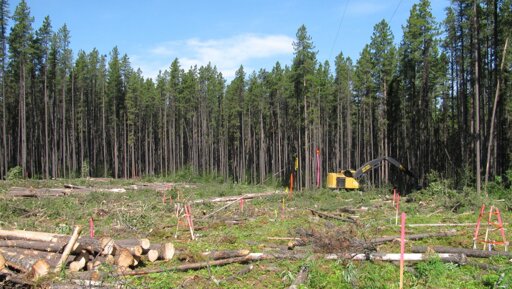
Boreal forests are being clear-cut faster than some of their wildlife and plant species can recover, with a few failing to return even 100 years after harvesting, according to University of Alberta-led research.
From Biology News - Evolution, Cell theory, Gene theory, Microbiology, Biotechnology via This RSS Feed.
Maybe I missed it, but they didn’t mention whether or not this effect included areas that were replanted after clear cutting. Are they talking just about how the biodiversity never fully returned…or the trees themselves never filled in the clearcut spaces, on their own?
From the linked paper in the discussion section:
Recovery was probably facilitated by redevelopment of the understory, shrub and sapling layers, which are particularly rapid in broadleaf and mixed forests, providing nesting and foraging habitat for birds. This probably also explains why the greatest divergence in similarity of harvested and reference forests was greater for conifer than for broadleaf or mixed forests. This probably also explains why the greatest divergence in similarity of harvested and reference forests was greater for conifer than for broadleaf or mixed forests.
[…]
Whereas in just over half of cases (biotic groups × forest types) predicted times to ‘full recovery’ of community composition were within 30 years post harvest, important ecological differences remain between harvested and natural forests (for example, characteristics of deadwood, very large trees, population continuity) that could result in longer-term effects on biota21,25,28. Some features of mature forests (for example, large trees and snags, large decayed downed wood) take many decades to re-develop25, delaying recovery of species such as cavity nesters43, saproxylics and epiphytes28,44. As hypothesized, biota that showed no resilience or very long (>95 years) predicted times to ‘full recovery’ (saproxylic beetles, small mammals, bryophytes, lichens) were associated with ecological features that tend to be missing in post-harvest forests (large downed decayed dead wood, large live and dead trees)
[…]
But in mixed and coniferous forests, recovery was much slower, taking more than 55 years for small mammals such as mice and voles, 85 years for flowering plants, 95 years for lichens, and more than 100 years for mosses and liverworts. And beetles dependent on deadwood for survival showed no signs of recovery at all within the 16 to 29 years of existing data available for review.
Essentially, planting trees cannot replace the complex environment that was destroyed. Those re-planted trees need to grow, then die and then finally rot to fully recreate the environment that was lost which will likely take more than a century.
But, that still doesn’t answer the question of whether replanting was specifically taken into account…only that full biodiversity takes a long time.
Obviously, the trees need to grow back before any of the other organisms can repopulate the forest. But, replanting versus simply allowing those trees to spread throughout the clearcut naturally, would greatly accelerate that process. But the article makes no distinction between natural recovery versus assisted.
There are places in BC that were clearcut in the 80’s that are still almost entirely barren. This stands in total contrast to areas that were replanted manually, where it’s hard to tell that they were ever clearcut at all. I can’t say the recovery is complete, but the difference is massive.
Ah, sorry. I got distracted. I suspect there wasn’t enough/any data to really make that distinction. I mean if they could I don’t see why they wouldn’t.
