

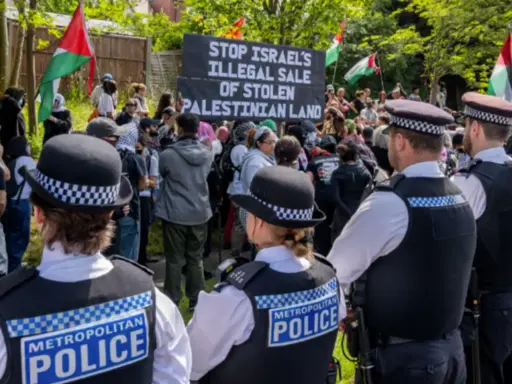
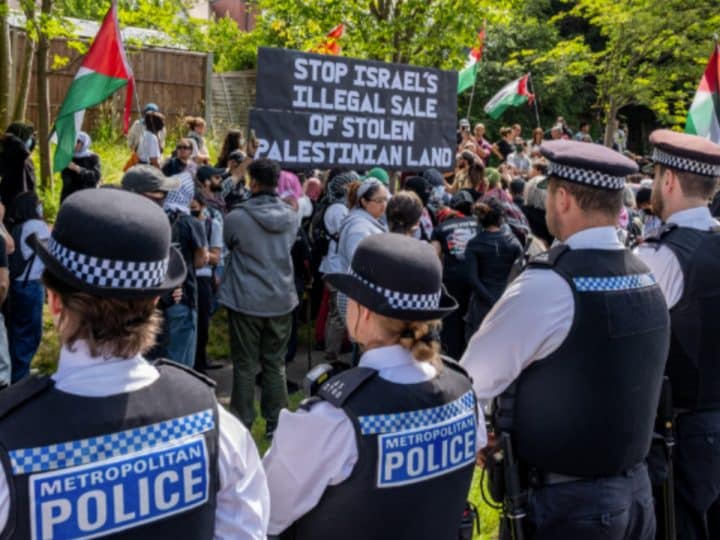
29 June is the day that Section 164 of the Crime and Policing Act 2026, creating new restrictions on protests at places of worship, comes into force. On the same day, a new Netpol report examines the police response to violent attacks on an anti-Zionist protest against the ‘Great Israeli Real Estate Event’ that took place at a synagogue in Edgware on 14 June.
Testimonies from Palestine solidarity campaigners and anti-Zionist Jewish activists, who mobilised to highlight how the event was openly promoting the sale of land in illegal Israeli settlements in the occupied West Bank, describe how a violent Zionist counter-protest ambushed and attacked them.
Their experiences also recount how the Metropolitan police stood by and allowed these attacks to take place.
Netpol’s report, One Day in Edgware, documents shocking examples of verbal intimidation, death threats and physical violence against protesters opposed to the property fair – crimes that Met officers witnessed but failed to intervene against.
It also describes the violent anti-Arab and racist invective and sexist abuse from Zionist counter-protesters – hate crimes that Met officers chose to ignore.
The report concludes that police inaction was a failure in their legal duty to provide a heightened level of protection for the right to protest.
Even the one positive decision that police made to protect protesters on the day – escorting them safely to Edgware underground station – has been twisted by political adversaries into claims that they were holding an ‘intimidatory march’ though a Jewish neighbourhood.
Edgware policing fell short
Yet despite numerous recent pledges to counter false and misleading claims likely to fuel further public disorder, the Met has failed to take immediate steps to publicly correct this disinformation.
In a press statement, the Board of Deputies of British Jews, which had insisted that allegations against the ‘Great Israeli Real Estate Event’ had been “publicly refuted”, condemned the presence of protesters near Edgware United Synagogue as:
little more than an excuse to harass and intimidate members of the Jewish community.
It demanded that police use new powers as soon as possible to restrict protests to:
ensure such protests are kept a significant distance from places of worship [once again to] prevent intimidation to members of the Jewish community.
However, the Crime and Policing Act 2026 only allows the police, at least on paper, to lawfully impose restrictions on protests that deter people from:
accessing [a] place of worship for the purpose of carrying out religious activities [or from] carrying out religious activities at that place of worship.
An illegal settlements property fair, even if it takes place in a synagogue, is obviously not a religious activity.
Moreover, the testimony presented in the report makes the strongest of cases that the only evidence of harassment and intimidation of Jewish people was by Zionist and far-right counter-demonstrators.
Netpol has grave concerns that further pressure from pro-Israel groups, as well as evidence of the Met’s own false assumptions about Palestine protests and about the ‘wrong kind of Jews’ protesting attitudes towards Palestinians within Jewish communal life, risks shutting down the right to protest anywhere near a synagogue.
Kevin Blowe, campaigns and media coordinator for Netpol, said:
Netpol is documenting a crackdown on the right to protest happening almost every day, in different ways and in disparate parts of the country. ‘One Day in Edgware’ offers one snapshot of this growing state of repression.
In this instance it involves the failure of the police to protect campaigners from violent political opponents and the hypocrisy, from both the state and a prominent Jewish communal group, about what constitutes hate crime and intimidation if it is directed against Jewish people critical of illegal Israeli settlements.
Now that new police powers are about to come into force, we fear shutting down the right to protest anywhere near a synagogue is more likely even when – as in this instance – a synagogue is used for politically controversial and potentially illegal activities that are wholly unconnected to acts of worship the government claimed the legislation was intended to protect.
In July 2026, Netpol will publish its second report, One Day in Manchester. This examines the violent policing of an anti-fascist counter-demonstration against a far-right Britain First march held in April.
Featured image via Netpol / just.barold
By The Canary
From Canary via This RSS Feed.