


By Terje Alnes, June 29, 2026
The United States demands loyalty from its allies and full control over the military bases it maintains in allied countries. The Norwegian authorities refuse to discuss what this means in practice.
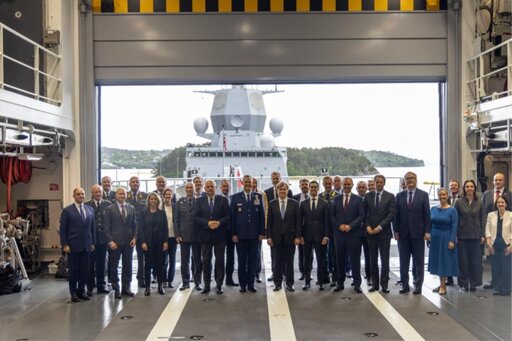
At the end of May or beginning of June, U.S. Under Secretary of War Elbridge Colby summoned the most committed NATO allies to a meeting at the Haakonsvern Naval Base in Bergen, on the Norwegian west coast. Norway was represented by, among others, Chief of Defense Eirik Kristoffersen and NATO Ambassador Anita Nergaard. NATO’s Supreme Allied Commander Europe, General Alexus G. Grynkewich, was also present.
Sweden, Finland, Poland, Germany, and the Netherlands were all invited to the meeting. Together with Norway, these countries are part of the most loyal “5% Club”, or as Colby himself put it: “NATO allies that are rapidly meeting their Hague spending commitments, ….” The meeting was held in complete secrecy and only came to light when Colby himself posted information and photos on X. The exact date of the meeting has not yet been confirmed.
The U.S. Has Far-Reaching Powers on Norwegian Soil
Colby says that the U.S. Department of War convened the meeting and that the Norwegian Ministry of Defense hosted it. Haakonsvern Naval Base was one of the first four bases to which the U.S. gained access when the Supplementary Defense Cooperation Agreement (SDCA) entered into force in 2022.
When Norwegian authorities have signed such an agreement, it means that they have granted the United States far-reaching powers on Norwegian territory, within what the agreement defines as “Agreed Facilities and Areas”. This means that the United States may transport, pre-position, and store defense equipment, supplies, and materiel. This equipment is to be used exclusively by U.S. forces, which have exclusive control over access to, use of, and disposal of the equipment. Norway has no way of monitoring what the United States is doing inside the bases. “Aircraft, vessels, and vehicles operated by or exclusively for U.S. forces shall be free from boarding and inspection without the consent of the United States”. This is stated in Article XI, paragraph 3 of the agreement.
So when the U.S. Under Secretary of War holds a secret meeting in Norway, it takes place inside the naval base, where an area has been turned into a little piece of the U.S. in Mathopen, Bergen—or, as stated in Article XII, Section 2 of the agreement: Where “Norway waives its primary right to exercise criminal jurisdiction over members of the U.S. forces …”. When the agreement became public, the conservative newspaper Aftenposten concluded that “American soldiers will be allowed to act in Norway as if they were in the United States”.
U.S. demands unrestricted access to bases in allied countries
At the NATO foreign ministers’ meeting in Helsingborg in May, U.S. Secretary of State Marco Rubio expressed disappointment that some NATO countries closed bases and airspace to the U.S. during the war against Iran. Spain, which hosts two key U.S. bases – the Rota Naval Base and the Morón Air Base – is singled out in particular. According to Reuters, there is an internal discussion within the Department of War about suspending countries from NATO if they impose restrictions on the use of U.S. bases in the future.
At the NATO meeting in Brussels on June 18, Minister of War Pete Hegseth reiterated his criticism of NATO countries that refused to allow the U.S. to use their bases in the attack on Iran, which violated international law. For Norway, this is a clear warning that we have no say in the matter when it comes to the U.S.’s use of the 12 “Agreed Facilities and Areas” within Norway’s most important defense facilities. We are not masters in our own house.
What the SDCA actually means is that we have given the U.S. the opportunity to establish exclusive zones within the bases, where only U.S. forces have access and where U.S. law applies. Here, the U.S. can build its own infrastructure, which it fully controls and from which Norway is excluded. In a crisis situation, U.S. forces can use the bases as they see fit. In short, U.S. needs take precedence over Norwegian interests if the two conflict.
Major Development Projects at Haakonsvern
Haakonsvern is the main base for the Norwegian Navy and the largest naval base in Northern Europe. It is home to the Norwegian frigates and submarine force. It also has excellent maintenance facilities. The naval base is the only location in Southern Norway with military maritime shipyard capacity, including a rock-cut hangar with a dry dock. Major construction projects are currently underway at Haakonsvern. Facilities are being built to accommodate a fleet of new warships, including new Norwegian and German submarines. Norway and Germany have a strategic cooperation agreement covering the education and training of crews, as well as the operation and maintenance of the new submarines, which will be based at Haakonsvern.
The Importance of Haakonsvern to the United States
- Haakonsvern is one of two ports in Norway where U.S. nuclear submarines can dock (the other is Grøtsund in Tromsø). For the United States, Haakonsvern is particularly important for logistical support, which includes the storage of ammunition, fuel, and spare parts for naval vessels.
2. Haakonsvern is located near the entrance to the GIUK Gap (Greenland–Iceland–UK), the maritime chokepoint that Russian naval vessels and submarines must pass through on their way out into the Atlantic Ocean. This is often referred to as one of the most important maritime corridors in the world, giving the naval base great strategic significance. For the United States, the base at Haakonsvern helps monitor Russian strategic nuclear submarines from the Northern Fleet and track Russian attack submarines that could threaten U.S. reinforcements to Europe. This is viewed as a front line for U.S. strategic deterrence.
3. Haakonsvern also plays a role in the recolonization of the Arctic, where the United States is attempting to limit Russian and Chinese activity and seeks a more prominent role as climate change opens up new sea routes and opportunities to exploit new natural resources.
4. The United States views Norway as a loyal and politically stable ally that can serve as a base for its own Arctic operations. Haakonsvern offers proximity and rapid access to the High North. Norway’s willingness to cede political and territorial sovereignty through a comprehensive, bilateral “cooperation agreement” means low risk for the United States and makes Norway highly valuable to U.S. military power.
Elbridge Colby’s visit to Haakonsvern shows that even though the U.S. plans to have fewer military forces in Europe in the future – a move Colby himself is helping to drive – the U.S. will nevertheless ensure that it maintains significant maritime capabilities in the High North. Haakonsvern thus emerges as a key component of this more selective U.S. presence. The SDCA provides the United States with the legal basis for this.
The Risks of a U.S. Base at Haakonsvern
The war with Iran should serve as a major warning to countries that host U.S. military bases. We have seen how host countries have been drawn into the war when Iran has systematically attacked U.S. bases in the Middle East with great force. With U.S. bases on Norwegian soil, it is clear that these, too, would be prime targets for bombing in an international crisis situation where the U.S. uses the bases for offensive military operations.
We must keep in mind that it was the United States that, during Trump’s first term, approached the Solberg government and asked to establish bases on Norwegian soil. This was, in other words, a U.S. initiative that has nothing to do with Norway’s defense. It was the United States that pressed for this, and the Norwegian government that gradually gave in to U.S. demands.
Haakonsvern, and other Norwegian military installations where the U.S. has established a military presence, are targets that will be attacked in the early stages of a military conflict. The establishment of 12 U.S. military bases in Norway increases the likelihood of nuclear weapons on Norwegian soil, in Norwegian waters, and in Norwegian airspace. This means that Norway could be used to launch nuclear missiles against Russia, and that Norway would become a natural target for Russian nuclear missiles.
In 2024, the Financial Times published a list of potential bombing targets, based on information from Western intelligence agencies. Haakonsvern is specifically mentioned here: “The Russian Baltic Fleet’s targets are largely located in Norway and Germany – including the naval base in Bergen, as well as radar stations and special forces facilities”.
The post What It Means to Have a U.S. Military Base at Haakonsvern, Norway appeared first on World BEYOND War.
From World BEYOND War via This RSS Feed.
It means you become valid military targets for retaliatory strikes from countries the US picks wars with.
