

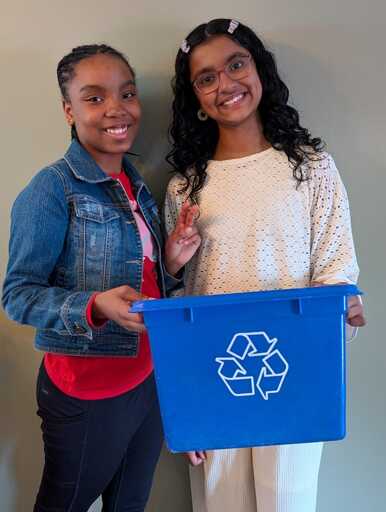
Photo: Cameron Straughan
Summary
- Grade 7 students Veda Nair and Latavia Douglas discovered their school and community no longer had access to recycling services after Ontario shifted responsibility for blue box collection to a producer-run system.
- Although the First Nation is eligible to join Ontario’s Blue Box Program, it has not registered due to logistical concerns.
- Nair and Douglas continue to advocate for recycling in their community, arguing they should have the same opportunity to protect the environment as anyone else.
In September 2025, Veda Nair and Latavia Douglas set out to start a recycling program at their school.
The Grade 7 students attend Mamawmatawa Holistic Education Centre, locally known as MHEC, in Constance Lake First Nation, about 500 kilometres northeast of Thunder Bay, Ont. They planned to encourage their classmates to sort paper, plastic and other recyclables through a student-led initiative called Project Z.E.R.O.
Project Z.E.R.O. stands for “zero mistakes, engage everyone, recycle and one school, one goal,” Nair said.
But the project quickly became complicated.
“When we first started, we just hoped that this would be a little project where we would just buy some recycling bins and everyone would recycle, but it evolved into a lot more,” Nair said.
For one thing, they learned there were no longer recycling services available in Constance Lake — not for their school, or the roughly 200 homes in the community. Any recycling they collected and sorted had nowhere to go.
Up until 2023, Ontario municipalities were responsible for their own recycling programs. Then, the Ontario government decided to make a major change, shifting that responsibility over to Circular Materials, a not-for-profit organization run and funded by the major producers of recyclables, like plastic and cardboard.
Municipalities and First Nations have gradually transitioned over to the new program — but not all of them, at least not yet. Constance Lake’s recycling had been handled through an agreement with the nearby Town of Hearst, Ont., but now, like more than 100 other First Nations, it is lacking that service.
“We were unable to continue it because the Town of Hearst isn’t responsible for the recycling anymore,” Nair said.
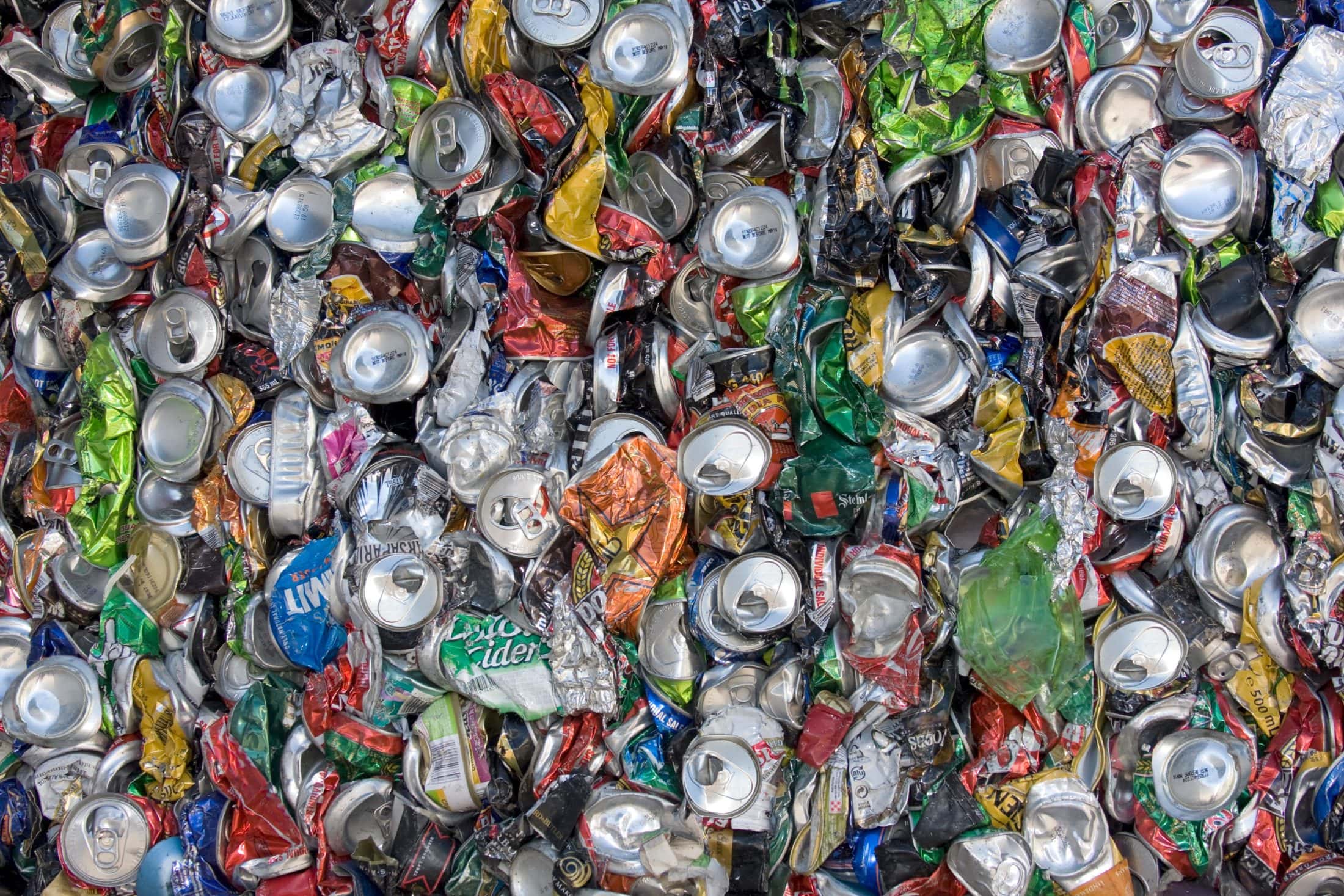
Plastic bottles, cans and other recyclable materials are designed to stay out of landfills. But in some First Nations, gaps in Ontario’s recycling system have left communities struggling to access blue box collection services. Photo: Darren Patterson / Pexels
Constance Lake is located about 32 kilometres by road northwest of Hearst. After the First Nation’s landfill site was closed in 2018, a solid waste and waste diversion service agreement was signed and the town provided recycling services for the First Nation, which has about 900 members living on reserve. According to the agreement dated March 28, 2020, Hearst would accept the First Nation’s waste and recycling material at the municipal landfill site in exchange for a service fee.
But that changed a few years later, according to Éric Picard, the chief administrative officer for the Town of Hearst, to prepare for Ontario’s new recycling regime, the Blue Box Program. Lillian Sutherland, infrastructure and public works manager for Constance Lake First Nation, said the community has not received any recycling services since around 2022, when the provincial program was ramping up.
The First Nation’s waste is still handled by the town, but the recyclable materials are no longer accepted under the renewed agreement because blue box services are now administered by the province and producer-led organization.
That has left Nair and Douglas trying to figure out where their school’s recyclables could go.
Why doesn’t Constance Lake First Nation have a recycling program?
Ontario’s Blue Box Program recycles printed paper and packaging, including plastics, paper, glass, aluminum and steel. It is regulated by the provincial government and managed by Circular Materials. Its recycling services are largely contracted out to GFL Environmental Inc.
The Doug Ford government finalized its Blue Box Regulation in June 2021 and began transitioning responsibility for residential recycling from municipalities and First Nations to Circular Materials. The new system officially launched in July 2023. Under the regulation, all participating communities were to be included in the new system by Dec. 31, 2025.
Ontario’s Blue Box Regulation defines an eligible community as a local municipality, local services board area or First Nations reserve south of the Far North region of Ontario — but that doesn’t necessarily mean they’re participating.
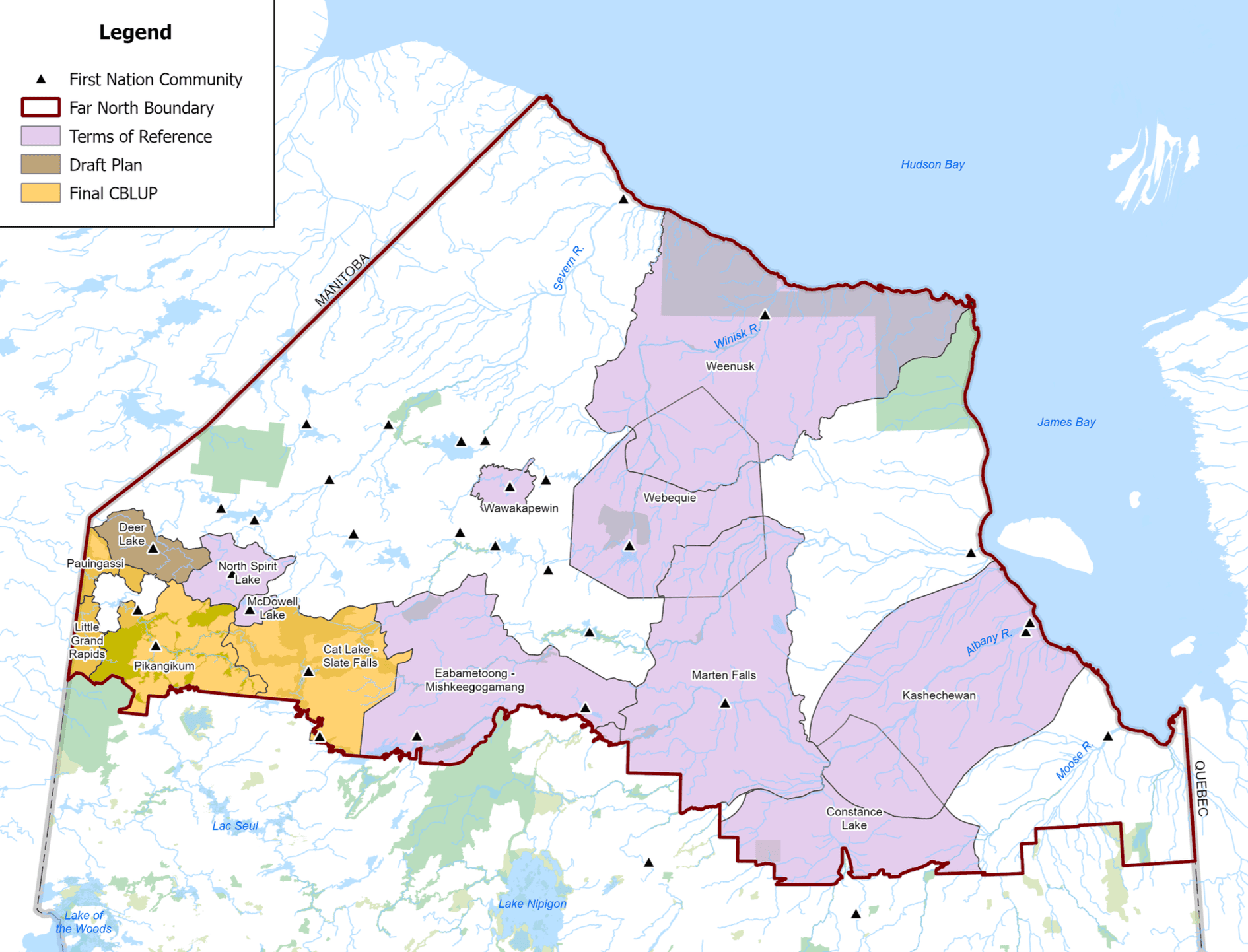
Ontario’s Far North boundary, shown in red, determines how a producer-led recycling program applies to First Nations. The Constance Lake First Nation reserve is located just south of the boundary, while many neighbouring First Nations north of the red line are subject to different blue box rules. Map: Supplied by Government of Ontario
Constance Lake, for example, is eligible for the program, according to a spokesperson for the Resource Productivity and Recovery Authority, the regulator mandated by the Ontario government to enforce the province’s recycling law. But it hasn’t signed up — and it’s not alone.
As of Jan. 1, 2026, only 12 First Nations out of 102 residing south of the Far North border had transitioned over to the new program.
Eligible First Nations must first register and submit information about their community and existing waste collection services. That information is then shared with Circular Materials. Once a First Nation is registered, Circular Materials is required to provide an offer of collection services or funding on behalf of the producers that finance the system.
Constance Lake First Nation Chief Richard Allen told The Narwhal the community did not apply to be a part of Ontario’s Blue Box Program due to logistical concerns — the cost of transportation to and from the community and concerns GFL would not service it because the reserve is on federal Crown land.
Part of the challenge facing Project Z.E.R.O. is that students and school staff have received conflicting information about why recycling services through GFL Environmental are unavailable in the community, and if it’s related to being on federal lands.
“We were a little panicked because, what would we do if the only company that was responsible for our recycling cannot help us with recycling?” Douglas said.
The Narwhal reached out to GFL Environmental Inc., but the company declined to comment, explaining that it is a contracted service provider, and referred questions to Circular Materials.
In an emailed statement to The Narwhal, Circular Materials wrote it is not currently engaged in any discussions about providing recycling service to Constance Lake First Nation and not in the position to comment on operations or any possible third-party private contract negotiations. It further wrote eligibility is determined by Ontario’s Blue Box Regulation.
“Circular Materials is committed to supporting First Nations communities with their needs and requirements around the blue box transition, in alignment with Ontario’s Blue Box Regulation,” Jennifer Kerr, a spokesperson for Circular Materials, wrote.
“Communities’ eligibility for participation in the Blue Box Program is determined by the Blue Box Regulation.”
‘It just seems a bit absurd’
Nair and Douglas began working on the project through their school’s enrichment program, a project-based learning class led by Cameron Straughan, who teaches science, technology, engineering and mathematics — or STEM.
Since learning about the lack of recycling service, the students have written letters to Kapuskasing-Timmins-Mushkegowuk MP Gaétan Malette, federal Environment Minister Julie Dabrusin and Indigenous Services Minister Mandy Gull-Masty, asking for advice and help.
“We recently did surveys at our school, and the results show that we have a lot of students and staff who are dedicated to recycling,” they wrote in the letter.
The students wrote that it “feels wrong” for paper and plastic to go into the garbage just because of where the community is located and that they have the support of their school to put a program in place, but need help to “find the right path.”
Nair said only Dabrusin’s office responded.
“And the funny thing is that they told us that they would transfer this to another person who is the Minister of Indigenous Services of Canada and we already sent them a letter,” she said.
Straughan said he was surprised by the limited response.
“I thought being students, a student-led project at a First Nation school, I thought that there’d be more response by far,” he said.
Indigenous Services Canada told The Narwhal the community has received $222,000 annually for their solid waste management needs since 2020-2021, which can cover recycling, garbage and compost.
The Narwhal reached out to Malette and Ontario’s Ministry of the Environment, Conservation and Parks, which oversees the blue box legislation, but did not receive a response before publication.
Mushkegowuk-James Bay MPP Guy Bourgouin declined to comment, but a spokesperson at his office said additional information is still being gathered and the situation continues to be reviewed.
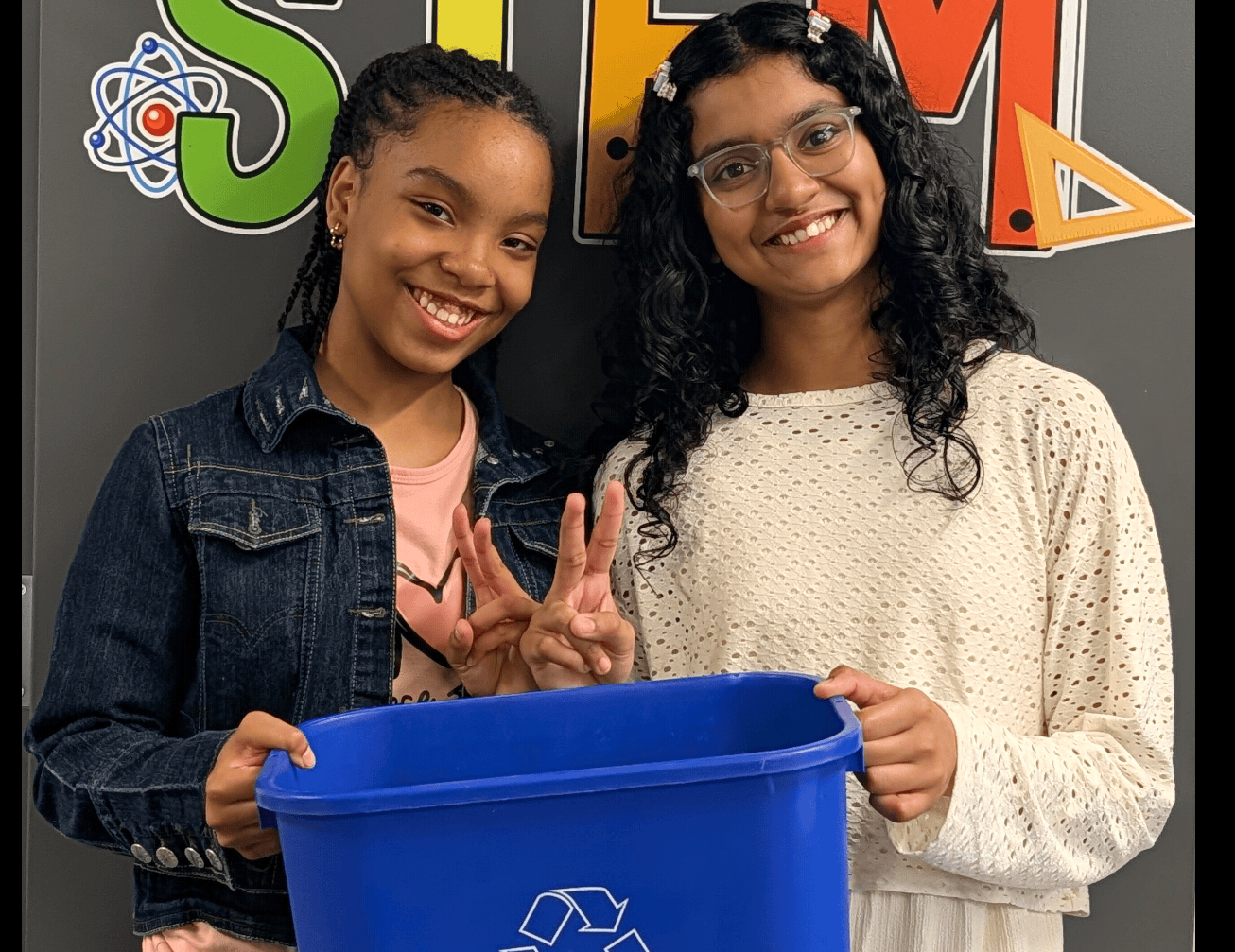
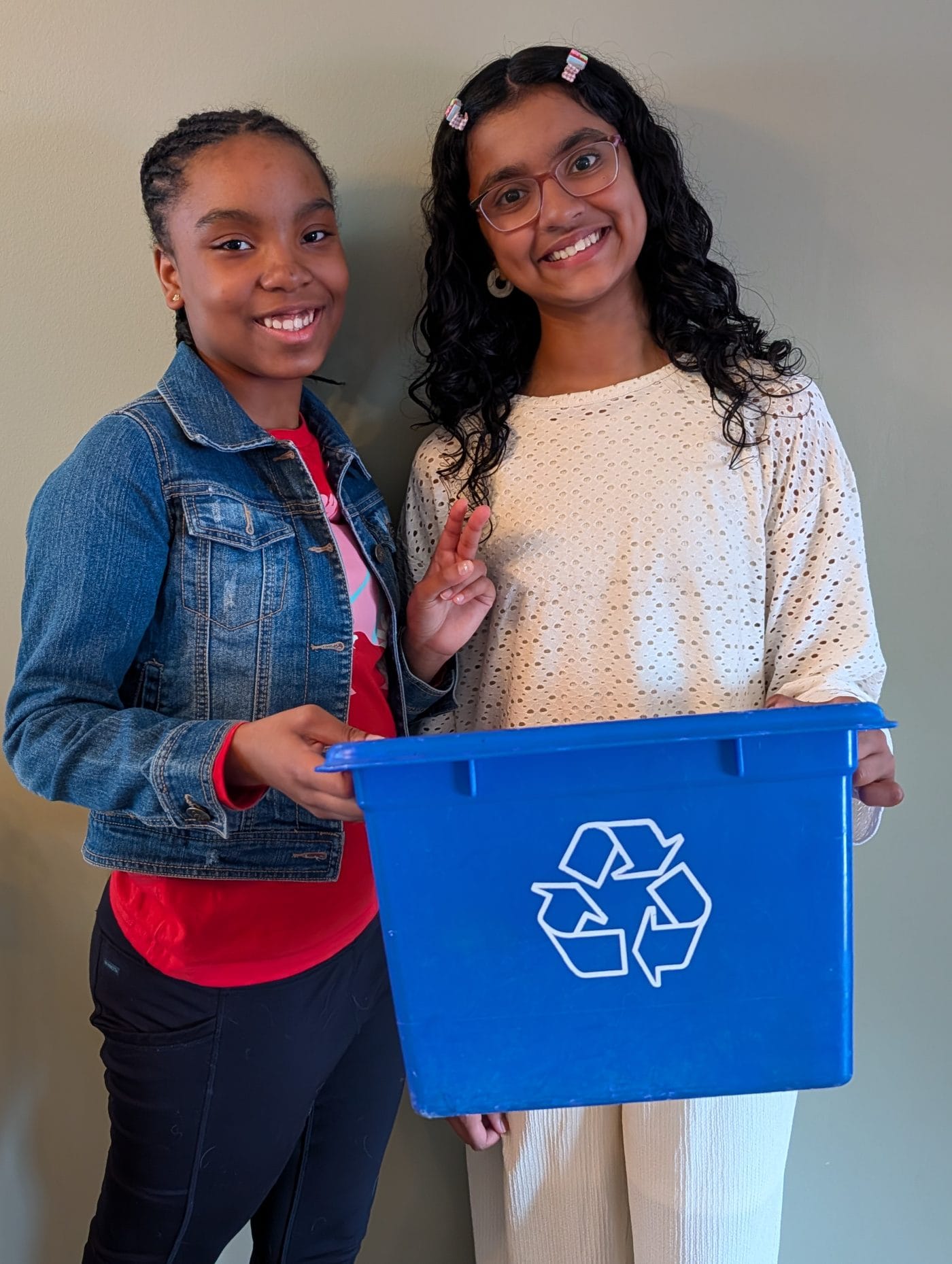
After months of research, meetings and letters, Grade 7 students Latavia Douglas, left, and Veda Nair are still waiting for a path to bring recycling to their school and community. They say they plan to continue the project this summer with help from their teacher. Photo: Cameron Straughan
Straughan said the situation is frustrating because Hearst is only about a 30-minute drive from Constance Lake First Nation. He knows because he lives there and drives to the school every weekday.
“It seems a bit absurd to me that [GFL] cannot send a recycling truck to pick up recycling for this community,” he said.
“And yet they do pick up garbage. They do have a garbage truck in Constance Lake. Garbage is delivered to the dump in Hearst, but not recycling.”
Straughan understands the issue is complicated, but believes the students have exposed a real problem.
“It just seems absurd that we’re tied by red tape, our hands are tied by red tape that we can’t get that recycling truck to deliver,” he said.
Straughan said he has been impressed by how Nair and Douglas handled the complexity of the recycling issue. And the school may still have a path forward. They’re currently looking into the First Nations Waste Management Initiative, a federal program that supports First Nations in developing sustainable waste management systems. Straughan expects to write a proposal over the summer.
“We have some more work to do ahead of us before we can actually get the recycling program up and running,” he said.
Students want decision-makers to understand that recycling should be available to their school — and community, Nair said. “As an Indigenous school or as any school, students use a lot of paper every day, we should have the rights to recycle and save our environment.”
Rajpreet Sahota is a community and policy reporting fellow. Her position is generously funded by the Canadian Race Relations Foundation. As per The Narwhal’s editorial independence policy, the foundation has no editorial input.
The Narwhal’s reporters are telling environment stories you won’t read about anywhere else. Stay in the loop by signing up for our free weekly dose of independent journalism.
From The Narwhal | News on Climate Change, Environmental Issues in Canada via This RSS Feed.