

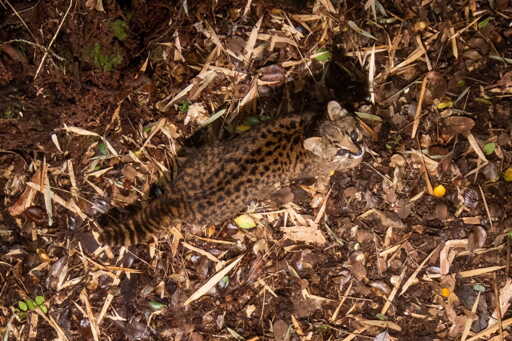
Guiña are small-forest-dwelling felids found in Chile and Argentina that are distinguished only by small, subtle black dots, making it difficult to tell one cat from another. A change in camera trap angle could open the door to a better understanding of their populations, with important conservation implications, a recent study says. Normally, researchers place camera traps at ground level to snap pictures of cats as they walk by. But telling one guiña (Leopardus guigna) from another from that angle proved incredibly challenging. “One of the fundamental questions in ecology is always how many individuals are there or what are the densities,” Nicholas Galvez, an associate professor at the Pontifical Catholic University of Chile, told Mongabay in an interview. “Sometimes that sounds like a very easy question, but it’s actually really difficult to answer in the field, especially with a species so small and cryptic.” To solve that problem, Galvez and his team switched their cameras to point downward, in a “zenith” position, attaching them to tree branches and poles in a temperate forest in Chile’s Reñihué Valley, in northern Patagonia. That switch enabled the scientists to identify 12 individuals based on their unique markings on their backs. The findings were published in the journal Oryx. Ilaria Agostini, a researcher with Argentina’s National Scientific and Technical Research Council, said it’s exciting research. “For the first time, it seems feasible to identify individuals in this very subtly marked cat,” she said in a video interview. When using camera traps for her own…This article was originally published on Mongabay
From Conservation news via This RSS Feed.