



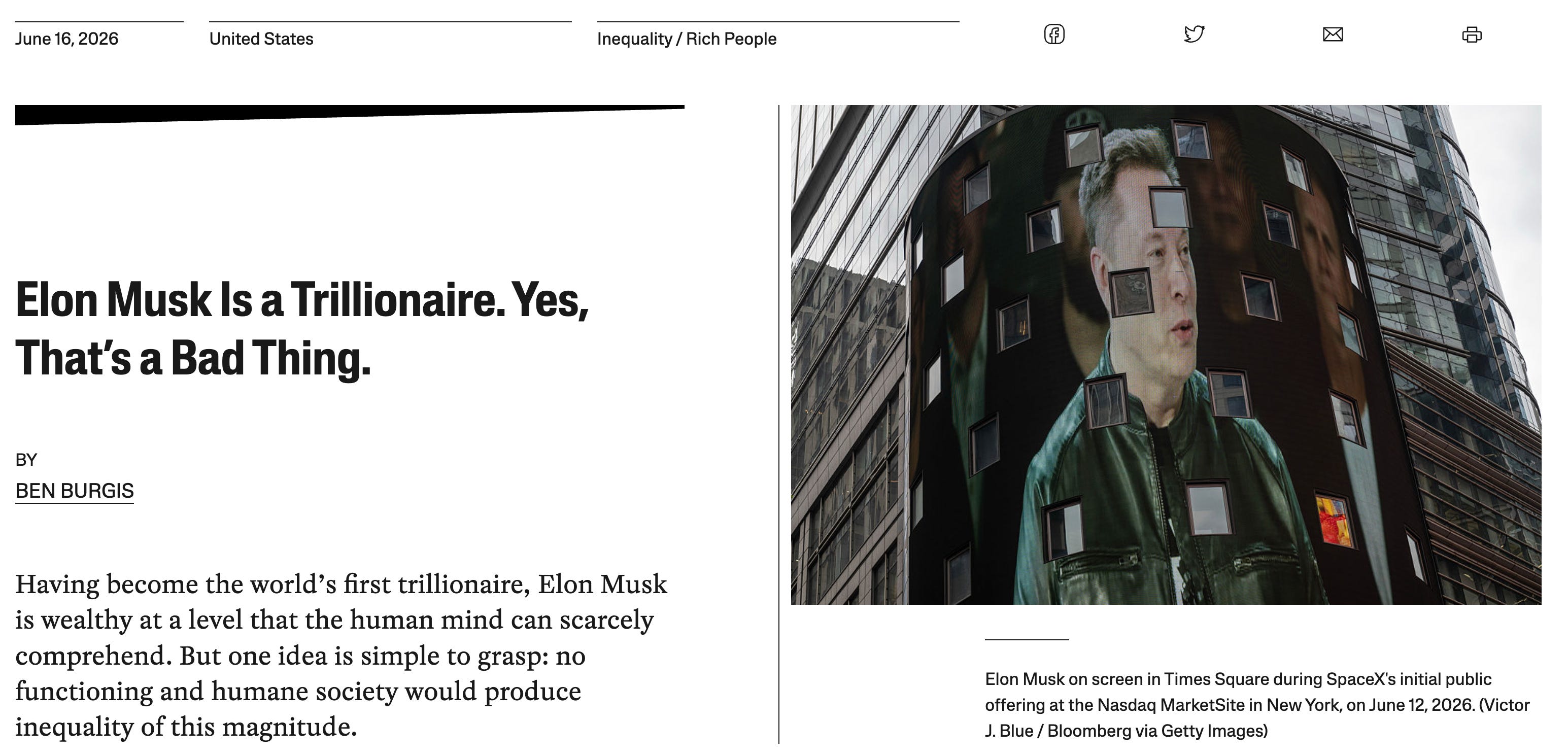
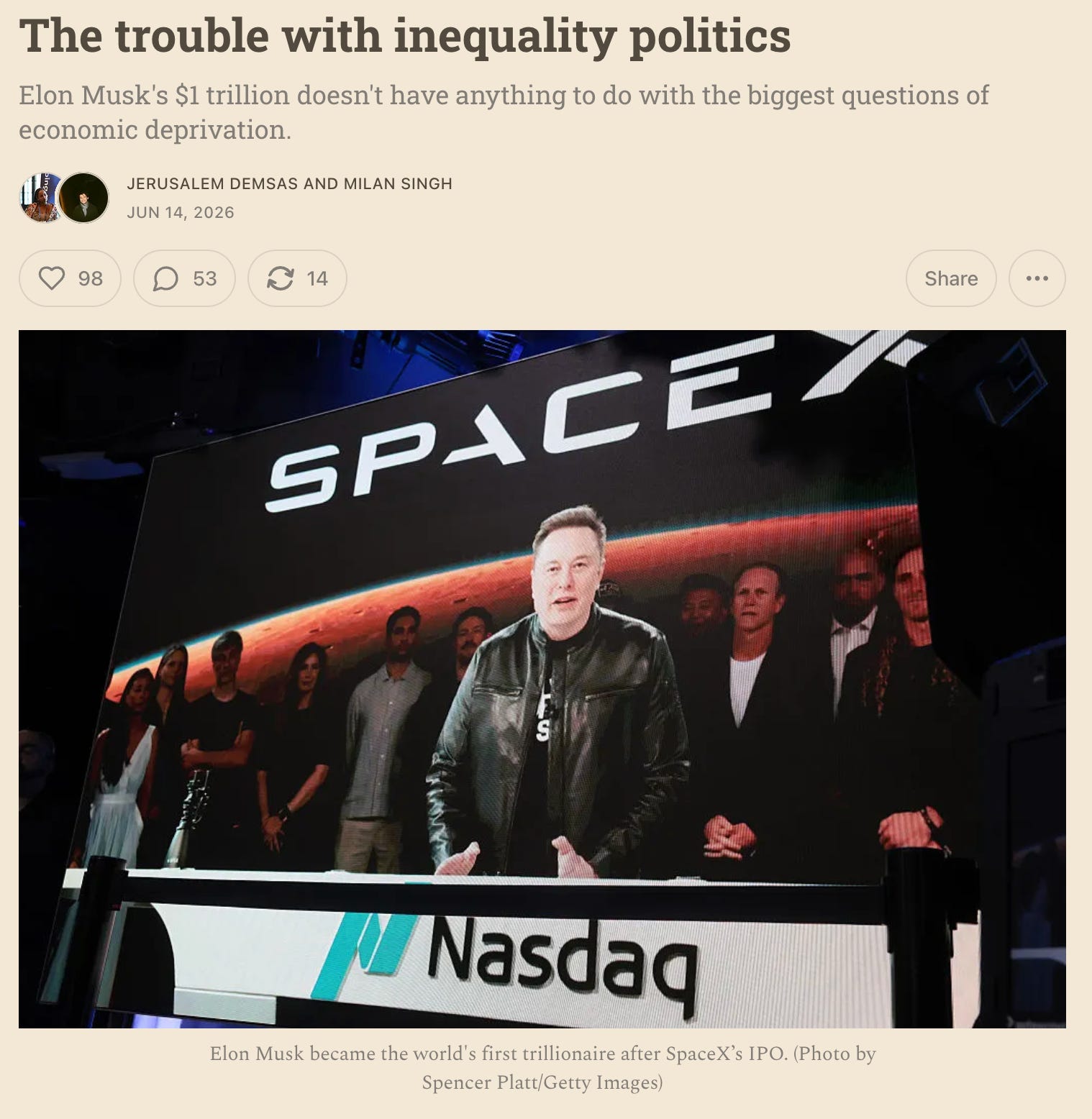
Earlier this month, Elon Musk officially became the planet’s first trillionaire.
Writing at her magazine The Argument, liberal pundit Jerusalem Demsas assures us that this is fine.
Most of the conversation about SpaceX’s IPO was about Musk himself, who has become a reactionary and powerful political figure seeking to prop up far-right political parties, anti-immigration politics, and a broad hostility to the liberal economic and political regime that made his life story possible.
I agree with all of those critiques of Musk, but I want to focus on the specific ire that his inauguration as the first trillionaire has drawn, because it’s exposed an unhealthy habit of mind among populists that focuses on gaps rather than absolute measures.
Like everyone else making the case that it’s no big deal for economic inequality to metastasize to the point that we need the word trillionaire, Demsas wastes some of her readers’ time explaining that Musk doesn’t literally have a trillion dollars in his bank account but merely holds assets valued at a a trillion dollars, and that if he tried to cash it all out at once that value would plummet. My guess would be that the number of likely readers who were actually confused about this point hovers right around zero. But explaining it makes pundits feel smart.
Putting that aside, she says several things about why having trillionaires (even ones who did have it all in their bank accounts, or stuffed under an unfathomable number of mattresses) would actually be fine. I responded to a couple of them in the article I wrote about Elon’s trillionaire status for Jacobin but I want to expand on those responses and cover the rest here.
There are two reasons I’m so interested in Demsas’s defense of this new frontier of inequality. First, the tangle of philosophical and practical-political issues here is interesting in itself. Second, Demsas’s short piece is a good sample of a kind of liberal commentary that does a good job of performing thoughtfulness and rigor in a way that flatters readers and reassures them in their existing ideological prejudices while never descending further than a quarter an inch from the surface of the issue. Bluntly, it annoyed the shit out of me.
Why is it an “unhealthy habit of mind” to “focus on gaps rather than absolute measures”? And why does Demsas think we have to choose?
As far as I can tell, several things are going on at once here.
First, Demsas endorses a position philosophers call sufficientarianism. While the egalitarian thinks that we should be morally concerned with the gap between the economic floor and the economic ceiling, the sufficientarian thinks all that matters is the height of the floor. If everyone has enough, the distance separating that “enough” from the “much more than enough” that others might have is morally irrelevant.
So, near the end of her article, she says:
Gaps between people, absent material deprivation, is simply not a moral problem.
That seems pretty clear.
My own view is that sufficientarianism is extraordinarily implausible. As I wrote in the Jacobin article,
even if we could somehow disentangle these things, we should question her assumption that only deprivation matters and fairness is irrelevant. Imagine a world where everyone had whatever you would personally consider to be “enough.” Now imagine that all the black people in this world stayed at “enough” while all the white people were raised to a vastly higher level. Presumably liberals like Demsas would (quite rightly) find this maddeningly unfair, on the grounds that an arbitrary factor like skin color shouldn’t make a difference to anyone’s life outcome. The problem is that exactly the same reasoning should apply to inequalities that stem from, for example, some people being born into the working class and others being born as the heirs to vast fortunes.
Similarly, I could have added, it should apply to inequalities that stem from the unequal distribution of whatever natural talents might help people to climb upward mobility ladders in a given society. This is the foundation of luck-egalitarianism, the view that inequalities are morally objectionable to the extent that they stem from factors beyond the control of those left holding he short end of the stick. (Demsas doesn’t engage with issues like this. In general, she shows a remarkable lack of curiosity about why so many people who’ve spent their lives thinking about these issues don’t share her conceptual starting-point.)
Second, she helps herself to the assumption, without argument or even explanation, that caring about inequality somehow rules out caring about absolute material deprivation. More on that below.
Finally, she goes beyond rejecting in-principle egalitarianism (the position that inequality is a moral problem in itself) and strongly suggests that we shouldn’t even be concerned that inequality might be a problem in so far as it has problematic practical consequences. I say suggesting since she never exactly comes out and says this part. But surely she doesn’t think the only reason “populists” have a problem with inequality is because they’re philosophically committed to in-principle egalitarianism.
And she throws in this argument-in-passing:
If we had a system where Elon was still CEO of SpaceX and Tesla but simply had to redistribute more of his shares and make many more billionares, would that really change how much political power he has? I doubt it. He’d still get to decide whether Ukraine or Russia gets Starlink access.
As an argument against the “unhealthy habit of mind” by which “populists” care too much about economic inequality, this is a non-starter. It’s one thing to say that the economic inequality between Musk and an ordinary citizen (or even an unusually prosperous citizen, like the owner of a small chain of car dealerships) had already passed the threshold where Musk’s wealth granted him an outrageous amount of political power long before he became a trillionaire. It’s quite another to say that “populists” are wrong to think that one of the problems with economic inequality is that it makes a mockery of democracy by granting the wealthiest citizens an outrageous amount of political power. In fact, it very much looks like she’s granting the second thing.
Perhaps Demsas also thinks that caring about equality of political power is an “unhealthy habit of mind.” If so, it’s odd that she doesn’t spell that out. And if she does by any chance care about substantive democracy in the political realm, it seems to me that she’s given us an excellent reason to care about limiting inequality to a threshold below the one she says Musk passed long before he became a trillionaire.
Immediately after the odd argument about political power, Demsas switches gears to thinking about the relationship between domestic and global economic inequality.
Sometimes Westerners will do a sort of cope where they point out that the multiples that separate the average American and Musk are way larger than those between the world’s poorest and the average American. But even under inequality-logic, that only works if you ignore the many, many people with zero wealth and negative wealth. After all, the multiple between zero and $193,000 is infinity, whereas the multiple between $193,000 and $1 trillion is 5.2 million.
I have no idea what she means by “inequality-logic” but the gap between $193,000 and zero is $193,000.
Since she includes a hyperlink for the word “cope,” you might be forgiven for assuming that clicking on it would lead you to a source that made the point that “the multiples that separate the average American and Musk are way larger than those between the world’s poorest and the average American.” Or even a source that made any sort of argument expressed in terms of “multiples” at all. It doesn’t. The hyperlink leads to a MoneyWise article by AnnaMarie Houlis called “‘The average American is now closer to Jeff Bezos in net worth than Jeff Bezos is to Elon Musk’ as Musk becomes the world’s first trillionaire.”
Not only does it contain no “cope” comparing the gap between the world’s poorest and the average American to the gap between Elon Musk and the average American, but it never mentions that comparison at all. It’s a very short article, and as the title indicates, what it does is compare the gap between Jeff Bezos and the average American to the gap between Jeff Bezos and Elon Musk. And it compares them by using subtraction.
Bezos’ fortune is currently estimated at just below $250 billion. That means that the difference between Bezos and Musk is over $750 billion. Meanwhile, according to recent estimates, the median American household has a net worth of roughly $193,000. That means that the difference between the average American household and Bezos, while massive, is indeed smaller.
So, I really have no idea what Demsas is talking about here.
There’s some other interesting number-crunching:
The difference between a billion and a trillion, after all, is far greater than you may think. To put it into perspective: A billion seconds equals almost 32 years. A trillion seconds? More than 31,000 years.
…but no “inequality-logic” employing “multiples” anywhere in sight, and certainly no employment of it for the sake of “cope” about global inequality.
Whatever the target of the “cope” critique is supposed to be, let’s put that aside and think about global inequality itself.
Here’s my big question about that:
Does Demsas think globalinequality is “not a moral problem”?
I understand that her sufficientarianism means that she can say that it’s a moral problem if lots of people in Haiti, for example, are deprived on “absolute” measures. But if at least some Haitians actually or hypothetically (a) have whatever standard of living Demsas would regard as “enough,” but (b) are doing vastly worse than their otherwise similar American counterparts because they were born in Haiti, is that morally important?
I can understand thinking that it wasn’t a moral problem for the pre-Columbian residents of Hispaniola and pre-Columbian Europeans to have different living standards, just as it plausibly wouldn’t be for Earthlings and residents of other planets where we don’t even know there’s life to have different living standards, but if we all live together in a global economic system, the dynamics of which have the predictable result that someone who due to nothing but bad luck in the genetic lottery was born in Port-au-Prince has a much worse living standard than an otherwise similar person born in Cleveland or Brooklyn, that does strike me as at least prima facie unjust.
Of course, even if it is unjust, it might be a hard injustice to completely eradicate. In many ways, it’s much easier to formulate a plausible theory of change for domestic inequality.1 But the issue Demsas is writing about is antecedent to all of that. Her contention is that “inequality” (presumably meaning either domestic or global) is “simply not a moral problem.”
She just seems to take it for granted that egalitarians-about-their-own-country won’t even see global equality as a morally significant long-term goal. But why not?
There was a moment in one of the 2016 Democratic presidential debates that seared itself into my memory, when Hillary Clinton bragged about her friendship with Henry Kissinger and Bernie Sanders responded that he was “proud to say” that Kissinger was not his friend and he brought up the coup to overthrow Chile’s democratic socialist president Salvador Allende. It’s a useful useful example of an egalitarian-about-his-own-county caring much more than a liberal technocrat did about their government’s role in thwarting an attempt to alleviate poverty and inequality in the third world. But it’s also a reminder of an important reality that Demsas’s liberal ideological blinders make it hard for her to see.
As she herself seems to vaguely acknowledge in the paragraph about Musk’s political power, inequality (not just in the distribution of wealth, but in structural-economic power upstream of that) systematically shapes the politics and state institutions of unequal societies. Does anyone really think the U.S. would have stomped around Latin America crushing experiments in left-wing economics if not for the domestic influence of wealthy corporations?
Demsas frames domestic economic inequality as a distraction from the plight of “the world’s poorest.” In practice, though, the former makes it far more difficult for people who live in poor countries to alleviate the latter.
She continues:
But most importantly: the difference between me and someone living in rural Eritrea is not just our wealth but the inequality that comes with living in a country without basic access to civil liberties like freedom of speech, freedom of religion, strong property rights protections, government-provided infrastructure, and protection from casual violence.
The “strong property rights protections” is a well-worn bit of conceptual gerrymandering that free-market enthusiasts use to to make it sound like capitalist economics is a package deal with the rest of the list. (See the Fraser Institute’s farcically dishonest “freedom” rankings for another example.) In the real world, there are many instance (e.g. Pinochet’s Chile) where much of the rest of Demsas’s list has been sacrificed on the altar of protecting captial.
Even putting that aside, though, what’s the point? That when all those elements are put in place, the "absolute measures” of economic well-being adjust themselves accordingly? If so, the empirical record hasn’t been kind to that assumption. In 2026, plenty of places in the developing world combine formal protections of liberal-democratic rights with poverty well below where I’d assume Demsas would put her standard of sufficiency. So, even if she thinks all that stuff helps, it clearly doesn’t suffice.
Alternately, she could be saying that the things on her list are even more important than economic sufficiency. If so, though, it seems a bit off-topic in a short article arguing that economic sufficiency matters and economic equality does not.
Perhaps she just threw in a liberal catechism with very little regard to how it fit the overall shape of her argument. If so, as a democratic socialist I concur with much of the catechism. But I wish she’d left it out to free up a bit of space in her article to focus on the issue at hand.
She continues:
Mostly, I just don’t think material inequality is a good way to organize one’s political thinking. Absolute measures of well-being like longevity, access to clean running water, health care, housing, and education are more conceptually clear.
Taken seriously, this is a bizarre argument for two reasons. First, there’s at least one sense in which economic inequality is actually more conceptually clear than many of the absolute measures she lists here. There’s plenty of conceptual wiggle room about what counts as adequate education, for example, whereas the gap between $193,000 and zero (exactly $193,000), or between the average American’s $193,000 and Jeff Bezos’s $250 billion (two hundred forty-nine billion, nine hundred ninety-nine million, eight hundred and seven thousand) is so conceptually clear we can assign an exact number to it.
Of course, any serious egalitarian thinker would say that the kind of inequality that matters most isn’t as simple as dollars and cents. One one account, what matters most might be equalizing absolute well-being. On another, it might be equalizing something like a capacity to act in the world. Luck-egalitarians would say that what matters is “equal access to advantage.” There are complex debates here. But there are with how to think about what counts as a good education too!
Second, even if absolute measures about healthcare, education, and so on were more conceptually clear than equality, how on earth are we supposed to get from that premise to the conclusion that we should only care about absolute measures and regard inequality as a non-problem?
Returning to the list of formal liberal rights Demsas rattled off above, think about free speech. Anyone with a passing knowledge of either the long and tangled history of court cases about America’s First Amendment, or with the even more tangled history of disagreements about what counts as an unacceptable violation of extra-legal norms about free discussion and censorship in non-governmental contexts, knows that the whole subject comes with a lot of conceptual headaches.
But what would Demsas make of someone who made the following argument?
Mostly, I just don’t think caring about free speech and opposing censorship is a good way to organize one’s political thinking. Binary questions like whether someone has a right to vote are more conceptually clear.
Demas writes:
After all, the same flawed logic that would indict Musk for his mindboggling amounts of wealth would indict everyone reading this article when compared to the billions of people living in abject poverty.
Notice the goalpost-shifting here. Are we talking about whether to indict (domestic or global inequality (domestic or global)? Or whether to indict its beneficiaries?
Because if we changed this bit to:
Te same logic that would sees the inequality between average Americans and Elon Musk as a moral problem would also see a moral problem in the inequality between average Americans and the billions of people living in abject poverty.
…I suspect most readers wouldn’t be so quick to jump to the conclusion that the logic was “flawed.”
If we are going to shift the subject from an assessment of the justice or injustice of global or domestic inequality to our moral assessment of the beneficiaries of inequality, then it might matter whether we’re only talking about inequality in resources or also talking about inequality in power. Even leaving Marxist conceptual categories out of the discussion, the vaguest left-populist language about “oligarchs” already assumes the distinction.
Next, we might ask about how that power is being used. A Friedrich Engels, for example, would get a very different grade on that test than an Elon Musk. If we think rampant inequality is unjust, then it’s surely relevant to our moral assessment of Musk that, unlike either Engels or the average American, he’s done everything in his power to make the world more unequal.
Demsas says:
Gaps between people, absent material deprivation, is simply not a moral problem. If everyone in the world had access to a decent standard of living, but some people were quadrillionaires, I don’t know that I would care about the latter. Moreover, it’s easy to imagine a world without much inequality but significant deprivation; that’s just most of human history when most people lived in subsistence agrarian economies.
Everything in this paragraph before the “moreover” is just a table-banging assertion of sufficientarianism, unaccompanied by the barest hint of an argument. After the “moreover,” she’s saying something more interesting, though again, she just takes it for granted that we face a moral zero-sum choice between caring about the height of the floor and caring about the gap between the floor and the ceiling.
As I noted in the Jacobin article:
Saying that both considerations matter isn’t some novel attempt to have it both ways. It’s the traditional socialist position. There’s a reason that Karl Marx and Friedrich Engels spend the opening pages of the Communist Manifesto rhapsodizing about the effectiveness of capitalism in building up the machinery of an advanced global economy. They didn’t want to retreat to a world of subsistence farming, but they also didn’t think we needed to learn to live with capitalist inequality. Instead, they thought that the way capitalism supercharged global economic development created the possibility, for the first time in history, of moving toward a postcapitalist world that would be better than either one. This vision remains the socialist North Star.
Again, though, it’s entirely possible that Demsas truly doesn’t know that this is the classical left position. She just doesn’t seem to be curious about this sort of thing.
Finally, she writes:
Largely, when you look at measures of inequality, it’s possible to have high-inequality, high-poverty countries (South Africa, Botswana, Namibia) and low-inequality, high-poverty countries (Belarus, Moldova, Ukraine). I just don’t think inequality is that related to the central problems facing society, and structuring our discourse around it makes for a genuinely incoherent politics.
The first sentence is a sublime irrelevance unless we have some reason to think we can’t care about both dimensions at once.
It’s worth saying one last time:
If she has such a reason in her back pocket, she doesn’t share it with us.
And what can you even say about that last sentence?
I’ve quoted every single thing Jerusalem Demsas says about inequality in the article. In all of that, in the whole thing, do you see anything that backs up this final claim about incoherence?
I see several arguments for the claim that egalitarianism is wrong. None of those arguments are very good, and most of them are based on a blatant false dichotomy, but at least they’re there. What I don’t see is anything that even looks like an attempt to show that egalitarianism is incoherent. But the claim sounds nice and decisive, and it comes after several paragraphs of performing intellectual rigor.
I guess that’s what counts.
Technocratic liberals are going to form some part of our political discourse for the foreseeable future. That’s fine. I accept it as an inevitability.
But can we at least have a better class of technocratic liberals than this?
Thanks for reading Philosophy for the People w/Ben Burgis! This post is public so feel free to share it.
Even if your ideas about what a realistic transition to socialism might look like in the twenty-first century are very different from mine, and you’re imagining (a) abrupt insurrectionary change that (b) somehow happens at the same time, or close enough to the same time, everywhere in the world, that still leaves you with a considerable problem about socialist development in places with worst starting points, with the politics of resource transfers from better-off socialist countries, and so on. It’s a hard problem!
From Philosophy for the People w/Ben Burgis via This RSS Feed.