

This article by Lorenzo Chim originally appeared in the June 28, 2026 edition of La Jornada, Mexico’s premier left wing daily newspaper.
Campeche, Camp. Mexican and Slovenian archaeologists led by Ivan Šprajc located, inside the Calakmul Biosphere Reserve, in Campeche, a Maya city more than a thousand years old; it is a monumental site that had its peak in the Late-Terminal Classic period, which they named Minanbé, which in Maya means “there is no road.”
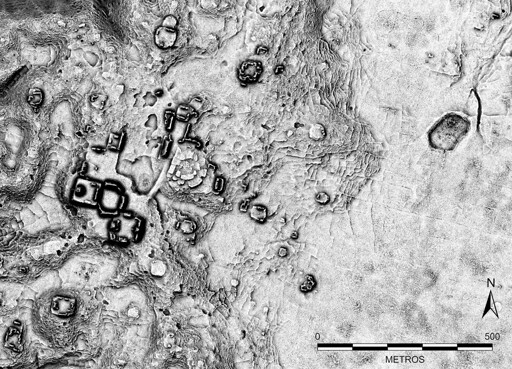
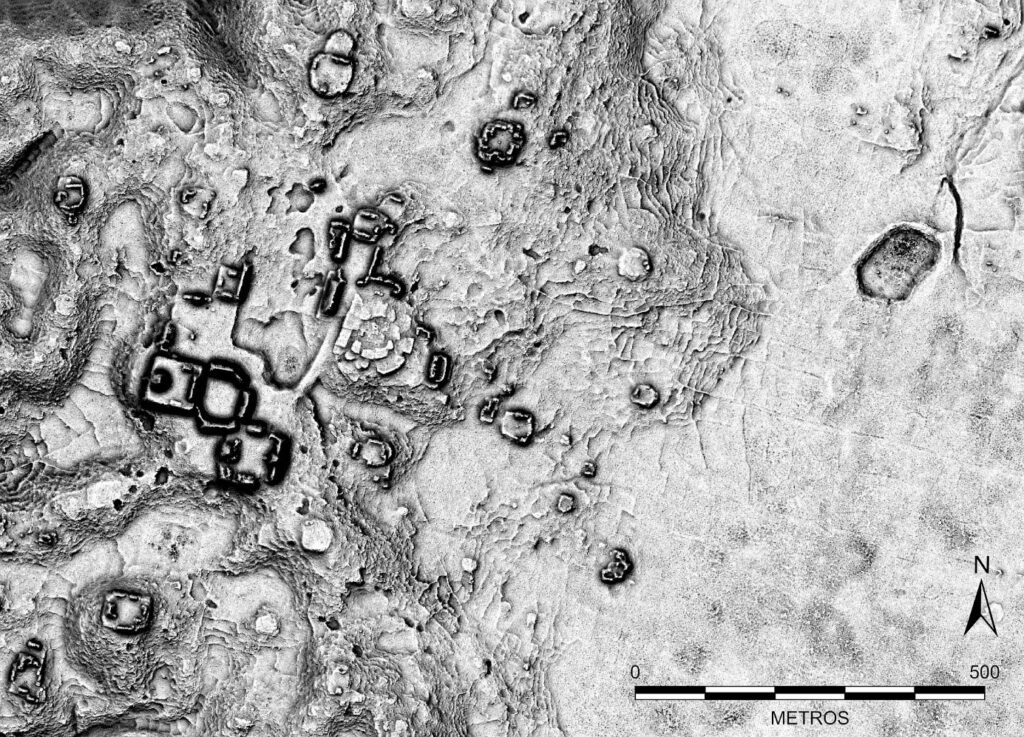
Official information released by the National Institute of Anthropology and History (INAH) notes that in the northern sector of the reserve, a surface survey was carried out of a site to the west of Chactún, a governing center reported 13 years ago and for which they had airborne laser scanning (LiDAR) data.
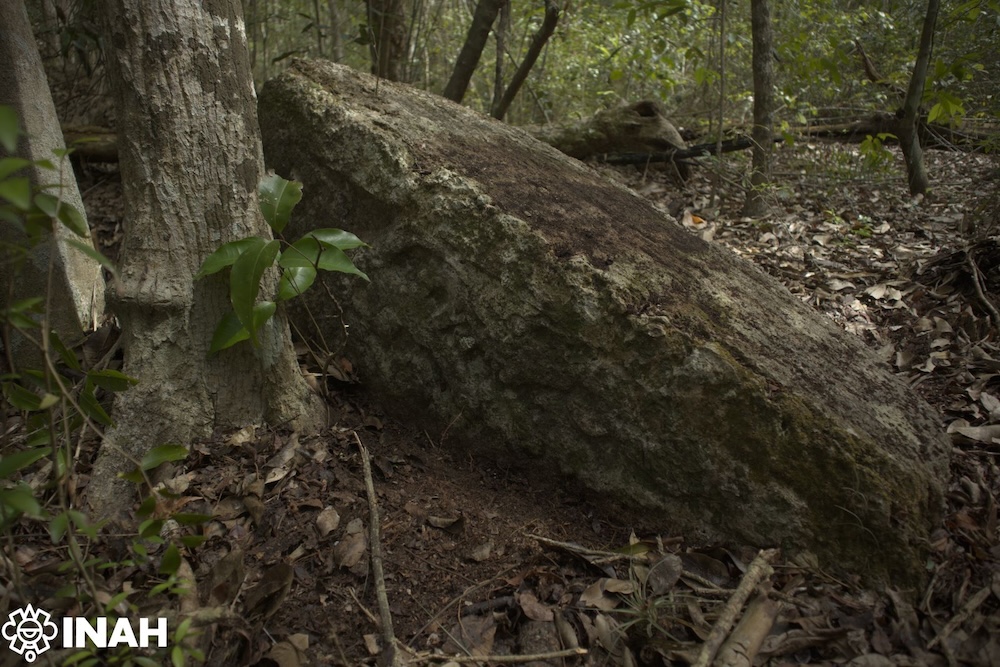
The presence of 14 stelae and altars suggests that it held an important place in the regional hierarchy during the Late Classic period (600-900 CE). Photo: Quintín Hernández.
“The archaeologists and workers from the community of Constitución who took part in the exploration cleared a path with the edge of a machete along 5 kilometers to advance on ATVs and then walk a similar distance under the sun,” the INAH statement notes.
The archaeologists Atasta Flores Esquivel, Israel Chato López, Quintín Hernández Gómez, and Vitan Vujanović carried out the survey of the place, moving from the LiDAR images, which showed a 15-hectare settlement beneath the forest canopy, to the ground-level verification of an urban core, with plazas surrounded by palatial and religious buildings, terraces, and wetlands with hydraulic channeling.
INAH reports that one of the tallest structures, a pyramidal temple exceeding 13 meters in height, has features of the Río Bec style, such as fine masonry or smooth panels on the facade, a steep staircase, and moldings at the top.
It is “the first time I have recorded a more or less well-preserved temple, and a stela still with glyphs,” Vujanović explains.
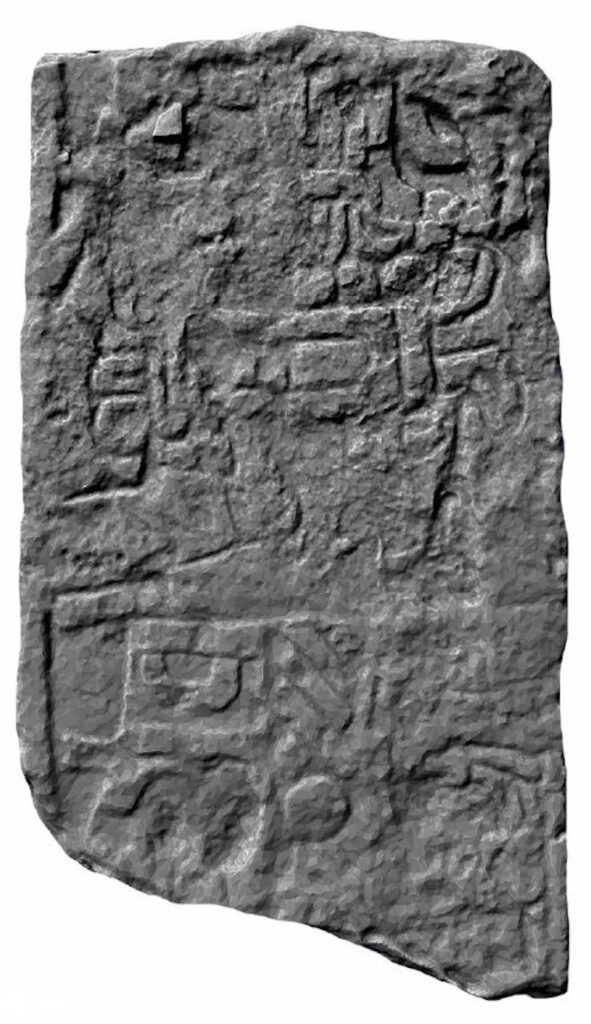
Stela 1 / INAH
Stela 1 also stands out, which has a decapitation scene engraved on it, the first monolith the team was able to notice, in addition to 14 monuments, some of them with iconographic elements and hieroglyphic texts.
With this find, Ivan Šprajc, affiliated with the Research Center of the Slovenian Academy of Sciences and Arts, culminates three decades of his project dedicated to the survey of the Central Maya Lowlands, a fossilized archaeological landscape that was the habitat of between 9 and 11 million people during the Late Classic period (600 and 900).
Quintín Hernández, another of the archaeologists who collaborates with Šprajc, recalls that when they explored the northern part of the site, they found a series of monuments in a row, of which those at the southern end of the causeway, which connects the central and northeastern sectors, were uncovered to carry out their photogrammetric recording.
The specialist stresses that in the upper part of Stela 1, where a figure appears wielding a knife or axe to decapitate an individual, a calendrical sign is visible recording the date 5 Ajaw (the year 849).
“This is key because we can think that the whole set of monuments, or some of them, were erected by that point in the Terminal Classic, close to the abandonment of the region’s sites in the 10th century.”
At Minanbé, round altars and one rectangular altar were also found. As can be inferred from their arrangement, several were intentionally altered.
-
Thousand-Year-Old Maya City Discovered in Campeche
June 28, 2026
Mexican and Slovenian archaeologists used LiDAR to find Minanbé in the Calakmul reserve, with a 13-meter temple and a stela carved with a decapitation scene dated 849.
-

Exhibition on Maya Culture Amazes in China
June 28, 2026June 28, 2026
The “most ambitious and largest-scale” international exhibition in the museum’s nearly 10-year history. More than 800 artifacts fill Beijing’s Capital Museum, where curators trace parallels between Mayan, Inca and Chinese civilization.
-

25 Experts from the Mexican Red Cross, Dogs, and Equipment Join Rescues in Venezuela
June 28, 2026
The 25-member team flew out of Toluca with five canine units and 3.5 tons of gear for a 14-day mission, as Venezuela’s quake toll passes 1,430 dead.
The post Thousand-Year-Old Maya City Discovered in Campeche appeared first on Mexico Solidarity Media.
From Mexico Solidarity Media via This RSS Feed.