

Venezuela earthquake rescue efforts intensify as international brigades help save lives after deadly June 24 quakes that killed over 1,430 people.
Related: Over 2,600 Volunteers Registered in Venezuela to Support Earthquake Rescue Efforts
Venezuela earthquake rescue efforts intensify as global brigades join search
The Venezuela earthquake rescue efforts have entered a decisive phase as authorities confirm new survivors are still being found amid the rubble left by the powerful earthquakes that struck the country on June 24. Officials reported that at least 33 people were rescued alive on Saturday, underscoring the urgency of ongoing operations during what experts describe as the most critical window for saving lives.
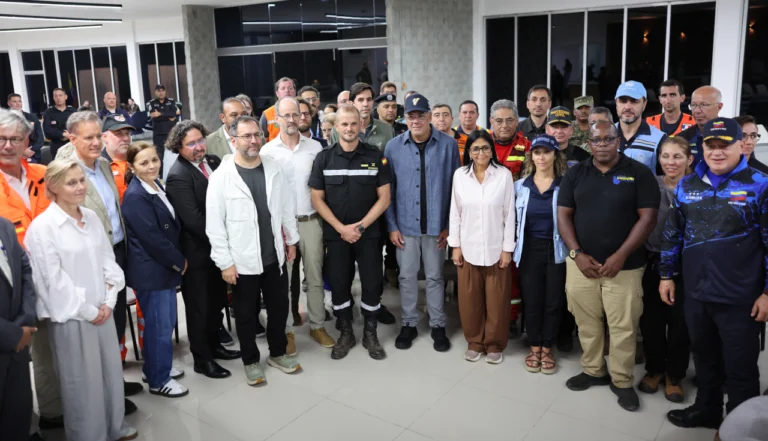
The acting president of Venezuela, Delcy Rodríguez, met with members of international rescue brigades to personally thank them for their support in the aftermath of the disaster. The Venezuela earthquake rescue efforts have become a coordinated national and international mission, bringing together emergency specialists, engineers, and volunteers from multiple countries.
According to updated official figures, the disaster has left 1,430 people dead and more than 3,238 injured, while over 3,100 individuals have lost their homes entirely. These numbers continue to evolve as rescue teams access heavily affected zones.
International brigades strengthen Venezuela earthquake rescue efforts
The Venezuela earthquake rescue efforts have been reinforced by specialized teams from countries including Mexico, Spain, and Colombia. These brigades have joined Venezuelan responders in a race against time to locate survivors trapped under collapsed infrastructure.
The earthquakes, measuring 7.5 and 7.2 in magnitude, struck northern Venezuela and severely impacted at least seven states, including La Guaira, Maracay, and several areas of Caracas. The destruction caused widespread structural collapse, disruptions to essential services, and the blockage of major transportation routes.
During a meeting at the Miraflores Palace in Caracas, attended by diplomats and international representatives, Rodríguez highlighted the extraordinary coordination between foreign and national teams. She described the work of international rescuers as “impressive and deeply moving,” noting their contribution has been vital to sustaining the Venezuela earthquake rescue efforts.
Critical hours define Venezuela earthquake rescue efforts
Authorities emphasized that the current phase represents the most critical hours for saving lives, as survival chances decrease significantly over time. Rodríguez stressed that while many citizens support through prayer and logistics, rescue teams remain on the front lines, navigating unstable debris and aftershocks.
“We are in the critical hours where lives can still be saved,” she said, acknowledging both the risks and determination of the crews. She also conveyed that the Venezuelan population places great hope in the ongoing rescue operations, particularly in areas where international teams have arrived.
The Venezuela earthquake rescue efforts continue despite complex conditions on the ground. Rescue personnel face damaged infrastructure, limited access routes, and ongoing seismic activity, all of which complicate operations and increase danger levels.
Government response and national coordination
The Venezuelan government has maintained continuous monitoring of the situation, coordinating with both domestic agencies and international partners. Rodríguez noted that authorities have been closely tracking the progress of rescue teams, ensuring that logistical support and information flow remain consistent.
She acknowledged that the country is facing a major natural catastrophe, emphasizing the scale and complexity of the emergency. “We wanted to briefly bring you together, despite your vital work, to thank you on behalf of the Venezuelan people,” she told international responders.
The Venezuela earthquake rescue efforts also include coordination with local communities, which play a crucial role in identifying affected zones and assisting with aid distribution.
Geopolitical context and regional implications
The Venezuela earthquake rescue efforts are unfolding within a broader geopolitical framework marked by both challenges and opportunities for international cooperation. The rapid arrival of foreign rescue teams reflects a moment of humanitarian convergence, where political differences have been temporarily set aside to address an urgent crisis.
This disaster highlights the importance of regional disaster preparedness and multilateral coordination in Latin America and the Caribbean, an area prone to seismic and climate-related risks. It may also influence future agreements on joint emergency response mechanisms, infrastructure resilience, and humanitarian aid channels.
Additionally, the visibility of international support could have longer-term implications for Venezuela’s diplomatic relations and global engagement, particularly if cooperation continues beyond the immediate emergency phase.
From teleSUR English via This RSS Feed.